
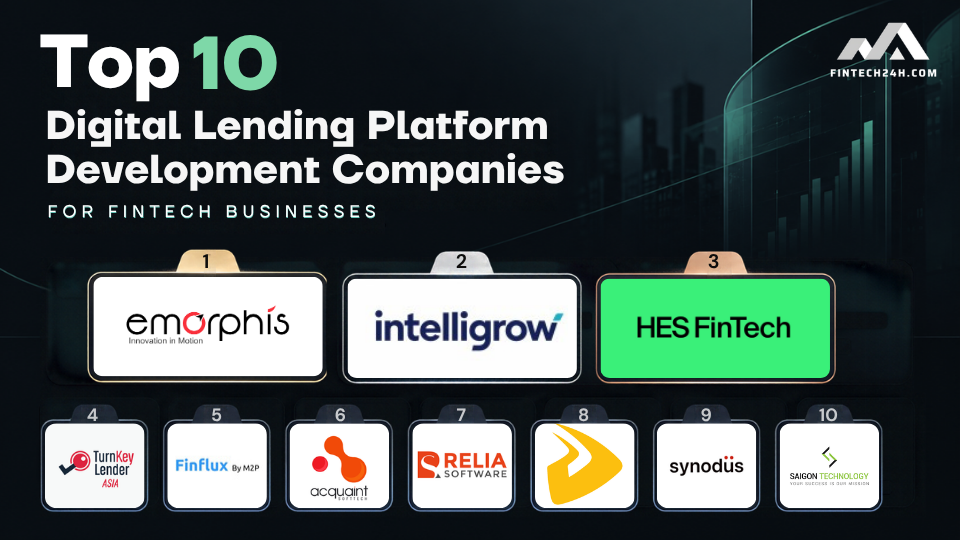
To build secure, scalable, and compliant lending software, financial institutions and fintech startups often seek specialized development partners. This article identifies the Top 10 Digital Lending Platform Development Companies for Fintech Businesses, highlighting providers that offer expertise in loan origination, underwriting, and comprehensive loan management solutions. These companies help businesses navigate the complexities of modern lending operations, from automated applications to digital disbursement and repayment management, ensuring security, scalability, and regulatory control.
Choosing the right digital lending platform development company is therefore more than a technical decision. Businesses need a development partner that understands lending operations, borrower experience, credit assessment, financial integrations, and the challenges of managing loans throughout their lifecycle. A poorly designed platform can create fragmented data, slow approval processes, inconsistent risk assessments, and expensive maintenance requirements as the lending portfolio grows.
The market includes several types of providers, ranging from custom fintech software development teams to specialized lending technology vendors with configurable platforms. Some are better suited to building a lending product from the ground up, while others offer established software that can be adapted to particular lending models.
What to Look for in a Digital Lending Platform Development Company
Before comparing providers, fintech businesses should establish which parts of the lending lifecycle their platform needs to support. A consumer lending startup, an SME lender, and a financial institution modernizing its existing loan management system may have substantially different technical requirements.
The following criteria can help narrow the shortlist.
-
Lending domain expertise: Experience with loan origination, credit assessment, underwriting, repayment management, collections, or other relevant lending workflows.
-
Custom development capabilities: The ability to build business-specific features instead of forcing every operation into a fixed software model.
-
Security and compliance readiness: Support for access controls, audit trails, encryption, identity verification, and jurisdiction-specific regulatory requirements.
-
Integration capabilities: Experience connecting credit bureaus, banking systems, payment providers, identity verification services, accounting software, and third-party APIs.
-
Scalability and maintainability: An architecture that can accommodate additional lending products, higher transaction volumes, and changing business rules.
-
Implementation and ongoing support: Clear delivery processes, testing practices, documentation, and a realistic plan for maintenance after launch.
A strong provider should also be transparent about what it has actually delivered. Financial software experience is valuable, but a company that has built payment applications does not automatically have the same expertise as a team that has implemented underwriting or loan servicing workflows.
Top 10 Digital Lending Platform Development Companies for Fintech Businesses
The companies below represent different approaches to lending technology, including specialized lending development, configurable financial software, and broader fintech engineering. They are not ranked by an independently verified performance score; instead, each profile explains the provider’s potential fit and the considerations businesses should investigate before engaging.
1. Emorphis Technologies
Emorphis Technologies is a software development provider with a dedicated lending platform development offering. Its published service scope covers major lending functions, including loan origination, underwriting, KYC/AML workflows, decisioning, servicing, and collections. This makes the company relevant to businesses evaluating an end-to-end lending system rather than a standalone borrower-facing application.
For fintech businesses, the appeal of a specialized lending development partner is the ability to consider the full loan lifecycle during architecture and implementation. Application intake, identity checks, credit assessment, approval workflows, and repayment management need to work together, even when individual components are maintained as separate services. For those exploring broader digital transformation, these partners often overlap with top 10 SaaS technology companies supporting business digital transformation.
Emorphis is worth evaluating when a lender needs a tailored platform supporting retail or SME lending and wants to discuss a modular technical architecture. Prospective clients should clarify which components are available as reusable solutions, which require custom engineering, and how integrations with existing financial systems would be handled.
Key capabilities to evaluate:
-
Custom lending platform development.
-
Loan origination and underwriting workflows.
-
KYC/AML and credit decisioning integrations.
-
Loan servicing and collections functionality.
-
Modular architecture for evolving lending requirements.
Best suited for: Fintech companies and lenders seeking a specialized partner for developing or modernizing lending workflows.
2. Intelligrow
Intelligrow focuses on financial technology and custom software for banks, non-bank financial companies, and digital lending businesses. Its published service offering includes customized lending platforms, integrations, and workflows designed around individual business models.
This approach is relevant when standard lending software cannot accommodate a lender’s operational requirements. For example, a business may need configurable eligibility rules, specialized approval hierarchies, integrations with local financial data providers, or different workflows for several loan products.
Rather than treating every lending business as identical, custom development can allow organizations to adapt the software to their underwriting policies and operational processes. The trade-off is that customization requires careful scope management, testing, documentation, and long-term technical ownership. For complex enterprise-grade logic, many firms also look into python development to ensure long-term scalability.
Before selecting Intelligrow, businesses should establish whether the proposed solution includes a reusable lending foundation, a fully bespoke implementation, or a combination of both. They should also confirm the availability of relevant lending references and the responsibilities associated with post-launch support.
Key capabilities to evaluate:
-
Tailored lending software development.
-
Financial system integration.
-
Configurable lending workflows.
-
Architecture and scalability planning.
-
Customization for specific financial business models.
Best suited for: Financial institutions and fintech businesses whose lending processes require substantial customization.
3. HES FinTech
HES FinTech is a lending technology provider known for its HES LoanBox platform and lending software capabilities. Unlike a general-purpose software development agency, HES FinTech offers an established lending technology foundation that businesses can evaluate for implementation and configuration.

Its relevance lies in the operational complexity of lending systems. Loan applications, underwriting decisions, repayment schedules, customer accounts, and collections are connected processes. A specialized lending platform can provide a more structured starting point than developing every component independently.
HES LoanBox is worth considering for lenders that prefer to evaluate an existing lending solution before committing to a fully custom build. The key question is how well the available functionality matches the intended loan products, jurisdictions, approval policies, and integration requirements.
Businesses should request a detailed demonstration covering their actual lending scenarios rather than relying solely on a feature checklist. They should also examine configuration limits, implementation timelines, reporting capabilities, and the commercial implications of future customization.
Key capabilities to evaluate:
-
Established lending software and implementation.
-
Loan origination and servicing workflows.
-
Repayment and collections functionality.
-
Configuration for different lending operations.
-
Integration and ongoing maintenance requirements.
Best suited for: Lenders looking for an established lending software foundation rather than building every core component from scratch.
4. TurnKey Lender
TurnKey Lender provides lending automation software designed to support digital lending operations. Its platform-oriented approach makes it relevant to businesses looking to automate loan processing and manage lending activities through an established technology solution.
A digital lender must coordinate multiple stages, from receiving an application to assessing borrower eligibility, making a credit decision, disbursing funds, and managing repayment. Automating these stages can reduce manual handoffs and improve process consistency when the workflows are appropriately configured.
TurnKey Lender is worth evaluating when a business wants to compare an existing lending automation solution against the cost and complexity of bespoke development. The decision should depend on whether the platform can accommodate the organization’s loan products, risk policies, reporting requirements, and operating model.
The evaluation should also distinguish between features included in the standard offering and those requiring additional configuration, integration, or professional services. Lenders should confirm how decision rules are maintained, how exceptions are handled, and what flexibility is available as their products evolve.
Key capabilities to evaluate:
-
Lending process automation.
-
Credit assessment and decision workflows.
-
Loan management functionality.
-
Integration with external financial services.
-
Configuration and implementation requirements.
Best suited for: Digital lenders seeking an established lending automation platform with configurable workflows.
5. Finflux
Finflux is a lending technology platform associated with digital lending and loan management for financial institutions and lending businesses. Its product-oriented approach makes it relevant to organizations that want to evaluate existing lending software rather than commission a completely bespoke platform.

The distinction matters for businesses entering the lending market. Building a lending system from the ground up offers considerable flexibility, but it also requires substantial work on loan calculations, repayment schedules, operational controls, exception handling, and system integrations. An established platform may provide a more practical starting point when its functionality aligns with the business model.
Finflux is worth including in a shortlist for lenders assessing configurable technology for digital loan operations. The specific fit depends on the products being offered, the complexity of the credit process, and the integrations required in the target market.
A structured evaluation should examine how the platform handles product configuration, portfolio management, data migration, reporting, and changes to lending policies. Businesses should also establish whether their desired borrower experience can be delivered through existing functionality or requires additional development.
Key capabilities to evaluate:
-
Digital lending software.
-
Loan management workflows.
-
Product configuration and operational processes.
-
Integration and implementation requirements.
-
Support for business growth and additional loan products.
Best suited for: Financial institutions and digital lenders evaluating configurable lending technology for their operating model.
6. Acquaint Softtech
Acquaint Softtech is a custom software development company that can be considered by fintech businesses evaluating external engineering support for financial applications. Its broader development orientation makes it a different option from providers whose principal offering is a dedicated lending product.
For businesses with a clearly defined lending concept, a custom development team can help translate requirements into borrower interfaces, administrative dashboards, backend services, and integrations. This approach is especially relevant when the lending experience or operating model needs to differentiate itself from standardized solutions.
However, general software development capability should not be confused with verified expertise in every aspect of lending technology. Credit decisioning, financial calculations, auditability, sensitive data handling, and regulatory workflows require domain-specific design and testing. For those needing to secure their digital assets, it is also wise to review top 10 cybersecurity companies to watch in 2026.
Before engaging Acquaint Softtech, fintech teams should assess its experience with financial applications, the proposed engineering team’s composition, and its ability to address lending-specific requirements. A small discovery engagement or technical proof of concept can help establish whether the team understands the business problem before the project expands.
Key capabilities to evaluate:
-
Custom web and application development.
-
Backend engineering and API integration.
-
Borrower and administrative interfaces.
-
Testing and ongoing technical support.
-
Experience with financial software requirements.
Best suited for: Fintech startups seeking an external engineering team to develop a tailored lending application, subject to verification of lending domain expertise.
7. Relia Software
Relia Software is a software development company with experience across web applications, mobile products, backend systems, and other digital solutions. Its broader engineering services make it a potential option for fintech businesses that need a dedicated development team to build or extend a digital lending product.
A lending application often requires more than a single customer interface. The borrower experience must connect to application processing, document management, internal review tools, notifications, and reliable backend services. If the platform also supports multiple loan products, the underlying architecture must accommodate different eligibility rules and repayment structures without creating unnecessary complexity.
Relia Software is worth evaluating when the project requires custom engineering across mobile, web, and backend components. Its suitability for a particular lending project should be established through relevant case studies, technical discussions, and evidence of experience with sensitive financial data.
Businesses should pay particular attention to how the development team would implement audit logs, permissions, error handling, automated testing, and integrations with external financial services. These capabilities can have a significant effect on the platform’s reliability after launch.
Key capabilities to evaluate:
-
Web and mobile application development.
-
Backend systems and API integration.
-
Custom fintech product engineering.
-
Quality assurance and deployment support.
-
Long-term application maintenance.
Best suited for: Fintech startups and product teams that need custom lending application development across multiple technical layers.
8. Designveloper
Designveloper is a software development and consulting company based in Vietnam. Its service portfolio includes custom software, web and mobile application development, UI/UX design, and dedicated development teams, making it relevant to fintech businesses considering outsourced product development.

For digital lending businesses, borrower experience can directly influence how easily applicants complete onboarding and submit the information needed for an assessment. Clear application flows, accessible interfaces, responsive document submission, and transparent status updates can help reduce avoidable friction.
Designveloper is worth evaluating for projects where the borrower-facing product, internal interfaces, and supporting backend systems need to be developed together. A company with broad application development experience can be useful when the project requires both product design and engineering, although lending-specific capabilities should be assessed separately.
Before choosing the provider, businesses should request examples of comparable financial applications and discuss how sensitive information, authentication, access permissions, and external integrations will be managed. They should also establish whether the team can support the project beyond its initial release.
Key capabilities to evaluate:
-
Custom fintech application development.
-
Web and mobile product engineering.
-
UI/UX design and borrower onboarding.
-
Backend development and API integration.
-
Dedicated development team arrangements.
Best suited for: Fintech businesses seeking a Vietnam-based development partner for borrower-facing applications and supporting software systems.
9. Synodus
Synodus is a software development company offering custom digital product engineering and technology services. Its broader development model makes it a potential candidate for fintech organizations that need to build new applications, modernize existing systems, or extend internal engineering capacity.
Digital lending products frequently combine customer onboarding, document collection, decision workflows, operational dashboards, and connections to external services. These components need to share reliable data while preserving clear responsibilities across the system. A development partner should therefore understand not only how to implement individual features but also how the complete architecture will behave under operational pressure.
Synodus is worth evaluating for projects that require a custom software solution and a structured development process. However, businesses should verify the team’s direct experience with lending workflows rather than assuming that general fintech or enterprise software experience covers every lending requirement.
During the selection process, ask for a proposed system architecture, a breakdown of core integrations, and a testing strategy for financial calculations and workflow exceptions. These discussions can help reveal whether the team is prepared to handle the reliability requirements of a lending product.
Key capabilities to evaluate:
-
Custom software development.
-
Digital product engineering.
-
Backend and integration development.
-
System modernization.
-
Quality assurance and delivery planning.
Best suited for: Fintech companies seeking a custom engineering partner for lending products or the modernization of existing financial applications.
10. Saigon Technology
Saigon Technology is a Vietnam-based software development provider offering custom application development and dedicated engineering teams. Its broader outsourcing capabilities make it a potential choice for fintech businesses that need additional development capacity or a partner to build a tailored software product.

For a digital lending project, the development scope may include borrower onboarding, loan application forms, administrative dashboards, integrations, reporting, and supporting backend services. A dedicated team can help deliver these components, provided the project has clear requirements and appropriate technical oversight. For those looking to optimize their internal workflows, it is also worth considering top 10 financial planning & analysis software companies 2026.
Saigon Technology is worth evaluating when a business wants to compare outsourced development against building an entirely internal engineering team. The main considerations are the team’s familiarity with financial software, its ability to work within the client’s architecture, and the clarity of responsibilities for testing, deployment, and maintenance.
As with other general-purpose development companies, lending-specific experience should be validated before making a commitment. Businesses should ask how the proposed team would handle loan calculations, audit trails, data protection, integration failures, and changes to business rules after launch.
Key capabilities to evaluate:
-
Custom software development.
-
Web and mobile application engineering.
-
Dedicated development teams.
-
API integration and system maintenance.
-
Quality assurance and deployment support.
Best suited for: Fintech businesses looking for outsourced engineering capacity to build or extend a custom digital lending application.
How to Choose the Right Digital Lending Development Partner
The most suitable provider depends on whether the business needs an existing lending platform, a customized solution built on reusable components, or a fully bespoke system. The following considerations can help fintech decision-makers make a more informed choice.
1. Define the Lending Model Before Comparing Vendors
Start by identifying the products the platform must support. Consumer loans, SME financing, salary advances, installment lending, and secured loans may require different eligibility rules, document requirements, repayment schedules, and risk controls. Defining these requirements early makes it easier to compare providers on relevant capabilities rather than general marketing claims.
2. Decide Between Custom Development and an Established Platform
An established platform may reduce the amount of foundational software that needs to be developed, particularly when the lender’s processes align with its existing functionality. Custom development offers greater control over the product and workflow but may require more discovery, engineering, testing, and maintenance.
A hybrid approach is also possible: a lender can use an existing platform for core loan management while developing a differentiated borrower experience or integrating specialized decisioning services. The right approach depends on the business’s time-to-market goals, budget, technical resources, and long-term product strategy.
3. Evaluate Integration and Data Requirements
Lending software rarely operates in isolation. Depending on the market and business model, it may need to connect to identity verification services, credit bureaus, banking systems, payment providers, accounting tools, and internal customer relationship management software.
Ask potential partners to explain how they handle API failures, data reconciliation, duplicate records, and changes in third-party services. These details are often more revealing than a high-level list of supported integrations.
4. Treat Security and Compliance as Design Requirements
Financial applications handle sensitive personal and financial information. Security should be built into the architecture rather than added as a final checklist. Relevant considerations include role-based access control, encryption, audit logging, secure authentication, data retention, and incident response, often complemented by understanding cyber insurance trends.
The applicable regulatory obligations depend on the jurisdictions, lending products, and responsibilities of the parties involved. A development company can help implement technical controls, but its involvement does not automatically make a lender compliant. Businesses should establish who owns regulatory interpretation, legal review, risk approval, and ongoing compliance monitoring.
5. Validate Delivery Quality and Total Cost of Ownership
The initial development quote is only one part of the overall investment. Implementation, third-party services, cloud infrastructure, security testing, data migration, support, and future enhancements can materially affect total cost.
Before signing a contract, ask for a milestone-based delivery plan, acceptance criteria, documentation commitments, and a clear division of responsibilities. For an early-stage fintech business, a focused minimum viable product may be more appropriate than attempting to launch every lending feature at once.
Frequently Asked Questions
1. What is a digital lending platform development company?
A digital lending platform development company builds or implements software that supports online lending operations. Depending on its specialization, it may develop borrower applications, loan origination systems, underwriting workflows, credit decisioning integrations, disbursement processes, repayment management, collections, and reporting tools.
Some providers create custom software for individual clients, while others offer established lending platforms that can be configured or integrated into existing systems.
2. How much does it cost to develop a digital lending platform?
The cost depends on the lending model, number of workflows, integration complexity, security requirements, target markets, and whether the business chooses custom development or an existing platform. A focused MVP with a limited product scope will generally require a different budget from a multi-product platform with complex underwriting and servicing requirements.
Businesses should request itemized estimates that distinguish discovery, design, development, third-party fees, deployment, and ongoing maintenance instead of comparing headline prices alone.
3. How long does it take to build a digital lending platform?
The timeline depends on scope, integration readiness, regulatory requirements, and the complexity of the lending workflows. A limited MVP may be delivered substantially sooner than a comprehensive platform supporting several loan products, advanced decisioning, and extensive legacy integrations.
A realistic project plan should include requirements discovery, architecture, development, testing, security review, user acceptance testing, and deployment preparation.
4. What features should a digital lending platform include?
Core features typically include borrower onboarding, loan application management, document collection, eligibility assessment, underwriting workflows, approval tracking, disbursement integration, repayment scheduling, and operational reporting. Depending on the business model, the platform may also need KYC/AML integrations, fraud controls, collections management, notifications, and customer self-service features.
The exact feature set should follow the lender’s operational requirements rather than a generic checklist.
5. Should a fintech startup choose custom lending software or an existing platform?
An existing platform can be a practical option when its core workflows closely match the startup’s lending model and its configuration options provide sufficient flexibility. Custom software may be preferable when the business needs differentiated workflows, specialized integrations, or greater control over its product architecture.
A hybrid model can also balance implementation speed with customization. The decision should consider total cost of ownership, time to market, integration requirements, and the team’s ability to maintain the solution.