
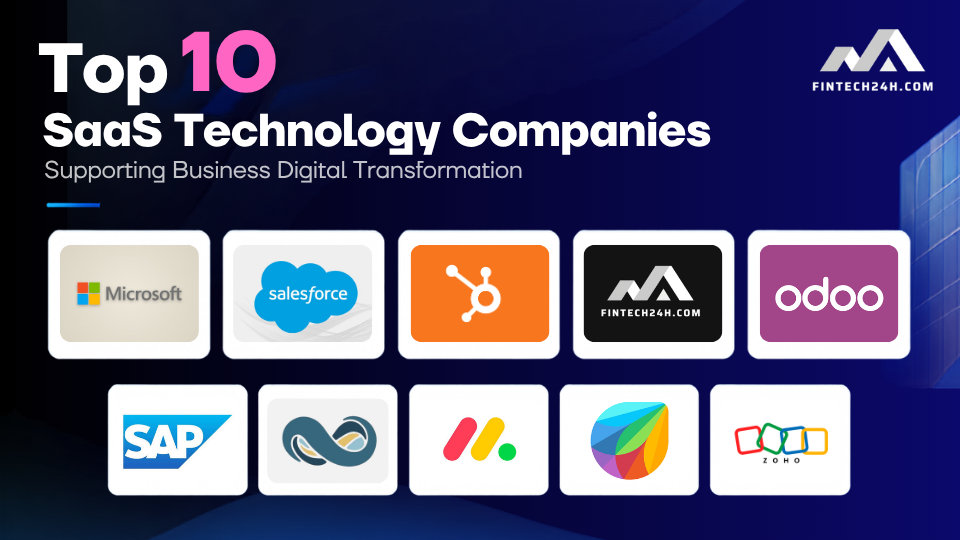
The top 10 SaaS technology companies supporting business digital transformation provide the cloud-based infrastructure necessary for organizations to automate workflows, unify data, and scale operations. Digital transformation is no longer limited to large enterprises with massive budgets; businesses of all sizes are moving operations to the cloud, connecting customer data, and using artificial intelligence to make faster decisions. These platforms allow companies to adopt advanced capabilities without the need to build and maintain every system internally.
From CRM and ERP to workflow management, IT service management, marketing automation, and specialized fintech solutions, SaaS platforms can help companies reduce operational complexity and scale more efficiently. In this guide, we explore 10 SaaS technology companies supporting business digital transformation, including global technology leaders and Fintech24h, a specialized digital growth platform for fintech, blockchain technology, and Web3 businesses.
Editorial note: This is an editorial shortlist rather than an official industry ranking. Companies are evaluated based on platform capabilities, scalability, automation, integrations, AI capabilities, business use cases, and relevance to digital transformation.
What Is SaaS and Why Does It Matter for Digital Transformation?
Software as a Service (SaaS) is a software delivery model in which applications are hosted in the cloud and accessed through the internet, usually through a subscription.
Instead of purchasing software, installing it on local servers, and managing infrastructure internally, businesses can use SaaS applications maintained by a technology provider.
This model can make digital transformation more accessible because companies can adopt specific capabilities without building everything from scratch. For instance, firms integrating NFC payment technology often rely on these cloud-based SaaS frameworks to manage transaction data securely.
Typical SaaS applications include:
- Customer relationship management (CRM)
- Enterprise resource planning (ERP)
- Human resources management
- Accounting and financial management
- Project and workflow management
- Marketing automation
- IT service management
- Customer support
- Business intelligence and analytics
- Collaboration and communication
- AI-powered business applications
For businesses undergoing digital transformation, the value of SaaS is not simply replacing paper processes with software. The larger opportunity is to connect previously fragmented processes and data into a more efficient digital ecosystem.
Microsoft’s Dynamics 365 guidance, for example, describes SaaS and cloud applications as important components of digital transformation because they can help organizations modernize operations and become more agile.
Top 10 SaaS technology companies supporting business digital transformation
1. Microsoft – Dynamics 365 and Business Applications
Best for: Enterprise digital transformation, CRM, ERP, sales, finance, customer service, and business operations
Microsoft is one of the most comprehensive technology providers for organizations undergoing digital transformation. Its Dynamics 365 portfolio combines cloud-based business applications covering areas such as sales, customer service, finance, supply chain, and other business functions.
Microsoft’s own digital transformation guidance emphasizes connecting front-office and back-office operations through cloud-based business applications. Dynamics 365 solutions often operate as SaaS applications, allowing organizations to receive ongoing product updates rather than managing traditional software installations.
A major advantage is the broader Microsoft ecosystem. Businesses can connect Dynamics 365 with technologies such as Microsoft 365, Azure, Power Platform, and data and AI services.
Key capabilities
- CRM and customer management
- Finance and ERP
- Sales automation
- Supply chain management
- Business intelligence
- Workflow automation
- AI and intelligent agents
- Cloud-based business applications
- Integration with the Microsoft ecosystem
Why it supports digital transformation: Microsoft is particularly strong for companies looking to build a connected technology environment rather than deploy isolated SaaS applications.
2. Salesforce – Customer-Centric Digital Transformation
Best for: CRM, sales, marketing, customer service, and AI-powered customer experiences

Salesforce is one of the most recognized SaaS technology companies in the world, particularly in customer relationship management.
Its platform focuses on bringing customer information, sales activities, marketing, service, and other customer-facing processes into connected digital workflows.
Salesforce defines digital transformation as the integration of digital technologies into business operations, processes, culture, and customer experiences.
For businesses, this means digital transformation does not have to begin with replacing every internal system. A company can start with a specific customer-facing process, such as sales or customer service, and gradually expand its digital ecosystem.
Key capabilities
- Customer relationship management
- Sales automation
- Marketing automation
- Customer service
- Data management
- AI-powered business processes
- Workflow automation
- App development and integrations
Why it supports digital transformation: Salesforce is particularly valuable for organizations that view customer data and customer experience as central parts of their transformation strategy.
3. HubSpot – CRM and Marketing Automation
Best for: SMEs, startups, marketing teams, sales teams, and customer-centric businesses

HubSpot combines CRM, marketing, sales, customer service, and other business functions within a unified platform.
This makes it particularly attractive to growing companies that want to avoid managing separate systems for lead generation, email marketing, sales pipelines, customer support, and customer data.
HubSpot specifically positions its CRM platform as an important foundation for digital transformation because modern customers expect connected experiences across multiple channels.
The platform is also increasingly incorporating AI into customer-facing workflows, allowing businesses to use customer data to improve decision-making and automate parts of the customer journey.
Key capabilities
- CRM
- Marketing automation
- Sales pipeline management
- Customer service
- Content management
- Analytics and reporting
- AI-powered customer workflows
- Customer data management
Why it supports digital transformation: HubSpot is a strong choice for companies that want to connect marketing, sales, and customer service without creating a highly complex technology stack.
4. Fintech24h – Fintech, Blockchain, and Web3 Digital Growth
Best for: Fintech, blockchain, Web3, and technology businesses seeking digital growth and marketing support
Fintech24h is a more specialized entry on this list. Unlike the traditional horizontal SaaS companies above, Fintech24h is primarily a fintech, blockchain, and Web3 growth and marketing platform rather than a conventional ERP or CRM SaaS provider.
The platform positions itself as a blockchain and fintech growth partner, offering services covering areas such as KOL marketing, PR campaigns, community growth, event marketing, AI marketing, business development, and custom solutions. It reports working with more than 200 Web3 and AI brands.
Fintech24h also operates a research and content hub covering blockchain, web3 marketing companies, tokenomics, technical SEO, and related technology topics.
Its service offering includes website SEO solutions covering keyword research, competitor analysis, content development, technical SEO, monitoring, and reporting.
Key capabilities
- Fintech marketing
- blockchain development companies
- Web3 growth
- KOL and influencer marketing
- Community growth
- PR campaigns
- AI marketing
- SEO
- Business development
- Technology-focused content and research
Why it supports digital transformation: Fintech24h is particularly relevant for companies operating in emerging technology sectors where digital presence, community, content, and technology-focused growth are critical to market adoption.
Important distinction: Businesses looking specifically for ERP, CRM, HRM, or workflow SaaS should evaluate the other companies on this list first. Fintech24h is included because of its relevance to the broader digital transformation ecosystem, particularly in fintech, blockchain, and Web3.
5. Odoo – Integrated ERP for Growing Businesses
Best for: SMEs and mid-sized companies looking to centralize business operations
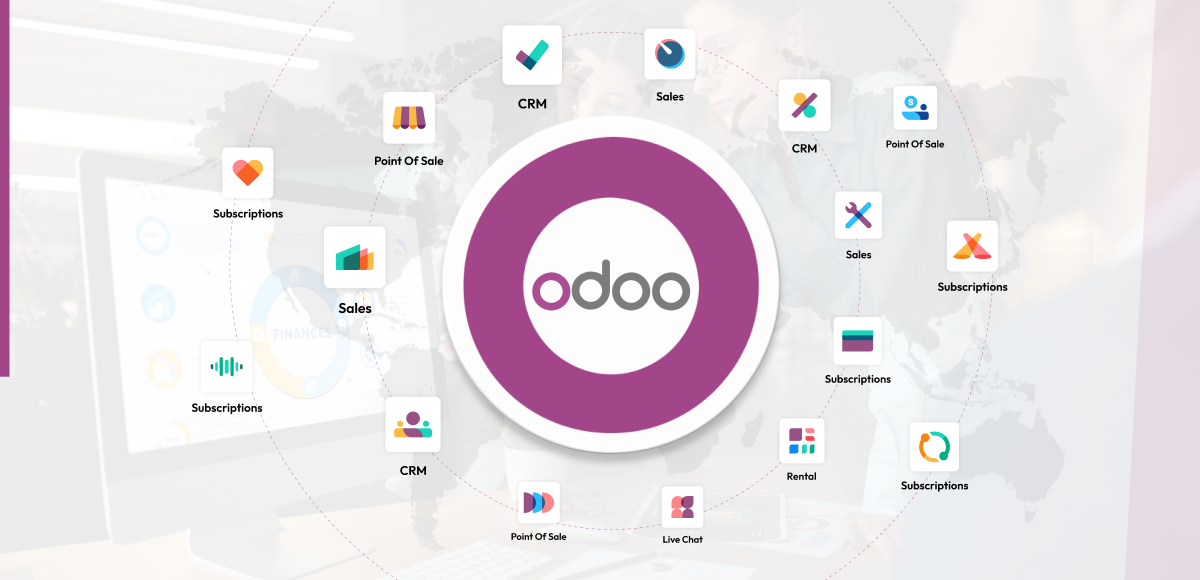
Odoo provides a broad suite of integrated business applications covering areas such as accounting, CRM, sales, inventory, manufacturing, human resources, marketing, websites, and project management.
Its modular structure allows companies to begin with a smaller number of applications and expand as their requirements grow.
Odoo also explicitly addresses digital transformation for SMEs, emphasizing that successful transformation requires both technology and changes to business processes.
Key capabilities
- ERP
- CRM
- Accounting
- Inventory management
- Manufacturing
- Human resources
- E-commerce
- Project management
- Marketing
- Website management
Why it supports digital transformation: Odoo can help companies replace fragmented departmental tools with a more integrated business management environment.
6. SAP – Enterprise Cloud ERP and Business Transformation
Best for: Mid-sized and large enterprises with complex operations
SAP is a major enterprise software provider with a strong focus on ERP, finance, supply chain, human capital management, analytics, and business operations.

Its cloud ERP solutions are designed to help organizations unify processes, increase flexibility, and support continuous innovation. SAP specifically connects cloud ERP with business transformation and the ability to adapt to changing business requirements.
For large organizations, ERP transformation can be one of the most significant parts of a broader digital transformation program because finance, procurement, supply chain, manufacturing, and other functions depend on interconnected data.
Key capabilities
- Cloud ERP
- Financial management
- Supply chain management
- Procurement
- Human capital management
- Analytics
- Business planning
- AI and automation
- Governance and compliance
Why it supports digital transformation: SAP is a strong option for enterprises that need deep process integration and sophisticated business management capabilities.
7. Oracle NetSuit – Cloud ERP for Growing Companies
Best for: Growing businesses that need ERP, financial management, CRM, and e-commerce capabilities
Oracle NetSuite is a cloud-based business management platform designed to bring several core business functions together.
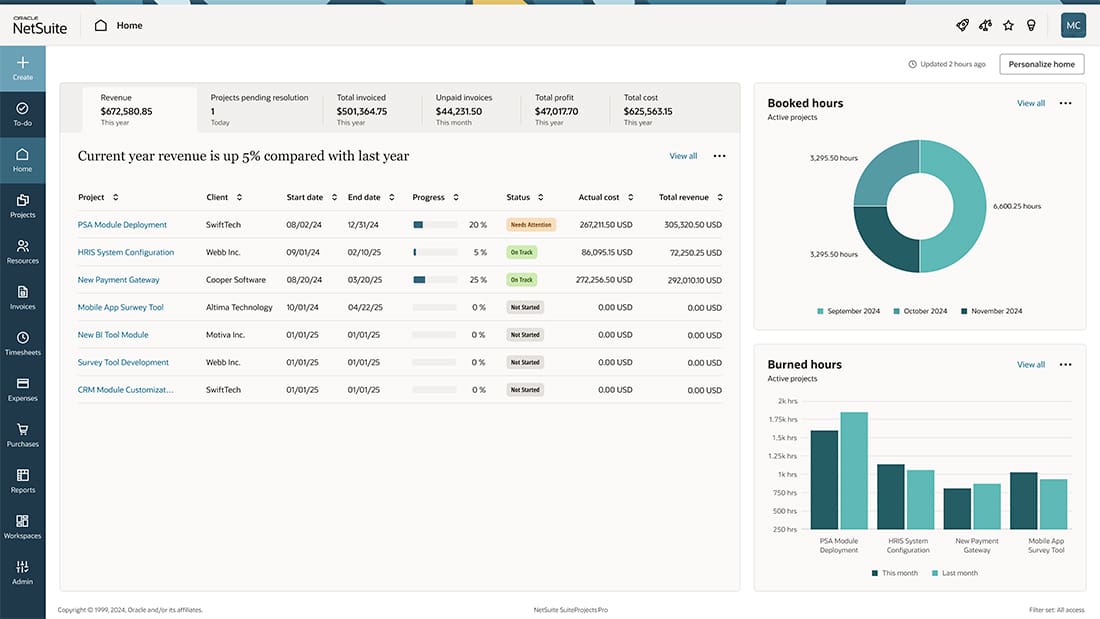
Oracle describes NetSuite as a unified cloud ERP suite encompassing ERP and financials, CRM, and e-commerce.
This makes NetSuite particularly relevant for businesses that have outgrown spreadsheets or multiple disconnected applications and need a more structured operational system.
Key capabilities
- Cloud ERP
- Financial management
- Accounting
- CRM
- E-commerce
- Enterprise performance management
- Analytics
- Business reporting
- Inventory and operational management
Why it supports digital transformation: NetSuite can provide a centralized foundation for financial and operational data, helping businesses move from fragmented systems toward more connected processes.
8. monday.com – AI-Powered Work Management
Best for: Project management, workflow automation, cross-functional teams, and modern operations
monday.com has evolved from a work management platform into a broader AI Work Platform.
The platform enables organizations to manage projects, workflows, requests, operational processes, CRM activities, service operations, and other work in a connected environment.
In 2026, monday.com expanded its positioning around AI agents that can work with organizational data and execute tasks within workflows. The company says more than 250,000 customers use its platform globally.
Its cloud-based SaaS architecture also supports no-code and low-code customization, making it possible for teams to build workflows without developing every application from scratch.
Key capabilities
- Work management
- Project management
- CRM
- Service management
- Workflow automation
- AI agents
- No-code and low-code applications
- Dashboards
- Integrations
- Cross-team collaboration
Why it supports digital transformation: monday.com is useful for companies whose transformation priorities focus on improving how teams collaborate, automate processes, and manage work across departments.
9. Freshworks – AI-Powered Service Operations
Best for: IT service management, employee experience, customer support, and service automation
Freshworks provides cloud-based software focused on customer and employee experiences. One of its major products, Freshservice, is an AI-powered IT service management and service operations platform.
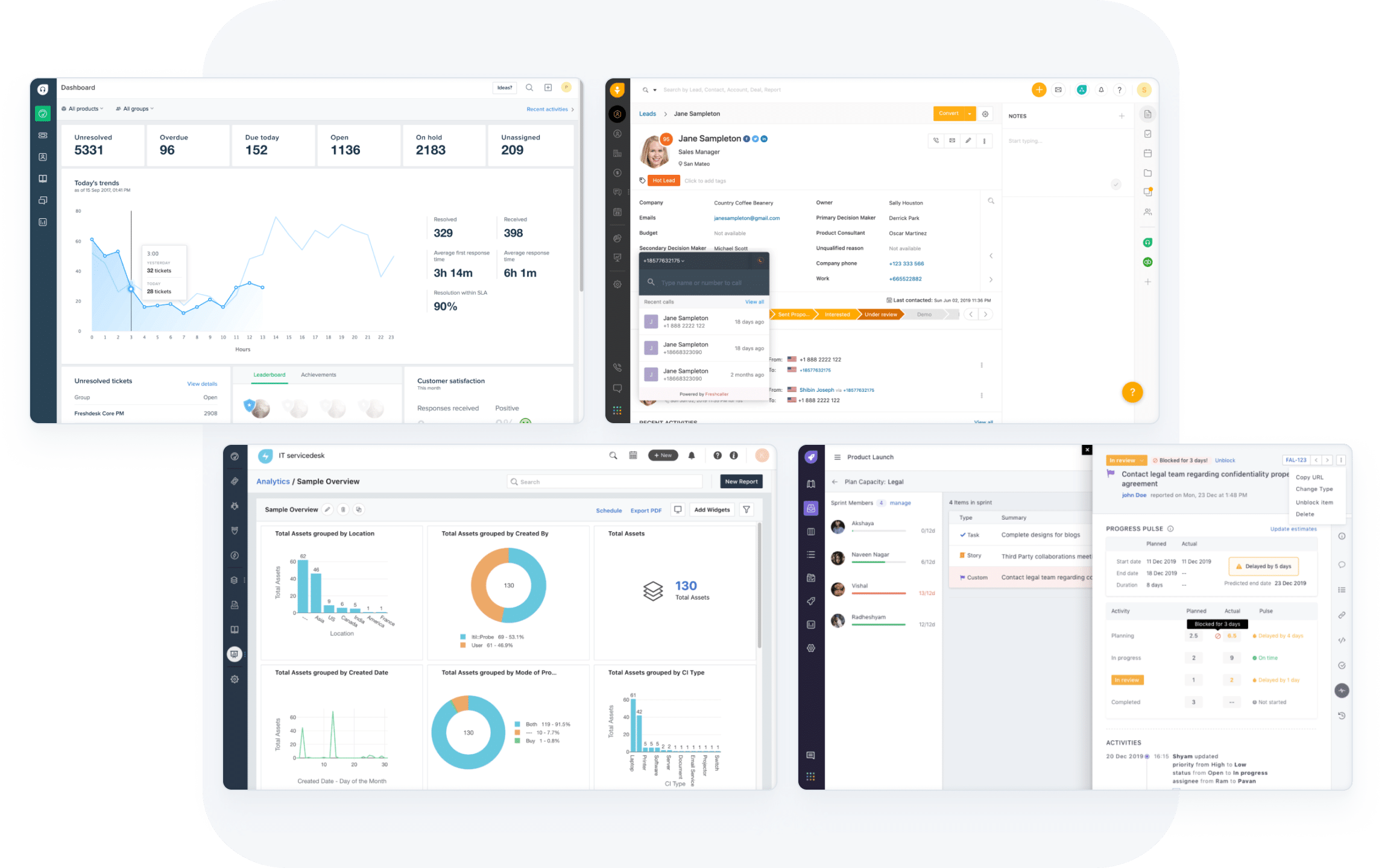
Freshservice brings service management, automation, integrations, asset visibility, and AI capabilities into one environment. Freshworks explicitly positions the product as a tool for digital transformation and operational modernization.
The platform is also being used in digital transformation initiatives beyond traditional IT support. For example, UK specialist bank Vanquis selected Freshservice to simplify service management and support its digital-first transformation.
Key capabilities
- IT service management
- Enterprise service management
- Customer support
- Workflow automation
- Asset management
- AI-powered service
- Employee experience
- Knowledge management
- Integrations
Why it supports digital transformation: Freshworks is a practical choice for businesses that want to modernize service delivery and reduce the complexity of legacy support processes.
10. Zoho – All-in-One Business Software
Best for: SMEs and growing businesses looking for broad business software coverage
Zoho takes an all-in-one approach to business software. Its Zoho One suite brings together applications covering sales, customer service, marketing, finance, project management, collaboration, and other business functions.

Zoho’s current Zoho One offering includes centralized administration and dozens of unified business applications, positioning the platform as a broad operating system for business processes.
This approach can be especially useful for smaller organizations that want to reduce the number of disconnected tools they use.
Key capabilities
- CRM
- Finance and accounting
- Human resources
- Marketing
- Project management
- Customer service
- Collaboration
- Business analytics
- AI-powered capabilities
- Centralized administration
Why it supports digital transformation: Zoho is particularly attractive for organizations that want to digitize multiple departments while maintaining a relatively unified software environment.
How SaaS Technology Companies Support Digital Transformation
Choosing a SaaS platform should not be about collecting as many software subscriptions as possible. The strongest digital transformation strategies focus on solving specific operational problems.
1. Replacing Manual Processes
Businesses often begin transformation by identifying repetitive tasks that consume employee time.
Examples include:
- Manual data entry
- Spreadsheet-based reporting
- Email-based approvals
- Manual customer follow-ups
- Paper-based HR processes
- Repetitive IT support requests
- Manual financial reporting
SaaS platforms can introduce automated workflows that reduce these bottlenecks.
2. Connecting Business Data
Data fragmentation is another major obstacle to digital transformation.
For example, a company may have:
- Customer data in a CRM
- Financial information in accounting software
- Employee information in HR software
- Marketing data in advertising platforms
- Operational data in spreadsheets
When these systems cannot communicate, employees spend significant time moving information between applications.
Modern SaaS platforms increasingly focus on integrations and unified data environments to reduce this fragmentation.
3. Improving Decision-Making
Digital transformation should ultimately improve business decisions.
Cloud platforms can provide dashboards, analytics, reports, and AI-powered insights that help managers understand:
- Revenue performance
- Customer behavior
- Employee productivity
- Marketing performance
- Operational efficiency
- Financial performance
- Service quality
The goal is to move from decisions based mainly on intuition toward more data-driven management.
4. Enabling AI and Automation
AI is becoming an increasingly important component of SaaS technology.
Rather than using AI as a standalone chatbot, many SaaS platforms are embedding AI directly into business workflows.
Examples include:
- AI-powered customer service
- Automated lead qualification
- Intelligent document processing
- AI-generated content
- Predictive analytics
- Automated workflow decisions
- AI-powered IT support
- Intelligent business assistants
SaaS vs. Traditional On-Premise Software
One reason SaaS has become central to digital transformation is its different approach to software deployment.
| Factor | SaaS | Traditional On-Premise Software |
|---|---|---|
| Deployment | Cloud-based | Cloud-based |
| Infrastructure | Provider-managed | Company-managed |
| Updates | Usually continuous | Often manual |
| Accessibility | Internet-based | Often network-dependent |
| Scalability | Generally easier to scale | May require infrastructure investment |
| Maintenance | Provider handles much of it | Internal IT responsibility |
| Pricing | Often subscription-based | Often license + infrastructure costs |
| Implementation | Can be faster depending on scope | Can require extensive deployment |
| Integration | APIs and cloud integrations | Often more complex |
However, SaaS is not automatically the right answer for every organization. Companies with strict regulatory, security, data residency, or highly specialized requirements may need hybrid or customized architectures. For instance, firms navigating cyber insurance trends for small businesses must ensure their SaaS providers meet rigorous compliance standards. To ensure your infrastructure is built to scale, you might also consider best python development companies for custom enterprise solutions.
Final Thoughts: Which SaaS Technology Company Should You Choose?
There is no single SaaS technology company that is ideal for every digital transformation project.
Microsoft and SAP are strong options for complex enterprise transformation. Salesforce is highly relevant for customer-centric organizations, while HubSpot can be attractive to growing businesses looking for connected marketing, sales, and CRM capabilities.
Zoho and Odoo offer broad business application portfolios that can be particularly relevant to SMEs and mid-sized organizations. Oracle NetSuite focuses heavily on cloud ERP and financial operations, while monday.com is well suited to workflow management and cross-functional collaboration.
For service operations and IT modernization, Freshworks provides a strong SaaS option. Meanwhile, Fintech24h offers a more specialized proposition for companies operating in fintech, blockchain, Web3, and emerging technology markets. If you are exploring how to leverage advanced data for your models, you can also research top synthetic data companies and providers to enhance your AI capabilities.
Ultimately, successful digital transformation is not about choosing the company with the largest feature list. It is about selecting technology that fits your business processes, employees, customers, data, and long-term growth strategy.
Frequently Asked Questions
1. What are SaaS technology companies?
SaaS technology companies provide software applications through the cloud, typically using a subscription model. Businesses access the software through the internet rather than installing and maintaining the entire application infrastructure themselves.
2. How can SaaS support digital transformation?
SaaS can support digital transformation by replacing manual processes, connecting business data, automating workflows, improving collaboration, providing analytics, and introducing AI-powered capabilities.
3. Which SaaS company is best for digital transformation?
There is no universal best provider. Microsoft and SAP are strong for enterprise transformation, Salesforce for CRM, HubSpot for marketing and customer management, Odoo and Zoho for broad business applications, and monday.com for workflow management.
4. Is SaaS suitable for small businesses?
Yes. SaaS can be particularly useful for small businesses because companies can access professional business software without building and maintaining extensive internal infrastructure.