
The top 10 crypto compliance companies for exchanges and wallets provide the essential infrastructure needed to navigate complex regulatory requirements in 2026. As regulators strengthen mandates around AML, KYC, sanctions screening, and the Travel Rule, digital-asset platforms require specialized tools that go beyond basic identity verification.
The market has also become more specialized. Some crypto compliance companies focus on blockchain analytics and Know Your Transaction (KYT), while others concentrate on KYC/KYB, Travel Rule infrastructure, fraud prevention, or market surveillance. For an exchange or wallet, the right combination depends on where compliance risk appears in the customer and transaction lifecycle.
This guide looks at 10 providers that have established positions in the digital-asset compliance market without focusing on extremely large general technology corporations. The list covers a mix of blockchain intelligence, AML monitoring, identity verification, Travel Rule infrastructure, and crypto-native risk management.
Note: This list is organized by market relevance and product specialization rather than a universal performance ranking. Compliance requirements, supported jurisdictions, integrations, and product capabilities can change, so crypto businesses should validate current requirements before selecting a provider.
Why Crypto Compliance Matters for Exchanges and Wallets in 2026
Crypto compliance is no longer limited to checking a customer’s identity when they create an account.
A modern exchange or custodial wallet may need to manage several layers of compliance simultaneously:
- KYC: Verify individual customers and their identities.
- KYB: Verify companies, beneficial owners, and counterparties.
- AML screening: Identify exposure to sanctions, PEPs, adverse media, and other risk indicators.
- KYT: Monitor blockchain transactions and wallet activity.
- Wallet screening: Check whether an address is connected to illicit or high-risk activity.
- Transaction monitoring: Detect suspicious patterns across deposits, withdrawals, and transfers.
- Travel Rule compliance: Exchange required originator and beneficiary information between VASPs.
- Fraud prevention: Detect account takeover, identity fraud, scams, and suspicious behavior.
- Case management: Document investigations and maintain audit trails.
The regulatory environment is also developing rapidly. In July 2026, the Financial Action Task Force reported continued global progress on licensing and registering VASPs and implementing the Travel Rule, while also identifying remaining gaps in risk mitigation and supervision. FATF also highlighted risks involving stablecoins, unhosted wallets, offshore VASPs, and crypto-enabled fraud.
In the European Union, the MiCA transition period for existing crypto-asset service providers could run only until July 1, 2026, or until authorization is granted or refused, whichever comes first.
This makes compliance infrastructure an operational requirement rather than simply an internal policy exercise.
Top 10 Crypto Compliance Companies for Exchanges and Wallets
1. Scorechain
Best suited for: Crypto exchanges, wallets, Web3 platforms, and businesses that need blockchain analytics and AML transaction monitoring.
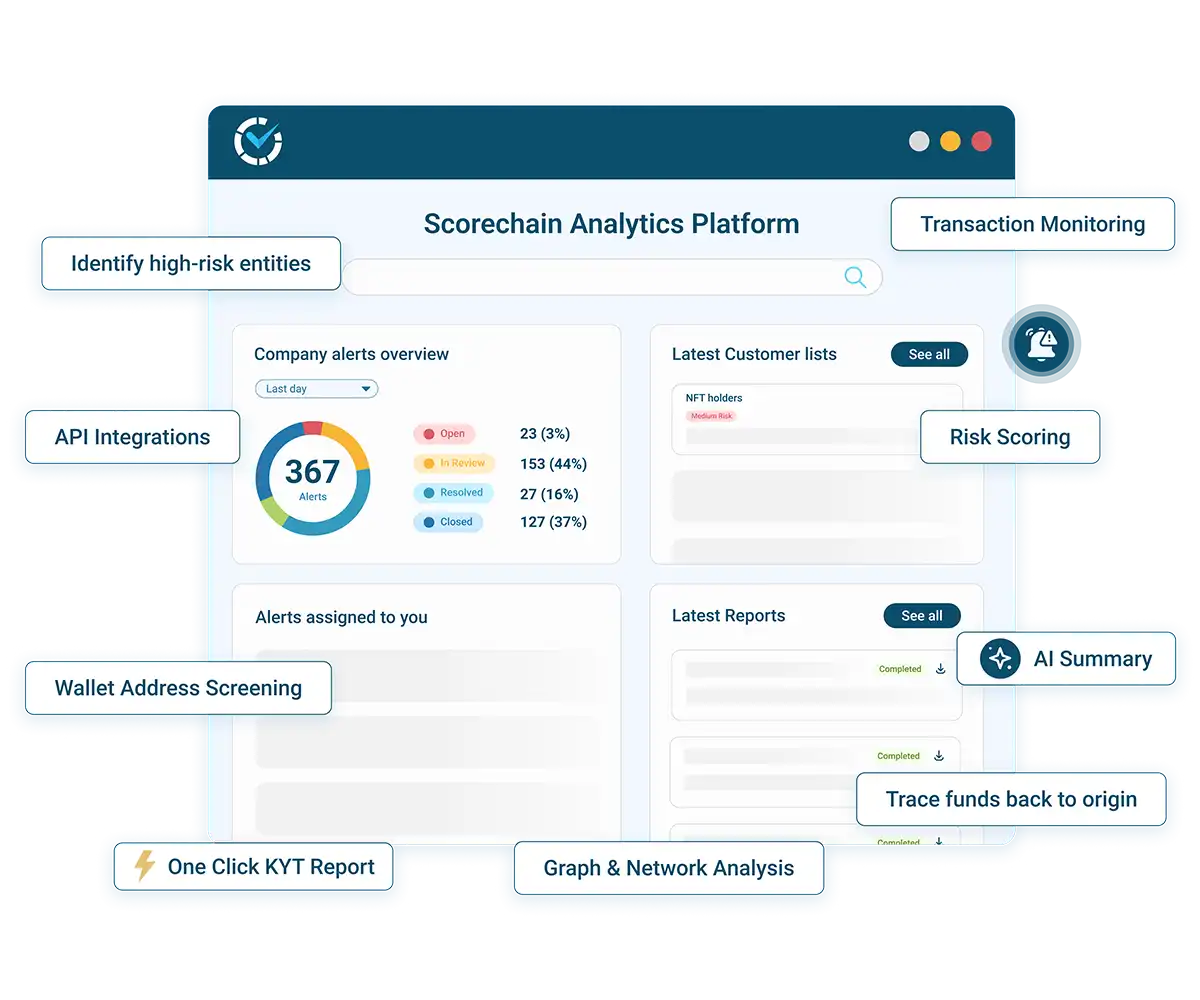
Scorechain is a Luxembourg-based blockchain analytics and crypto AML compliance company focused specifically on digital assets. Its platform combines wallet screening, transaction monitoring, blockchain investigations, risk scoring, and digital-asset intelligence. The company’s current product offering is designed for crypto businesses including exchanges, wallets, stablecoin projects, DeFi platforms, and other Web3 platforms. Scorechain states that it supports more than 200 organizations, 25+ blockchains, over 1 billion labeled entities, and more than 2,700 VASP due-diligence reports.
For exchanges, one of Scorechain’s relevant capabilities is configurable transaction monitoring. Compliance teams can monitor deposits and withdrawals against different risk scenarios instead of relying only on static wallet blacklists.
Its wallet screening functionality can also be used to identify sanctions exposure and risky counterparties before or during transactions. The platform supports API-based integrations as well as dashboard-based workflows, giving compliance teams options depending on their technical setup.
Key capabilities
- Wallet screening
- Crypto transaction monitoring
- Blockchain investigations
- Risk scoring
- VASP due diligence
- Sanctions screening
- Digital-asset intelligence
- API integrations
- Stablecoin monitoring
- Compliance reporting
Why consider Scorechain?
Scorechain is particularly relevant for crypto-native businesses that want blockchain analytics to sit directly inside their AML and transaction-monitoring workflow rather than relying on a general financial compliance platform.
2. Crystal Intelligence
Best suited for: Exchanges and wallets that need transaction monitoring, wallet screening, cross-chain investigations, and regulator-ready evidence.
Crystal Intelligence focuses heavily on blockchain analytics and financial-crime compliance for virtual asset service providers.
Its current Crystal Expert platform is positioned around AML compliance, transaction monitoring, wallet screening, sanctions screening, VASP due diligence, investigations, and regulatory reporting. The company states that its platform supports more than 330 blockchains and has attributed more than 110,000 entities.
One of Crystal’s distinguishing areas is entity attribution. Instead of treating every blockchain address as an isolated string of characters, its analytics platform attempts to connect addresses with real-world entities and counterparties.
This can be useful for compliance teams investigating complex transaction flows, particularly when funds move through multiple chains, bridges, swaps, mixers, or other intermediary services.
Crystal also emphasizes auditability. Compliance teams can generate case reports, maintain audit trails, and produce evidence for licensing reviews, internal audits, and regulatory examinations.
Key capabilities
- Real-time transaction monitoring
- Wallet screening
- Entity attribution
- Sanctions screening
- Cross-chain investigations
- VASP due diligence
- Travel Rule support
- Risk scoring
- Regulatory reporting
- Audit trails
Why consider Crystal Intelligence?
Crystal can be especially relevant for exchanges and wallets where compliance teams need to investigate suspicious flows rather than simply generate a risk score.
Its focus on cross-chain tracing and entity attribution makes it useful for businesses dealing with complex on-chain activity.
3. Merkle Science
Best suited for: Crypto platforms looking for behavior-based blockchain risk detection and customizable transaction monitoring.
.webp)
Merkle Science is a crypto risk and intelligence company that focuses on blockchain analytics, transaction monitoring, investigations, and compliance.
Rather than relying exclusively on static lists of risky addresses, Merkle Science emphasizes behavioral analytics and customizable risk policies.
Its Compass platform provides transaction monitoring based on configurable rules and behavioral indicators. The company’s platform is designed to help crypto businesses identify suspicious activity, manage investigations, and produce compliance documentation.
This approach can be useful because blockchain risk is not always represented by a single known bad address. Suspicious behavior may involve transaction patterns, source-of-funds relationships, repeated transfers, structuring, or interactions with multiple entities.
Merkle Science also positions its platform as jurisdiction-agnostic, allowing organizations to configure risk policies based on their own compliance requirements.
Key capabilities
- Behavioral transaction monitoring
- Blockchain risk intelligence
- Wallet screening
- Custom risk policies
- Case management
- Source-of-funds analysis
- Multi-chain monitoring
- Compliance reporting
- API integration
- Crypto investigations
Why consider Merkle Science?
Merkle Science is a useful option for teams that want more configurable behavioral risk detection rather than depending exclusively on predefined risk databases.
It can be particularly relevant to exchanges with internal compliance teams that need to customize monitoring rules around their own risk appetite.
4. AnChain.AI
Best suited for: Crypto businesses that want AI-assisted blockchain investigations, AML monitoring, and transaction risk screening.
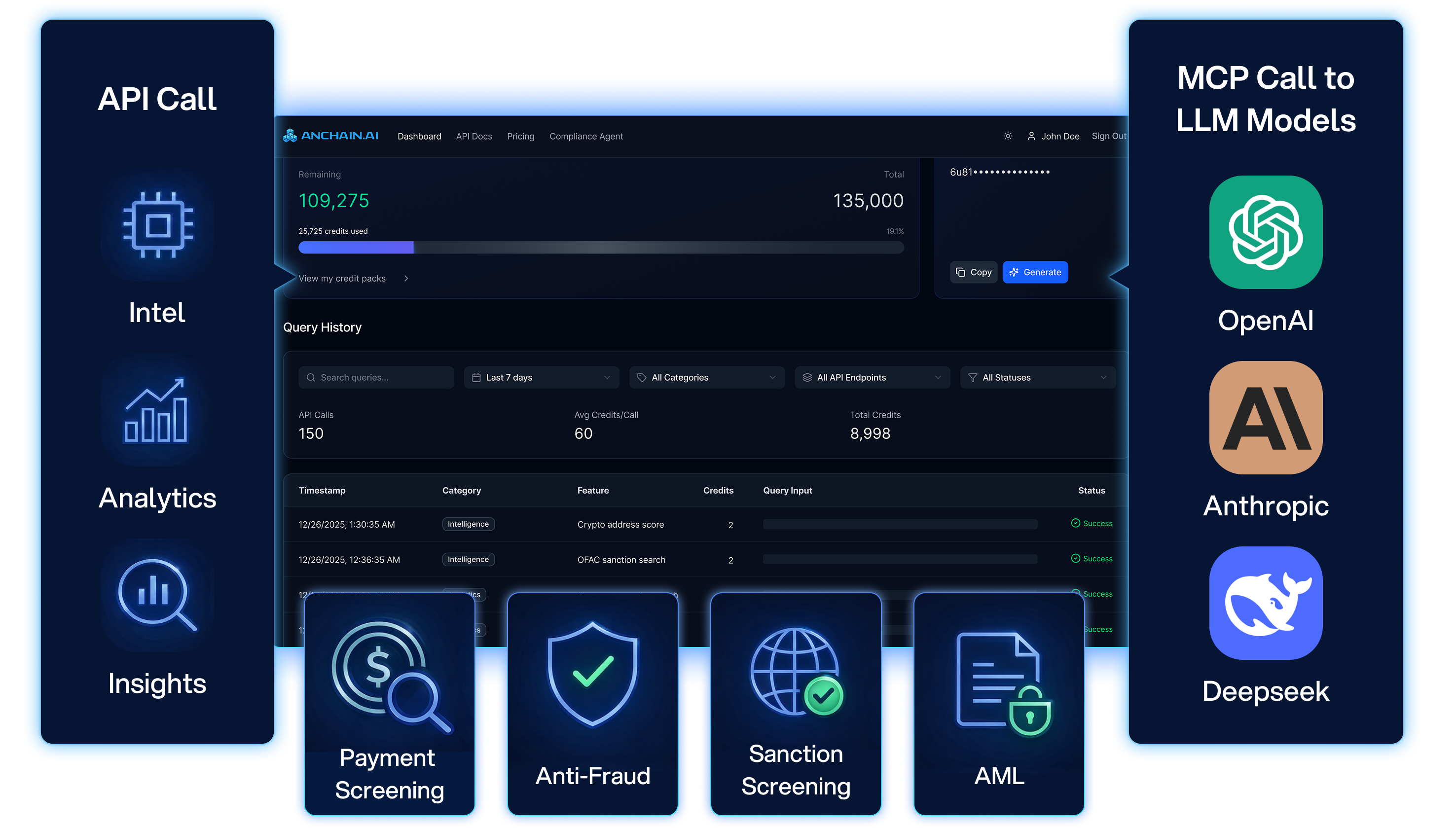
AnChain.AI combines blockchain intelligence, AI-driven analytics, AML compliance, fraud detection, and crypto investigations.
Its current CISO platform provides address risk profiling, transaction monitoring, entity clustering, behavioral analysis, cross-chain tracing, and automated reporting. AnChain.AI states that its systems support more than 41 blockchains, have screened more than 70 million transactions, and analyzed more than 1 billion blockchain entities.
The company is also moving toward pre-transaction risk screening. In 2026, AnChain.AI reported an integration with MetaMask that uses real-time risk signals to screen transactions before users confirm them.
For exchanges and wallets, this distinction can matter. Traditional AML monitoring often focuses on identifying suspicious activity after or during a transaction. Pre-transaction screening introduces another control point where risk can potentially be assessed before funds move.
AnChain.AI also provides automated investigation and reporting capabilities designed to reduce the amount of manual work involved in tracing blockchain transactions.
Key capabilities
- AI-powered blockchain analytics
- AML transaction monitoring
- Wallet risk scoring
- Sanctions screening
- Cross-chain investigations
- Entity clustering
- Automated transaction tracing
- Compliance reporting
- Fraud detection
- Pre-transaction screening
Why consider AnChain.AI?
AnChain.AI is particularly relevant for compliance teams exploring AI-assisted investigations and real-time risk detection.
Its combination of blockchain analytics and automated investigation workflows makes it different from providers focused primarily on identity verification.
5. Notabene
Best suited for: Exchanges and custodial wallets that need dedicated Travel Rule infrastructure.
Notabene focuses on one of the most operationally challenging parts of crypto compliance: the Travel Rule.
The Travel Rule requires relevant virtual asset businesses to collect and transmit information about the originator and beneficiary of certain transactions. Implementing this requirement becomes complicated when exchanges and wallets interact with different counterparties, jurisdictions, protocols, and self-hosted wallets.
Notabene provides infrastructure for Travel Rule compliance and counterparty management. Its exchange solution includes counterparty discovery, transaction authorization, Travel Rule data exchange, and compliance workflows. Notabene currently states that its network includes more than 2,100 regulated counterparties across more than 100 jurisdictions.
This makes Notabene different from a typical blockchain analytics company. Instead of primarily asking “Is this wallet risky?”, the platform focuses on questions such as:
- Who is the counterparty?
- Where should Travel Rule information be sent?
- Has the counterparty been identified?
- Can the transaction be authorized?
- What information needs to be exchanged?
Key capabilities
- Travel Rule compliance
- VASP discovery
- Counterparty verification
- Transaction authorization
- Originator and beneficiary data exchange
- Compliance workflows
- VASP network connectivity
- Self-hosted wallet workflows
Why consider Notabene?
For an exchange that already has KYC and blockchain monitoring but lacks Travel Rule infrastructure, Notabene addresses a more specific compliance problem.
It can therefore work alongside rather than replace a KYT or KYC provider.
6. Solidus Labs
Best suited for: Exchanges and trading platforms that need transaction monitoring, market surveillance, and financial-crime detection.

Solidus Labs approaches crypto compliance from a broader market-integrity perspective.
Its product portfolio covers transaction monitoring, market surveillance, and risk detection across crypto and financial markets. Its transaction-monitoring platform is designed to analyze both on-chain and off-chain transaction flows.
For exchanges, this can be particularly important because compliance risk is not limited to deposits and withdrawals. Trading activity itself can generate risks involving manipulation, fraud, money laundering, account takeovers, and coordinated behavior.
Solidus states that its transaction-monitoring solution is designed for exchanges and trading platforms processing high volumes of crypto and fiat activity. It analyzes behavioral signals across on-chain and off-chain flows to identify suspicious patterns.
Key capabilities
- Crypto transaction monitoring
- Market surveillance
- Market-abuse detection
- Fraud detection
- Behavioral analytics
- On-chain and off-chain monitoring
- Suspicious activity investigations
- Compliance case management
- Audit trails
- Regulatory reporting
Why consider Solidus Labs?
Solidus Labs is worth considering when an exchange needs compliance controls that extend beyond basic wallet screening.
Its market-surveillance capabilities can complement AML and KYC systems by addressing risks generated inside the trading environment itself.
7. Sardine
Best suited for: Crypto businesses combining KYC, AML, fraud prevention, transaction monitoring, and account-level risk management.
Sardine operates at the intersection of identity, fraud prevention, payments, and AML compliance.
For crypto businesses, the platform can be relevant across several stages of the customer lifecycle, from onboarding through ongoing transaction monitoring.
Its AML transaction-monitoring solution supports real-time and batch monitoring and provides configurable rules for identifying suspicious activity. Sardine also describes case-management capabilities for alert triage, investigation, and regulatory reporting.
This broader approach can be useful for businesses where fraud and compliance are closely connected.
For example, an exchange may face both:
- a suspicious blockchain transaction, and
- a compromised customer account making that transaction.
A purely blockchain-focused tool may identify the transaction risk, while an account-level risk system can provide additional context around the customer and device.
Key capabilities
- KYC
- AML screening
- Transaction monitoring
- Fraud detection
- Continuous monitoring
- Risk rules
- Case management
- Suspicious activity reporting
- Account-level risk analysis
- Payment fraud controls
Why consider Sardine?
Sardine can fit businesses that want to connect AML and fraud controls rather than managing them as completely separate systems.
This is especially relevant for exchanges and payment-oriented crypto platforms handling both fiat and digital-asset flows.
8. Blockpass
Best suited for: Web3 businesses, exchanges, wallets, and platforms looking for crypto-native KYC/KYB and AML infrastructure.
Blockpass is focused specifically on identity and compliance for the blockchain and Web3 ecosystem.
Its Web3 compliance suite includes KYC, KYB, AML, blockchain identity verification, wallet-related compliance, and Travel Rule functionality.
One notable product area is Unhosted Wallet KYC.
Self-hosted or non-custodial wallets create a different compliance challenge because there may not be a regulated intermediary controlling the wallet. Blockpass provides a workflow where users can verify ownership of a wallet address using a digital signature, allowing the crypto business to connect the wallet address with a verified identity.
Blockpass also introduced a lower-cost compliance plan in 2026 aimed at Web3 startups and smaller builders, including KYC/AML checks, crypto AML screening, and wallet certification.
Key capabilities
- KYC
- KYB
- AML screening
- Blockchain identity
- Wallet verification
- Unhosted wallet KYC
- Travel Rule
- Identity attestations
- Policy enforcement
- Web3 compliance
Why consider Blockpass?
Blockpass is particularly relevant when wallet identity and Web3-specific compliance are important.
Its focus on non-custodial wallets also gives it a more specialized position than traditional identity-verification platforms.
9. KYCAID
Best suited for: Crypto businesses looking for an integrated KYC, KYB, AML, and crypto transaction verification platform.
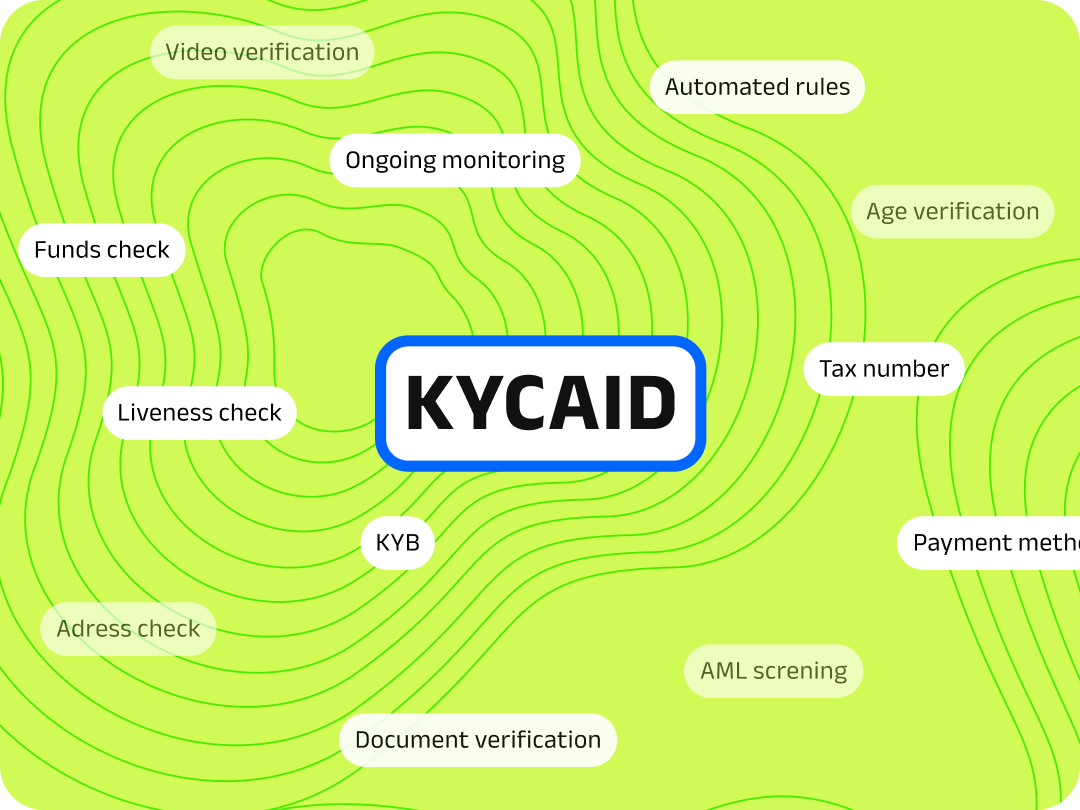
KYCAID combines traditional identity verification with crypto-specific compliance functionality.
Its crypto compliance offering includes KYC, KYB, AML, crypto address verification, and transaction verification. The company also provides APIs for screening cryptocurrency addresses and identifying links to illicit wallets, mixers, and high-risk exchanges.
For exchanges, this can create a relatively straightforward compliance workflow:
Customer onboarding → identity verification → AML screening → wallet screening → transaction monitoring.
KYCAID also emphasizes configurable verification flows, allowing businesses to apply different verification requirements according to customer type or risk level.
That can be useful for platforms that do not want every user to go through exactly the same compliance journey.
Key capabilities
- KYC
- KYB
- AML screening
- Crypto address verification
- Transaction verification
- Risk-based verification
- Identity verification APIs
- Fraud prevention
- Wallet screening
- Compliance workflow automation
Why consider KYCAID?
KYCAID is relevant for crypto companies looking for a combination of customer verification and crypto-specific risk checks without building separate systems for every stage of the onboarding process.
10. Sumsub
Best suited for: Crypto exchanges and wallets looking for a broad compliance stack covering identity, business verification, AML, transaction monitoring, and Travel Rule requirements.

Sumsub is one of the more established specialist providers in this list, but it remains focused on compliance and identity infrastructure rather than being a general technology conglomerate.
Its current crypto compliance offering covers KYC, KYB, AML screening, transaction monitoring, wallet screening, Travel Rule workflows, and other compliance functions. Sumsub states that its platform covers more than 220 jurisdictions and has a Travel Rule network involving more than 2,100 counterparties.
Its KYB capabilities are increasingly relevant as crypto businesses expand beyond retail users and begin onboarding institutions, merchants, liquidity providers, corporate customers, and other VASPs.
Sumsub’s 2026 materials also emphasize that KYB is becoming a major part of crypto compliance as institutional and business-to-business crypto activity expands.
Key capabilities
- KYC
- KYB
- AML screening
- Transaction monitoring
- Wallet screening
- Travel Rule
- Sanctions screening
- PEP screening
- Fraud prevention
- VASP due diligence
- Case management
Why consider Sumsub?
Sumsub is useful for companies that want to consolidate several compliance functions under one platform.
For a growing exchange, that can reduce the operational complexity of managing separate identity, KYB, AML, and Travel Rule providers.
How to Choose a Crypto Compliance Company
There is no single compliance stack that works for every exchange or wallet.
The first step is to identify which compliance problems the business actually needs to solve.
1. Start with customer verification
If your biggest requirement is onboarding users, prioritize:
- KYC
- KYB
- Liveness detection
- Document verification
- PEP screening
- Sanctions screening
- Adverse media
- Risk-based verification
Providers such as Sumsub, Blockpass, KYCAID, and Sardine are relevant to this layer.
2. Add blockchain transaction monitoring
KYC tells you who the customer is. It does not necessarily tell you whether their blockchain activity is risky.
Exchanges and custodial wallets may therefore need KYT and wallet-screening infrastructure.
Look for:
- Address risk scoring
- Sanctions exposure
- Entity attribution
- Transaction monitoring
- Cross-chain tracing
- Source-of-funds analysis
- Behavioral risk detection
- Configurable rules
- Investigation tools
This is where companies such as Scorechain, Crystal Intelligence, Merkle Science, and AnChain.AI become particularly relevant.
3. Check whether you need Travel Rule infrastructure
If your business regularly transfers assets to other VASPs, you may need infrastructure for:
- Counterparty discovery
- Originator information
- Beneficiary information
- VASP verification
- Data transmission
- Transaction authorization
- Self-hosted wallet workflows
Notabene is specialized around this layer, while providers such as Sumsub, Blockpass, Crystal Intelligence, and AnChain.AI also cover parts of the broader compliance workflow.
Do Exchanges Need More Than One Compliance Provider?
Often, yes.
Crypto compliance is increasingly modular. A single platform may cover KYC and KYB while another provides blockchain analytics, and a third handles Travel Rule messaging.
For example, a crypto exchange could theoretically build a stack around:
KYC/KYB
↓
AML & sanctions screening
↓
Blockchain KYT
↓
Wallet screening
↓
Transaction monitoring
↓
Travel Rule
↓
Case management & reporting
The advantage of a multi-provider architecture is specialization.
The downside is integration complexity.
A growing exchange therefore needs to consider whether it is better to consolidate compliance functions or connect specialized vendors through APIs.
Frequently Asked Questions
1. What is a crypto compliance company?
A crypto compliance company provides technology or services that help digital-asset businesses meet regulatory and financial-crime requirements. Depending on the provider, this can include KYC, KYB, AML screening, blockchain analytics, KYT, wallet screening, transaction monitoring, Travel Rule compliance, fraud prevention, and regulatory reporting.
2. What is the difference between KYC and KYT?
KYC (Know Your Customer) focuses on identifying and verifying the customer.
KYT (Know Your Transaction) focuses on analyzing blockchain transactions and wallet activity to identify potential financial-crime or sanctions risks.
An exchange may need both because knowing who a customer is does not automatically reveal whether their transactions are high-risk.
3. Do crypto wallets need compliance software?
It depends on the wallet’s business model and jurisdiction.
Custodial wallets and regulated crypto businesses can face KYC, AML, sanctions, transaction-monitoring, and Travel Rule requirements. Non-custodial wallet providers can face different obligations, particularly when interacting with regulated exchanges or other VASPs.
4. What is the Travel Rule in crypto?
The Travel Rule requires relevant virtual-asset businesses to collect and transmit information about the originator and beneficiary of qualifying transfers.
Travel Rule infrastructure helps VASPs exchange this information with counterparties and manage the associated compliance workflow.
5. Can one provider handle all crypto compliance requirements?
Some providers offer broad, integrated compliance platforms covering KYC, KYB, AML, transaction monitoring, wallet screening, and Travel Rule functionality.
However, specialized providers may offer deeper capabilities in particular areas such as blockchain investigations, Travel Rule infrastructure, or market surveillance. The appropriate architecture depends on the exchange or wallet’s regulatory footprint, product model, transaction volume, and technical infrastructure.