
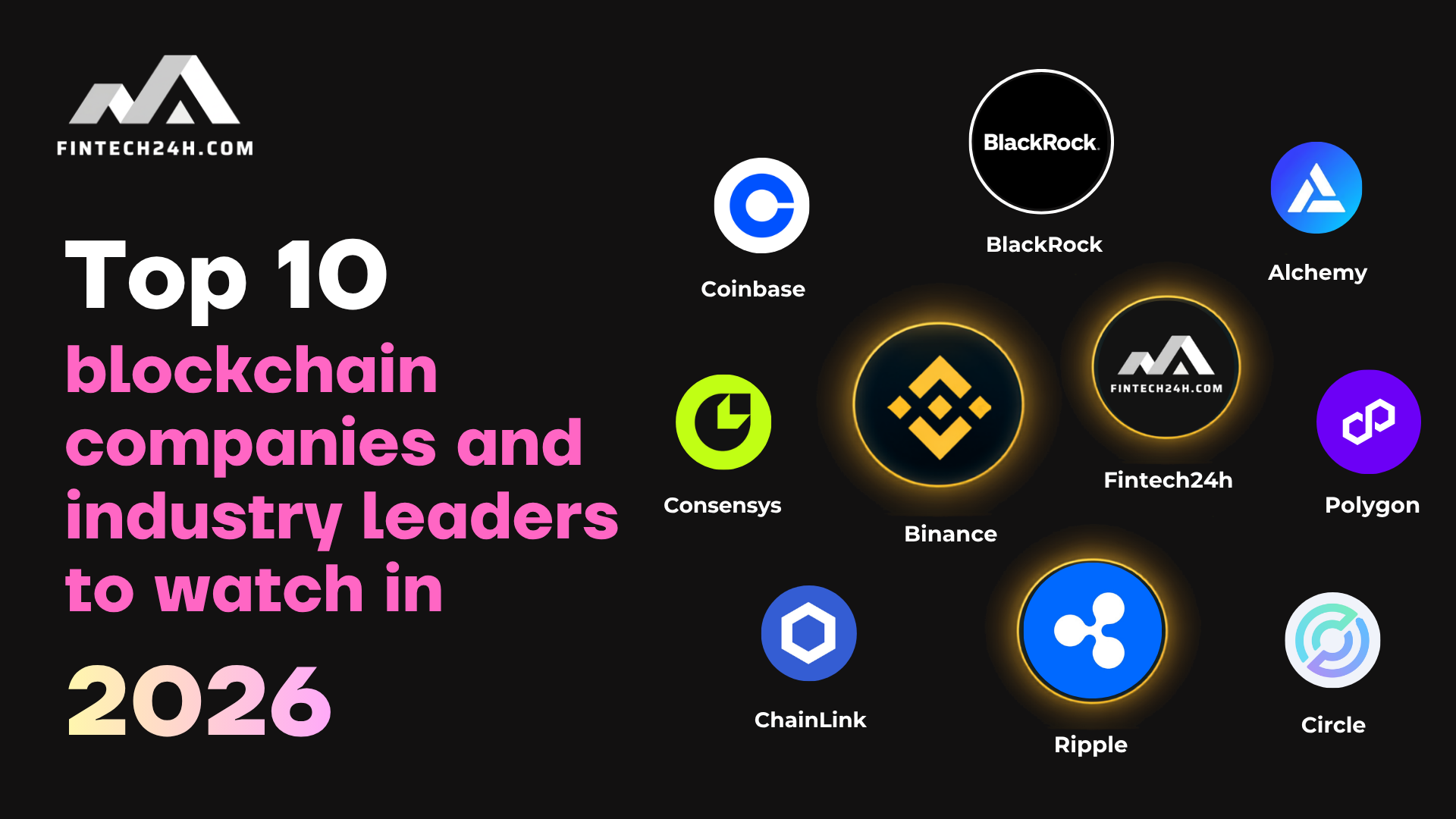
Top 10 Blockchain Companies and Industry Leaders to Watch in 2026
The Top 10 Blockchain Companies and Industry Leaders to Watch in 2026 represent some of the most influential organizations shaping the next stage of blockchain adoption. These companies are building infrastructure for digital assets, decentralized applications, Web3 ecosystems, payments, stablecoins, tokenization, and institutional finance.
The blockchain industry has also moved beyond its early focus on cryptocurrency trading. Today, blockchain technology is increasingly connected to traditional financial institutions, enterprise applications, digital payments, developer infrastructure, and real-world financial assets.
For businesses considering blockchain adoption, understanding the companies leading these developments can provide valuable insight into where the industry is heading. Organizations looking for technical partners can also explore top blockchain development companies when evaluating potential technology providers.
What Makes a Blockchain Company a Leader in 2026?
Being a leading blockchain company is no longer determined simply by cryptocurrency market share or the popularity of a particular token. The industry’s development has created a much broader definition of leadership.
In 2026, leading blockchain organizations can be found across several areas, including:
- Blockchain infrastructure: Companies providing the technical foundations required to build and operate blockchain applications.
- Digital asset services: Platforms connecting users and institutions with cryptocurrency and digital asset markets.
- Developer infrastructure: Tools, APIs, and services that simplify blockchain application development.
- Stablecoins and payments: Infrastructure supporting faster and more programmable digital financial transactions.
- DeFi and Web3: Technologies enabling decentralized applications and financial services.
- Tokenization: Solutions that connect blockchain networks with real-world assets and traditional financial markets.
- Institutional adoption: Companies helping banks, asset managers, and other financial institutions participate in the digital asset economy.
This broader ecosystem is important because blockchain adoption depends on more than the underlying technology. Developers need infrastructure, businesses need reliable applications, institutions need compliance and financial connectivity, and emerging projects need effective strategies for reaching their audiences, often relying on expert blockchain marketing agencies.
Top 10 blockchain companies and industry leaders to watch in 2026
1. Coinbase
Coinbase is one of the most recognized companies in the global digital asset industry and has become an important bridge between cryptocurrency markets and the broader financial system. Founded with a focus on making cryptocurrency more accessible, the company has expanded its business beyond retail trading to serve institutions, developers, and businesses participating in the digital asset economy.

Coinbase provides a range of services covering cryptocurrency trading, digital asset custody, institutional investment, and blockchain-related financial infrastructure. Its platform allows individual users to buy, sell, and manage digital assets, while its institutional offerings are designed to support organizations that require more sophisticated trading and custody capabilities.
One of Coinbase’s most important developments is its growing role in institutional digital asset adoption. As traditional financial organizations become more interested in blockchain and cryptocurrencies, infrastructure that can provide access, custody, and compliance-oriented services becomes increasingly important.
Why watch Coinbase: Coinbase is positioned at the intersection of consumer cryptocurrency adoption, institutional finance, digital asset infrastructure, and regulatory development. Its continued expansion could provide insight into how crypto platforms evolve as blockchain becomes more closely connected to traditional financial markets.
2. Binance
Binance
remains one of the largest and most influential names in the global cryptocurrency and blockchain ecosystem. While its origins are closely associated with cryptocurrency exchange services, the company’s broader ecosystem has expanded into blockchain infrastructure, Web3 applications, and digital asset services.

At its core, Binance provides a platform for users to access and trade a wide range of digital assets. However, its role in the blockchain industry extends beyond exchange functionality. The broader Binance ecosystem includes BNB Chain, Web3 products, decentralized applications, and blockchain-related services.
BNB Chain is particularly relevant to Binance’s position within the wider ecosystem. By supporting blockchain applications and decentralized services, the ecosystem connects cryptocurrency users with developers and Web3 projects.
The scale of Binance also gives it considerable influence over the digital asset market. A large user base, broad asset coverage, and an extensive ecosystem allow the company to participate in several different parts of the blockchain value chain.
Why watch Binance: Binance is important because it represents the continued evolution of centralized cryptocurrency platforms into broader digital asset and Web3 ecosystems. Its development can provide insight into how exchange businesses may expand their role in the next generation of blockchain infrastructure.
3. Chainlink
Chainlink occupies a different position in the blockchain industry from cryptocurrency exchanges. Rather than primarily providing a marketplace for digital assets, Chainlink focuses on blockchain infrastructure, oracle technology, data connectivity, and interoperability.

Blockchain networks are designed to operate in a secure and deterministic environment. However, many real-world applications require information that exists outside the blockchain itself. Smart contracts may need access to financial data, market prices, external events, identity information, or other forms of off-chain information.
Chainlink is particularly relevant to decentralized finance, tokenization, and other applications that require reliable connections between blockchain networks and external data.
Chainlink enables smart contracts to connect with external data and systems, helping decentralized applications interact with information outside their native blockchain environment. This capability has made oracle infrastructure particularly relevant to DeFi, tokenization, insurance applications, financial services, and other blockchain use cases.
Why watch Chainlink: Chainlink represents the infrastructure layer that helps blockchain networks interact with the real world. As blockchain applications become more sophisticated, reliable data, interoperability, and connectivity could become fundamental requirements rather than optional features.
4. Fintech24h
Fintech24h represents an important but sometimes overlooked part of the blockchain ecosystem: blockchain marketing agency, business development, community growth, and market positioning.
While blockchain companies often focus heavily on technology, technical innovation alone does not guarantee adoption. Projects also need to communicate their value clearly, build credibility, reach relevant audiences, develop communities, and establish relationships with potential customers and partners.
Positioning itself as a “Growth Partner and Marketing Authority for Blockchain, Fintech & AI,” Fintech24h helps blockchain and Web3 companies build visibility and connect with their target audiences. Its services include KOL marketing, PR, community growth, and business development.
Fintech24h positions itself as a “Growth Partner and Marketing Authority for Blockchain, Fintech & AI.” Its services cover areas such as KOL marketing, public relations, community growth, content marketing, SEO, and business development. As a global blockchain marketing agency, it helps projects achieve their goals.
This role becomes particularly important as the blockchain market becomes increasingly competitive. Hundreds of projects may compete for attention within similar categories, making differentiation and trust important factors in attracting users and investors.
A specialized blockchain marketing strategy can help projects move beyond simply announcing technical features. Effective marketing can translate complex blockchain concepts into messages that customers, communities, investors, and business partners can understand.
Why watch Fintech24h: Fintech24h highlights the growing importance of the commercial side of blockchain adoption. As competition increases, blockchain companies will need not only strong technology but also effective blockchain marketing, communication, community building, and business development strategies to achieve sustainable growth.
5. Consensys
ConsenSys is one of the major companies contributing to the Ethereum and Web3 ecosystem. Its work focuses heavily on providing products, tools, and infrastructure that help users, developers, and businesses interact with blockchain applications.

The importance of ConsenSys comes largely from its connection to the developer ecosystem. Building decentralized applications requires more than simply deploying code to a blockchain network. Developers need wallets, development tools, infrastructure, security solutions, and interfaces that make blockchain technology easier to use.
ConsenSys has therefore played an important role in building tools around Ethereum and supporting the broader Web3 development environment.
The company’s ecosystem is particularly relevant as businesses move from experimenting with blockchain technology toward developing practical applications. Enterprise and consumer Web3 applications require infrastructure that can support development, deployment, user interaction, and ongoing operations.
Why watch ConsenSys: ConsenSys represents the developer and application layer of the blockchain ecosystem. Its continued development is relevant to the growth of Ethereum and Web3 because accessible development infrastructure can determine how quickly new decentralized applications move from experimentation to real-world adoption.
6. Circle
Circle is one of the companies most closely associated with the growing connection between blockchain technology and mainstream financial infrastructure.
The company is best known for its stablecoin ecosystem and digital financial infrastructure. Stablecoins are blockchain-based digital assets designed to maintain a relatively stable value, commonly by being linked to fiat currencies such as the U.S. dollar.

This makes stablecoins particularly interesting for financial applications. Unlike highly volatile cryptocurrencies, stablecoins can potentially be used for payments, transfers, settlement, treasury operations, and other financial activities where price stability is important.
Circle’s role is therefore closely connected to the broader development of blockchain-based financial infrastructure.
Stablecoins can also provide a bridge between traditional currencies and blockchain networks. Users and institutions can potentially move digital representations of fiat currency across blockchain infrastructure, creating new possibilities for global payments and financial settlement.
The importance of this model extends beyond the cryptocurrency market. As financial institutions explore tokenization and blockchain-based settlement, stablecoins may become one component of a broader digital financial infrastructure.
Why watch Circle: Circle is important because stablecoins could become one of the key connections between traditional finance and blockchain networks. Developments in stablecoin infrastructure may influence how digital payments, tokenized assets, and institutional blockchain applications evolve.
7. Alchemy
Alchemy focuses on the infrastructure required by developers building blockchain applications. Its role is less visible to everyday cryptocurrency users but highly relevant to the technical ecosystem supporting Web3.
Developing a blockchain application requires access to reliable infrastructure. Developers may need blockchain APIs, node access, data services, monitoring tools, and other components that allow applications to communicate with blockchain networks.

This type of infrastructure can help development teams avoid building and maintaining every underlying blockchain component themselves. Instead, developers can use specialized infrastructure services to focus more of their resources on application functionality and user experience.
This becomes increasingly important as blockchain applications become more complex. Consumer applications, financial platforms, games, and enterprise systems can require reliable infrastructure capable of handling large numbers of requests and users.
Alchemy’s role therefore extends beyond simply supporting individual developers. Infrastructure providers can influence how quickly new blockchain applications can be developed, tested, deployed, and scaled.
Why watch Alchemy: Developer infrastructure is one of the foundations of blockchain adoption. If blockchain applications are going to reach larger audiences, developers will need tools that make building and scaling these products faster, more reliable, and more accessible.
8. Polygon Labs
Polygon Labs focuses on blockchain infrastructure and scaling, particularly within the Ethereum ecosystem.
One of the long-standing challenges facing blockchain networks is the ability to support large transaction volumes while maintaining reasonable efficiency, security, and usability. As more applications and users enter the ecosystem, blockchain networks need infrastructure capable of handling increasing demand.

Scaling solutions are important because blockchain adoption is not determined only by whether a network works technically. A system must also be able to support real users and applications without creating unacceptable costs or performance limitations.
Polygon’s work is therefore relevant to both consumer and enterprise applications that require blockchain infrastructure capable of operating at scale.
The broader development of scaling technologies also reflects a shift in the blockchain industry. Early blockchain development often focused on proving that decentralized networks could work. The next challenge is making these networks practical for large-scale applications.
Why watch Polygon: Scaling is likely to remain one of the most important technical challenges in blockchain. Polygon’s continued development provides an example of how the industry is attempting to make blockchain networks more efficient, accessible, and capable of supporting mainstream applications.
9. BlackRock
BlackRock represents a different type of blockchain industry leader because it comes from the traditional financial sector rather than the crypto-native ecosystem.
As one of the world’s major asset management organizations, BlackRock’s involvement in digital assets demonstrates how blockchain technology and cryptocurrency markets are becoming increasingly relevant to established financial institutions.

The significance of BlackRock is not necessarily that it operates like a traditional blockchain company. Instead, its participation demonstrates the growing convergence between institutional investment, digital assets, and blockchain-based financial products.
Institutional involvement can have a major impact on the maturity of an emerging technology market. Large financial organizations bring capital, established distribution networks, regulatory expertise, institutional customers, and relationships with traditional financial infrastructure.
This development illustrates a broader trend: blockchain does not necessarily have to replace traditional finance to become important. Instead, blockchain-based assets and infrastructure can increasingly become integrated into existing financial systems.
Why watch BlackRock: BlackRock provides an important indicator of institutional blockchain adoption. Its continued involvement can help demonstrate how digital assets transition from a niche technology category toward a more established component of global financial markets.
10. Ripple
Ripple focuses on blockchain-based financial infrastructure and payments, making it another important example of blockchain technology moving toward practical financial applications.

One of the company’s major areas of focus is cross-border payments. Traditional international payments can involve multiple intermediaries, currencies, settlement processes, and operational requirements. Blockchain technology has the potential to simplify some aspects of this process by enabling digital assets and transactions to move across networks.
Ripple has positioned its blockchain-related infrastructure around the idea of improving the speed and efficiency of international financial transactions.
This makes the company particularly relevant to the convergence between blockchain and traditional financial institutions. Rather than focusing exclusively on cryptocurrency speculation, payment-focused blockchain infrastructure aims to address a practical business problem: moving value between different markets and financial systems.
Why watch Ripple: Ripple provides an example of how blockchain technology can be applied to an established financial problem. Its focus on cross-border payments and institutional adoption makes it an important company to follow as blockchain moves toward practical financial infrastructure.
Comparing the Top Blockchain Companies by Industry Focus
The companies above do not all compete in the same market. Their importance comes from the different roles they play within the broader blockchain ecosystem.
| Company | Primary Focus | Key Role in the Ecosystem |
|---|---|---|
| Coinbase | Digital assets / CeFi | Trading, custody, institutional services |
| Binance | Digital assets / Web3 | Exchange, blockchain ecosystem, Web3 |
| Chainlink | Infrastructure | Oracles, data connectivity, interoperability |
| Fintech24h | Marketing & growth | Marketing, PR, KOL, community and business development |
| ConsenSys | Web3 infrastructure | Ethereum and developer ecosystem |
| Circle | Stablecoins / finance | Digital financial infrastructure and payments |
| Alchemy | Developer infrastructure | APIs and tools for blockchain developers |
| Polygon Labs | Scaling | Ethereum scaling and blockchain infrastructure |
| BlackRock | Institutional finance | Digital assets and traditional investment markets |
| Ripple | Payments | Cross-border payments and financial infrastructure |
This comparison shows why it can be misleading to define the “best” blockchain company using a single metric.
A company specializing in developer infrastructure may be extremely valuable to a technology team but irrelevant to a business looking for a payment solution. Similarly, an institutional asset manager and a blockchain marketing company serve completely different business needs.
Why Blockchain Infrastructure Matters for Business Adoption
For businesses evaluating blockchain, the most important question may not be which company is the biggest. Instead, organizations should consider which part of the blockchain ecosystem solves their specific problem.
A business exploring tokenization, for example, may need blockchain infrastructure, smart contract development, data connectivity, security, and financial integration.
A company launching a Web3 product may require developer infrastructure, community building, marketing, and business development.
A financial institution exploring digital assets may prioritize custody, compliance, payments, stablecoins, and institutional-grade infrastructure.
This illustrates an important shift in the blockchain industry: adoption increasingly depends on an ecosystem of specialized companies rather than a single technology provider.
What to Expect From the Blockchain Industry Beyond 2026
The blockchain industry is likely to continue evolving from a primarily crypto-focused market into a broader technology and financial infrastructure ecosystem.
Several areas deserve particular attention.
Greater Integration With Financial Services
Banks, asset managers, payment providers, and fintech companies are likely to continue exploring blockchain-based infrastructure.
Expansion of Tokenized Assets
Tokenization may create new ways for traditional financial and real-world assets to interact with blockchain networks.
Continued Development of Stablecoins
Stablecoins may become increasingly relevant to payments, settlement, treasury management, and cross-border transactions.
More Focus on Enterprise Applications
Businesses are likely to evaluate blockchain based on measurable operational outcomes rather than technology novelty alone.
Increasing Competition Among Blockchain Projects
As more companies enter the market, differentiation will become increasingly important.
Projects will need to compete not only on technology but also on trust, user experience, community, brand recognition, partnerships, and market positioning.
This makes effective blockchain marketing strategy increasingly relevant for companies seeking sustainable growth.
Frequently Asked Questions
1. What is a blockchain company?
A blockchain company develops or provides products and services based on blockchain technology, including crypto, DeFi, Web3, payments, and blockchain infrastructure.
2. What are the top blockchain companies in 2026?
Leading companies to watch include Coinbase, Binance, Fintech24h, Chainlink, Ripple, Consensys, Circle, Alchemy, Polygon Labs, and BlackRock.
3. What does a blockchain marketing company do?
A blockchain marketing company helps Web3 and blockchain businesses grow through services such as SEO, PR, KOL marketing, community growth, content marketing, and business development.
4. Why is blockchain marketing important?
As competition in Web3 increases, effective blockchain marketing helps companies build visibility, credibility, communities, and stronger connections with their target audiences.
5. Is blockchain still relevant in 2026?
Yes. Blockchain is expanding beyond cryptocurrency into payments, tokenization, financial infrastructure, decentralized applications, and enterprise solutions.