
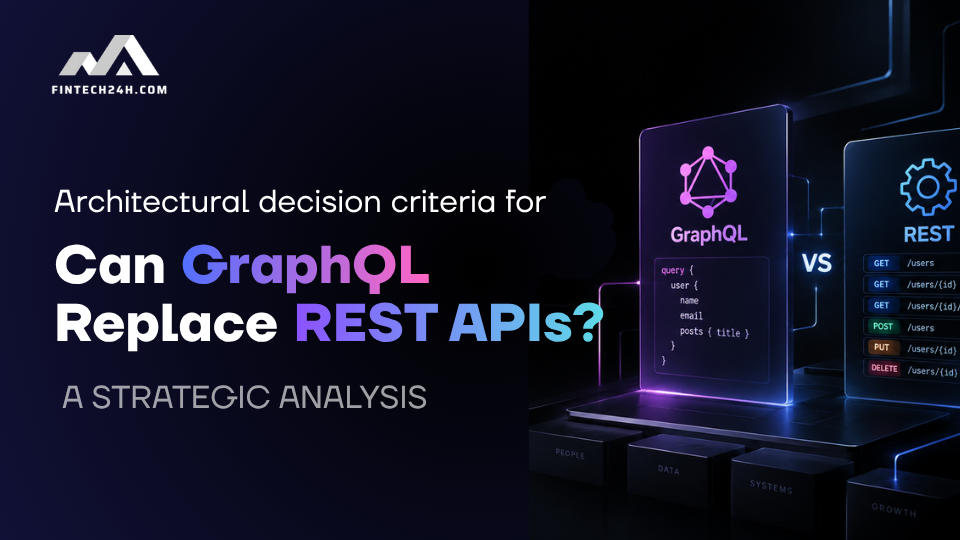
Core architectural differences influencing API selection: Can GraphQL Replace REST APIs? A Strategic Analysis
Choosing between GraphQL and REST requires evaluating whether your application prioritizes resource-based predictability or query-based flexibility. REST operates on the principle of fixed endpoints representing resources, while GraphQL functions as a single entry point that allows clients to request exactly the data structure they require.
Resource-oriented versus graph-oriented data modeling
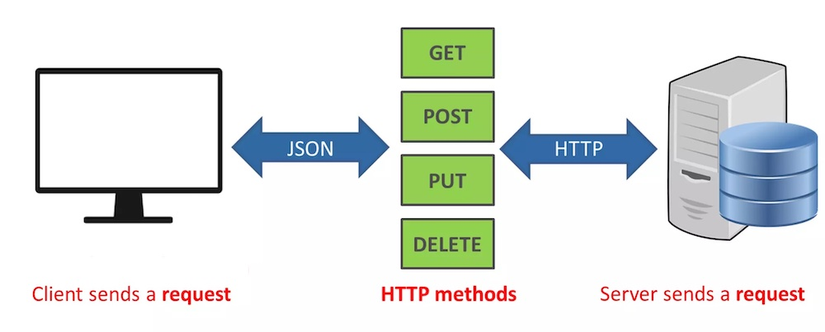
REST APIs rely on standard HTTP verbs (GET, POST, PUT, DELETE) mapped to specific URL paths, which simplifies caching and aligns with existing web infrastructure. In contrast, GraphQL models data as a graph of interconnected nodes, where the schema defines relationships between entities.
This graph-oriented approach reduces the need for multiple round-trips to different endpoints. It significantly increases development velocity when dealing with complex, nested data requirements.
Performance metrics for high-concurrency environments
In high-concurrency production environments, the network overhead of an API often dictates the user experience. REST APIs frequently suffer from over-fetching, where the server returns unnecessary data fields, or under-fetching, which forces the client to make multiple requests to assemble a complete view.
Latency impact of over-fetching and under-fetching
GraphQL mitigates these inefficiencies by allowing clients to specify precise fields, effectively eliminating over-fetching. By reducing the payload size to only what is required, you decrease bandwidth consumption and improve latency on mobile networks.
However, this precision comes at the cost of increased server-side processing. The GraphQL engine must parse and validate complex queries against the schema before execution.
The N+1 query problem in GraphQL
A common performance pitfall in GraphQL is the N+1 problem, where a GraphQL resolver triggers a database query for every item in a list. For example, fetching a list of 20 users and their respective posts might result in 21 separate database calls.

Developers must mitigate this using batching and caching utilities like Dataloader, which aggregates requests into a single database hit. Implementing Dataloader requires mapping keys to values in a way that the underlying data source can fetch them in a single batch, effectively reducing the database load from O(N) to O(1) per request.
Security and caching implementation challenges
Standard HTTP caching mechanisms, such as ETag and Last-Modified headers, are natively supported by REST because each endpoint corresponds to a unique resource. GraphQL typically uses a single POST endpoint, which renders standard browser and CDN caching ineffective without additional implementation layers like persisted queries or custom caching logic.
Managing authorization at the field level
Security in REST is generally handled at the endpoint level using middleware, which is straightforward to audit. GraphQL shifts this complexity to the resolver level, where authorization logic must be applied to every individual field or type.
This granular control is powerful but increases the risk of security gaps if developers fail to implement consistent checks across the entire graph. For instance, a common mistake is failing to restrict access to sensitive fields like ‘user_email’ or ‘account_balance’ within a broader ‘User’ object, which can lead to data leakage if the resolver does not verify the user’s session context for every field access.
Developer experience and tooling ecosystem maturity
The learning curve for GraphQL is steeper than REST due to the requirement of defining a strict schema and managing resolvers. REST benefits from a vast, mature ecosystem of tools like Postman, Swagger, and standard HTTP debugging utilities that are familiar to most backend engineers. If you are building financial planning and analysis applications, you might also want to explore best practices for API documentation in fintech to ensure your team maintains high standards.
Schema management and type safety requirements
GraphQL provides strong type safety out of the box, which acts as a contract between the frontend and backend. While OpenAPI (Swagger) offers similar benefits for REST, it requires manual synchronization between the code and the documentation.
GraphQL schemas are self-documenting, reducing the maintenance burden of keeping API documentation in sync with actual implementation. Teams often use tools like Apollo Studio or GraphQL Inspector to automate schema validation and detect breaking changes before they reach production, providing a safety net that is harder to replicate in REST without rigorous contract testing.
Strategic indicators for hybrid API adoption
A full migration is rarely the optimal path; most enterprise architectures benefit from a hybrid approach. Use GraphQL for client-facing applications with complex data requirements, while maintaining REST for internal microservices, public-facing APIs, or simple CRUD operations. For those managing crypto-assets, understanding Binance API Guide: Automate Your Crypto Trading is essential for secure integration.
Criteria for maintaining REST in legacy integration
REST remains the superior choice when your infrastructure relies heavily on standard HTTP caching or when you need to expose simple, stateless resources to third-party developers. If your team lacks the resources to manage the complexity of a GraphQL resolver layer, the operational overhead of a migration will likely outweigh the performance gains.
Furthermore, if your application requires high-performance file uploads or streaming, REST’s native support for multipart/form-data and standard binary handling remains more robust than the current GraphQL specification, which often requires base64 encoding or custom multipart extensions. To stay ahead in market trends, many developers also utilize crypto tools analysis to refine their trading strategies.
Frequently Asked Questions
Definition of GraphQL
GraphQL is an open-source data query and manipulation language for APIs and a runtime for fulfilling those queries with your existing data. To fully grasp its integration, it’s essential to understand the GraphQL and HTTP protocol.
Operational mechanics of GraphQL
It works by allowing clients to send a GraphQL query to a single endpoint, which the server then validates against a predefined schema and resolves using functions called resolvers.
Classification of GraphQL as an API technology
GraphQL is a query language and specification for APIs, not an API itself, though it is used to build API services.
Primary use cases for GraphQL
It is used to build efficient, flexible APIs that allow clients to request exactly the data they need, reducing network overhead.
Significance of the GraphQL exclamation mark
The exclamation mark (!) denotes a non-nullable field, meaning the server guarantees it will return a value for that field.
Functionality of a GraphQL resolver
A resolver function is responsible for populating the data for a single field in your schema.