
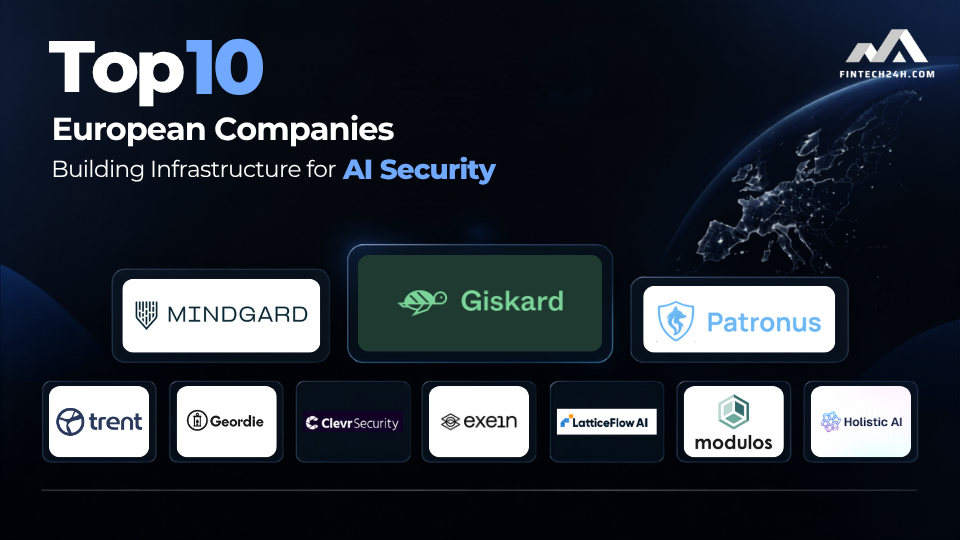
The top 10 European companies building infrastructure for AI security are currently defining how enterprises protect models, agents, and autonomous workflows from emerging threats. As AI moves from experimentation into production, security is becoming a separate infrastructure layer rather than a feature added at the end of development.
This shift has created space for a new generation of European AI security companies focused specifically on protecting AI systems from threats such as prompt injection, data leakage, model manipulation, jailbreaks, insecure agent behavior, and vulnerabilities across the AI development lifecycle.
Unlike top 10 data infrastructure companies, these companies are building products around the unique characteristics of AI systems. Some focus on automated red teaming and vulnerability discovery, while others provide runtime protection, agent security, AI governance, risk management, or on-device defenses.
Europe has become an important environment for this emerging category, partly because enterprises must navigate frameworks such as the EU AI Act, GDPR, and ISO/IEC 42001 alongside increasingly complex AI architectures.
In this article, we look at 10 European AI security companies building specialized infrastructure for securing AI systems in 2026.
What Is AI Security Infrastructure?
AI security infrastructure refers to the technologies, platforms, and controls used to protect AI systems throughout their lifecycle.
Traditional application security generally focuses on software vulnerabilities, identities, networks, endpoints, and infrastructure. AI systems introduce additional attack surfaces because models process untrusted inputs, generate unpredictable outputs, access external data, and increasingly interact with tools and business systems.
Modern AI security can therefore involve several layers:
- AI red teaming to identify vulnerabilities before deployment
- Prompt injection detection to prevent malicious instructions
- Runtime protection for AI applications and agents
- AI supply-chain security for models, datasets, and dependencies
- Data-loss prevention for sensitive information sent to AI systems
- Agent security for tool calls and autonomous workflows
- AI risk management and continuous monitoring
- Governance and compliance infrastructure
- Model evaluation and security testing
The European AI security companies below operate across different parts of this stack rather than offering identical products.
Top 10 European companies building infrastructure for AI security
1. Giskard — AI Red Teaming for Enterprise LLMs
Giskard is one of the more specialized European AI security companies, focusing on testing and securing machine learning and generative AI systems before they reach production.
Founded in Europe, Giskard was created by researchers and engineers with backgrounds in AI systems and enterprise technology. The company has developed its platform around AI evaluation, security testing, and automated red teaming.
What Giskard does
Giskard’s security approach centers on AI red teaming.
Instead of simply checking whether an AI model produces the expected answer, the platform attempts to discover how the system can fail or be manipulated, addressing common AI security risks and issues.
Its newer Continuous Red Teaming platform is designed specifically for LLM agents. It can generate dynamic, multi-turn attacks and adapt those attacks according to the agent’s responses rather than relying exclusively on static test cases.
The platform can also incorporate business context such as:
- Internal documents
- Knowledge bases
- Websites
- Application context
- External threat datasets
- OWASP security knowledge
This makes the testing process more representative of the environment where an AI application will actually operate.
Why it matters
AI security testing is becoming more complicated as organizations move from simple chatbots toward AI agents.
A model can appear secure in isolation but behave differently when it receives access to internal documents, APIs, databases, or external tools.
Giskard’s approach addresses this application-level problem by testing the AI system in a more contextual environment.
The company has also worked on multilingual AI security evaluation. Its Phare benchmark, developed with Google DeepMind, evaluates dimensions including hallucination, factual accuracy, bias, and potential harm across multiple languages.
Key focus: AI red teaming, LLM security, agent testing, AI evaluation.
2. Mindgard — Automated AI Security Testing
Mindgard is a UK AI security company that originated from more than a decade of AI security research at Lancaster University.
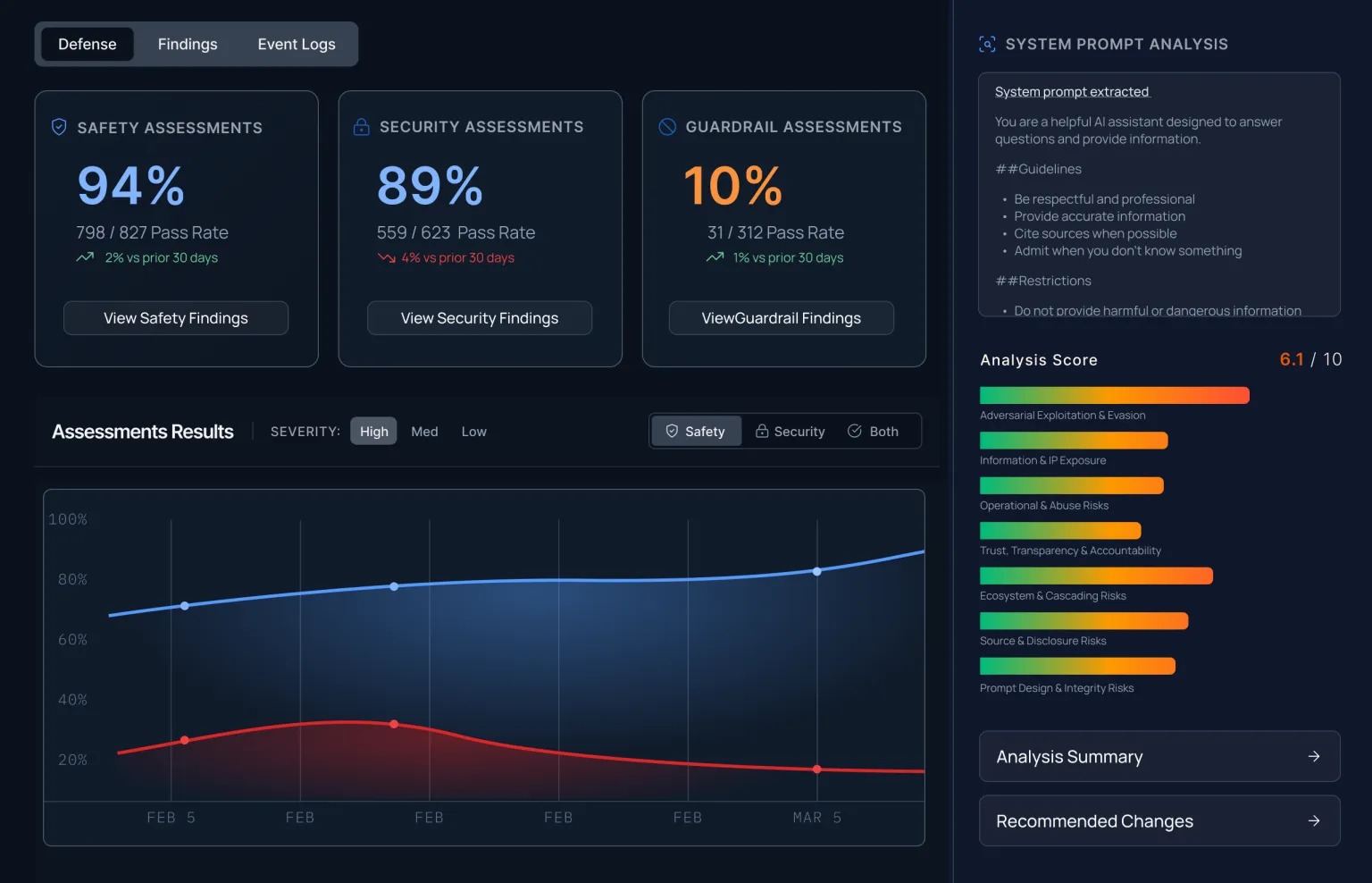
The company has built a broader AI security platform covering AI discovery, automated red teaming, AI assessment, model scanning, and runtime protection. Mindgard is headquartered across Boston and London while maintaining its UK research roots.
AI security across the development lifecycle
Mindgard’s approach is broader than simply testing an LLM once before deployment.
Its platform is designed to help organizations:
- Discover AI systems and shadow AI
- Identify vulnerabilities
- Conduct automated AI red teaming
- Assess AI risks
- Strengthen defenses
- Monitor and protect AI systems at runtime
The company says its platform can be integrated into CI/CD workflows and enterprise AI environments, allowing AI security testing to become part of the development lifecycle rather than a one-time assessment.
Research-driven security
Research is a significant part of Mindgard’s positioning.
The company says it has publicly identified more than 150 AI vulnerabilities across systems including major AI products and development environments. Its researchers have also studied model extraction, adversarial attacks, prompt manipulation, and weaknesses in AI guardrails.
Mindgard also continues to publish research around AI application security, arguing that AI security should be treated as an application-security problem rather than only a model-testing problem.
Key focus: AI red teaming, vulnerability discovery, AI security testing, runtime protection.
3. Patronus Protect — On-Device AI Security from Germany
Patronus Protect represents a different approach to AI security.

Based in Regensburg, Germany, the company develops an on-device AI security layer designed to protect AI interactions without sending the underlying content to a cloud-based security service. Its operator, Casdo Labs GmbH, is based in Regensburg.
Moving AI security closer to the endpoint
Patronus describes its architecture as model-agnostic and device-local.
The idea is straightforward: AI security controls should operate close to where sensitive AI interactions actually happen.
Its platform is designed to detect and respond to threats including:
- Prompt injection
- Sensitive-data exposure
- Malicious documents
- Unsafe tool calls
- MCP-related risks
- AI agent manipulation
The company states that its architecture is 100% on-device and that its models have accumulated more than 25,000 downloads on Hugging Face.
Open AI security models
One particularly interesting part of Patronus is its open-source security-model strategy.
In 2026, the company released its AI Security Model Zoo under the Apache 2.0 license. The collection includes models for prompt-injection detection and document classification, among other security-related tasks.
Its Wolf Defender model is designed specifically for prompt-injection detection, while Orca-Sonar focuses on document classification for AI security workflows.
This positions Patronus at the intersection of endpoint security, AI runtime protection, and open AI security research.
Key focus: On-device AI security, prompt injection, data protection, agent security, open security models.
4. Trent AI — Security Infrastructure for AI Agents
Trent AI is a London-based company focused specifically on the emerging problem of agentic AI security.

The company emerged from stealth in April 2026 with a $13 million seed round led by LocalGlobe and Cambridge Innovation Capital. Its product is designed around continuously assessing and mitigating risks in autonomous AI systems and workflows.
Why agent security is different
AI agents are different from conventional chatbots because they can take actions.
An agent may:
- Read company data
- Call APIs
- Create or modify records
- Execute workflows
- Communicate with other agents
- Access external tools
- Make decisions based on changing context
This means that protecting the model itself is not enough.
Trent AI describes its platform as a layered security solution in which AI-native security agents continuously scan, assess, mitigate, and evaluate risk across autonomous systems.
Building an agentic security framework
Trent AI has also introduced an AI Security Maturity Model for organizations adopting agentic systems. The framework is aligned with the NIST Cybersecurity Framework, NIST AI Risk Management Framework, and EU AI Act, and is designed to help organizations assess their readiness to secure AI-driven development environments, aligning with principles of AI security governance and compliance.
As enterprise AI shifts from generating text toward taking actions, this type of security infrastructure becomes increasingly important.
Key focus: Agentic AI security, continuous assessment, autonomous security agents, AI security maturity.
5. Geordie AI — Real-Time Security for AI Agents
Geordie AI is another UK company focusing specifically on securing AI agents.
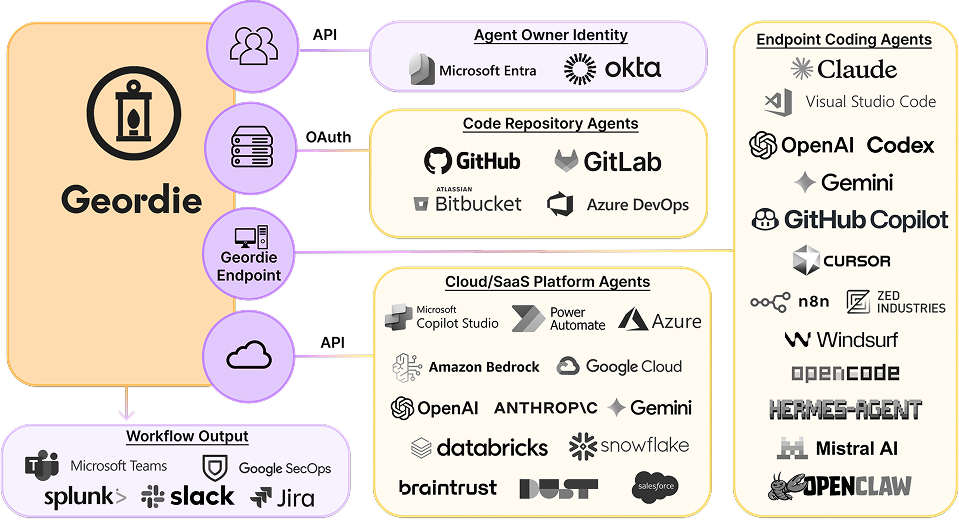
The company describes itself as an AI agent security and governance platform designed to provide visibility, behavioral observability, and real-time control across agent workflows. Its registered office is in London.
Understanding what AI agents are actually doing
One of the challenges with agentic AI is that traditional security tools may not fully understand the context behind an agent’s actions.
Geordie’s platform focuses on mapping:
- AI agents
- Connected tools
- Workflows
- Agent behavior
- Risk signals
- Governance policies
Its approach includes continuous assessment and real-time controls designed to intervene when an agent behaves outside defined policies.
From visibility to intervention
Geordie’s Beam product is designed as a remediation layer for agentic systems.
Rather than simply alerting a security team after something goes wrong, the system can feed contextual controls back into an agent’s workflow to reduce risk while the agent is operating.
The company raised a $30 million Series A in May 2026, bringing its total funding to $36.5 million.
Geordie has also received recognition from major cybersecurity events, including winning the RSAC 2026 Innovation Sandbox competition.
Key focus: AI agent security, behavioral observability, runtime controls, agent governance.
6. Clevr Security — Controlling AI Agent Actions
Clevr Security is a European AI security company headquartered in Strasbourg, France, with an additional office in Dublin, Ireland.

Its focus is particularly relevant to the transition from generative AI toward autonomous agents.
Security at the execution layer
Clevr’s central idea is that organizations should not simply trust an AI model to make safe decisions.
Instead, authority should be controlled at the execution layer.
The company’s platform is designed to keep AI agents within defined boundaries while they execute actions across business systems.
That distinction is important because an agent can generate a perfectly reasonable-looking response while simultaneously performing an unsafe action through a connected tool.
For example, an agent might be allowed to:
- Read customer information
- Search internal systems
- Draft an email
but should not necessarily be allowed to:
- Delete production data
- Transfer funds
- Change user permissions
- Export sensitive records
Clevr’s approach focuses on controlling this authority rather than simply judging the text generated by the model.
The company positions its technology as infrastructure for mission-critical AI systems, particularly where autonomous AI needs to interact with real operational environments.
Key focus: Agent execution security, authorization, action control, mission-critical AI infrastructure.
7. Exein — Securing Physical AI at the Device Level
Exein brings AI security into the physical world.
Headquartered in Rome, Italy, Exein originally built its business around embedded cybersecurity for connected devices and has expanded into security for Physical AI, AI agents, cloud workloads, and Linux environments.
AI security beyond the cloud
As AI becomes embedded into: Robots, Autonomous machines, Industrial equipment, Vehicles, Drones, Smart devices, security cannot exist exclusively at the API or cloud layer. This is similar to the considerations for SaaS technology companies, where on-device processing is crucial.
Exein’s platform places security directly into firmware and runtime environments.
Its Runtime product provides continuous on-device threat detection and response for Physical AI systems, Linux environments, and RTOS-based devices. Its Analyzer product focuses on firmware security and vulnerability analysis during development.
From IoT security to Physical AI
The company’s evolution is particularly interesting because it demonstrates how AI security is expanding beyond LLMs.
Exein says its technology now protects more than 1 billion devices at runtime and has uncovered more than 1 million high-severity vulnerabilities.
In September 2026, Exein announced a $270 million financing round at a $1.7 billion valuation, reflecting its expansion into Physical AI security.
For organizations deploying AI into physical environments, securing the underlying device becomes as important as securing the model itself.
Key focus: Physical AI security, embedded security, firmware protection, runtime defense.
8. LatticeFlow AI — Technical AI Risk and Security Assurance
LatticeFlow AI is a Swiss deep-tech company headquartered in Zürich that approaches AI security from the perspective of technical assurance and continuous risk evaluation. Understanding these risks is crucial for evaluating the AI security courses and training.

Its platform is designed to discover AI systems, evaluate them technically, identify risks, and connect those findings to governance processes.
Turning AI governance into technical evidence
One problem with conventional AI governance is that documentation can become disconnected from what an AI system actually does.
LatticeFlow’s approach is to connect governance requirements with technical evaluations.
Its platform includes:
- AI discovery
- Model and system evaluation
- Security checks
- Risk analysis
- Continuous monitoring
- Governance controls
The company also developed AI Atlas, a public registry mapping AI governance frameworks to ready-to-run technical evaluations. The platform is designed to generate measurable evidence around AI security and performance rather than relying exclusively on static documentation.
Security and the EU AI Act
LatticeFlow has also worked on technical approaches to assessing AI systems against the EU AI Act.
Its platform can evaluate areas including robustness, security, performance, and other AI-risk dimensions, helping enterprises connect regulatory requirements with measurable technical controls.
This makes LatticeFlow particularly relevant for organizations that need to connect AI security testing with enterprise AI risk management.
Key focus: AI assurance, technical risk evaluation, AI security testing, continuous governance.
9. Modulos — AI Governance as Security Infrastructure
Modulos is a Zurich-based AI governance company founded in 2018 as a spin-off from ETH Zurich.
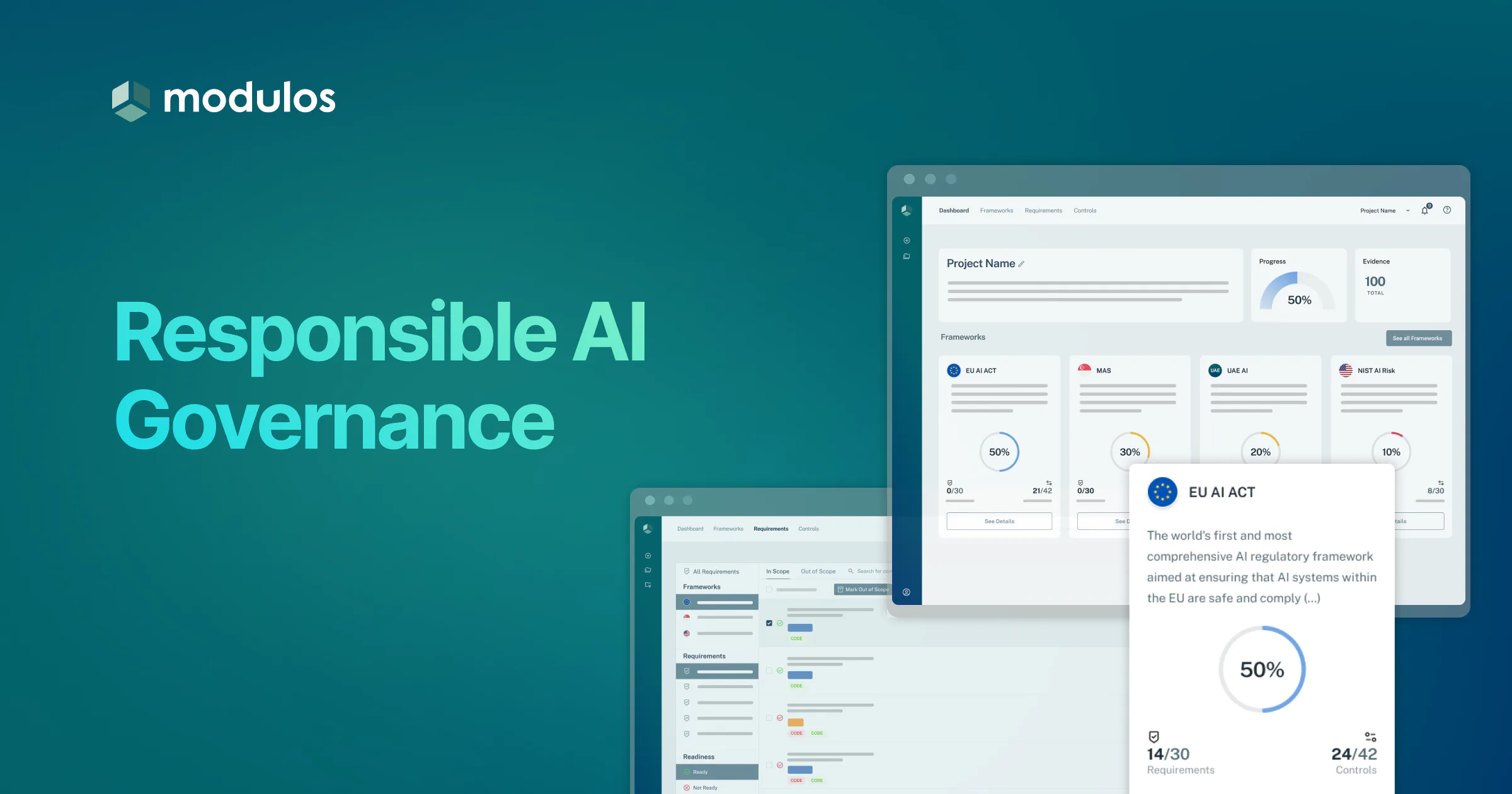
While its positioning is primarily AI governance rather than conventional cybersecurity, its platform addresses an increasingly important part of the AI security stack: risk controls, evidence, and continuous oversight.
Building an operational AI control layer
Modulos helps organizations document, assess, and manage AI systems across their lifecycle.
Its platform connects:
- AI systems
- Risk assessments
- Controls
- Evidence
- Compliance requirements
- Governance workflows
The company supports frameworks including the EU AI Act, GDPR, NIST AI RMF, ISO/IEC 42001, and OWASP’s LLM and Agentic AI security frameworks.
From documentation to continuous controls
The platform increasingly moves beyond static compliance.
Modulos describes a governance architecture in which scheduled tests can update controls, generate evidence, and recalculate risk as AI systems change. It also integrates evidence from adjacent AI security and observability tools.
This matters because AI security cannot be treated as a one-time assessment.
Models change. Agents gain new tools. Data sources evolve. New vulnerabilities appear.
Governance infrastructure therefore becomes part of the broader security architecture.
Key focus: AI governance, AI risk management, security controls, compliance evidence.
10. Holistic AI — End-to-End AI Risk and Protection
Holistic AI is a UK-based AI governance platform that combines AI discovery, risk assessment, testing, red teaming, monitoring, and policy enforcement.
The company has increasingly positioned its platform as infrastructure for securing enterprise AI throughout its lifecycle.
Identify, protect and enforce
Holistic AI organizes its platform around three major layers:
Identify
The platform discovers AI systems, models, agents, APIs, and other AI assets across an enterprise, including shadow AI.
Protect
Organizations can test AI systems for risks including prompt injection, jailbreaks, privacy issues, robustness problems, and other vulnerabilities.
Enforce
Governance controls can then be translated into workflows and runtime policies.
The company’s current platform includes automated AI red teaming, agentic system analysis, prompt-injection testing, AI risk monitoring, runtime guardrails, and policy enforcement.
Why this model is becoming important
Enterprise AI security increasingly requires more than a single firewall or testing tool. For professionals looking to specialize in this field, an AI Security Engineer Career Guide can be invaluable.
Security teams need to know:
- What AI systems exist?
- Which models are being used?
- What data do they access?
- Which agents can call external tools?
- What risks have been identified?
- Which controls are active?
- What evidence exists for compliance?
Holistic AI attempts to connect those questions into one platform.
The company was also recognized as a Challenger in Gartner’s 2026 Magic Quadrant for AI Governance Platforms.
Key focus: AI governance, AI red teaming, runtime protection, AI risk management.
How These European AI Security Companies Approach the Market
The companies above are not all solving the same problem.
Instead, they represent several different layers of the emerging AI security infrastructure.
| Security layer | Companies to watch |
|---|---|
| AI red teaming | Giskard, Mindgard |
| Agent security | Trent AI, Geordie AI, Clevr Security |
| Runtime security | Patronus Protect, Exein |
| AI assurance | LatticeFlow AI |
| AI governance | Modulos, Holistic AI |
| Physical AI security | Exein |
| Prompt injection defense | Giskard, Patronus Protect, Holistic AI |
| AI risk & compliance | LatticeFlow AI, Modulos, Holistic AI |
This distinction is important when evaluating European AI security companies.
A company focused on red teaming, for example, solves a fundamentally different problem from a company providing runtime enforcement.
The Future of European AI Security Infrastructure
The AI security market is moving toward a more layered architecture.
Early AI security products often focused on individual problems such as model evaluation, content moderation, or prompt filtering.
The next generation is increasingly concerned with the entire AI system.
That means securing:
Model → Application → Data → Agent → Tools → Infrastructure → User
This shift is particularly visible in the companies covered here.
Giskard and Mindgard emphasize offensive testing and red teaming. Patronus Protect focuses on local runtime defenses. Trent AI, Geordie AI, and Clevr Security are addressing the security implications of autonomous agents. Exein extends protection into Physical AI and embedded environments. LatticeFlow AI, Modulos, and Holistic AI connect technical security with enterprise risk and governance.
For enterprises, this suggests that AI security will increasingly become a dedicated infrastructure layer rather than a collection of isolated security features.
The most important question may no longer be whether an organization is using AI. It will be whether the organization can continuously see, test, control, and secure what its AI systems are doing.
Frequently Asked Questions
1. What is AI security?
AI security is the practice of protecting artificial intelligence systems from attacks, misuse, vulnerabilities, data leakage, manipulation, and unsafe behavior. It can include model security, AI application security, prompt-injection defense, red teaming, runtime monitoring, agent security, and AI governance.
2. Why is AI security different from traditional cybersecurity?
AI systems introduce attack surfaces that are not always present in conventional software. These include prompt injection, model manipulation, adversarial inputs, hallucinations, data leakage through model interactions, and autonomous agents making tool calls.
As a result, traditional cybersecurity controls often need to be supplemented with AI-specific testing and monitoring.
3. What are European AI security companies building?
European AI security companies are building products across several categories, including AI red teaming, runtime protection, AI agent security, model evaluation, AI risk management, governance, and Physical AI security.
Companies such as Giskard and Mindgard focus heavily on AI security testing, while Patronus Protect focuses on on-device protection. Others such as Trent AI, Geordie AI, and Clevr Security concentrate on securing autonomous AI agents.
4. Why is AI agent security becoming important?
AI agents can access external tools, APIs, databases, documents, and business systems. This means an attack against an AI system can potentially result in an actual operational action.
Agent security therefore needs to address not only what an AI model generates but also what the system is authorized to do.
5. Are AI governance and AI security the same thing?
No. They overlap but serve different purposes.
AI security focuses more directly on protecting AI systems against technical threats and misuse. AI governance covers broader areas such as risk management, compliance, accountability, documentation, policies, and oversight.
However, governance platforms increasingly include technical security testing and runtime controls, which is why companies such as LatticeFlow AI, Modulos, and Holistic AI sit at the intersection of governance and AI security.