
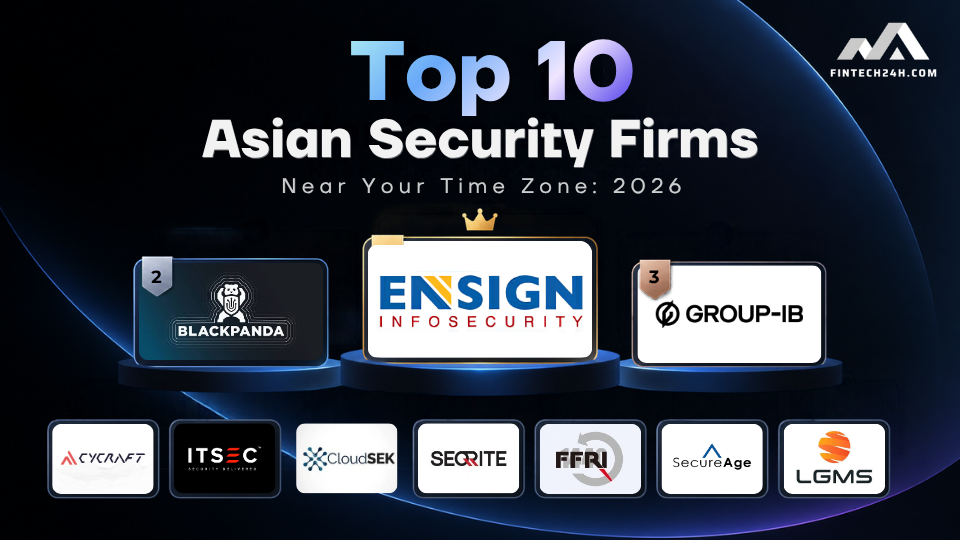
For businesses operating across Asia-Pacific, selecting the Top 10 Asian security firms near your time zone: 2026 provides a distinct operational advantage. Working with a provider in a nearby time zone simplifies communication, accelerates incident coordination, and ensures better familiarity with local regulatory and business environments. If you are looking for broader regional insights, our guide on Top 10 Asian companies building infrastructure for real-time payments offers a useful perspective on the digital landscape.
The Asia-Pacific cybersecurity market includes everything from managed security and threat intelligence to digital forensics, incident response, attack surface management, endpoint protection, and data security. This list highlights established regional specialists with meaningful cybersecurity capabilities and a clear presence in Asian markets.
For this comparison, the firms are considered based on regional presence, cybersecurity specialization, breadth of services, technical focus, and relevance to organizations operating in Asian markets. The ranking is editorial rather than a claim that one provider is universally better than another.
Top 10 Asian security firms near your time zone: 2026
1. Ensign InfoSecurity
Singapore-based Ensign InfoSecurity is one of the most prominent pure-play cybersecurity specialists in the region. The company focuses exclusively on cybersecurity rather than treating security as a secondary service within a broader IT portfolio.

Its capabilities cover security operations, threat detection, incident response, cyber threat intelligence, cloud security, identity management, cyber assurance, strategic advisory, and risk management. Ensign also positions itself around continuous monitoring and rapid response, making it relevant for organizations looking for an end-to-end security partner.
Best for: Enterprises seeking a broad cybersecurity services portfolio in Singapore and Southeast Asia.
Key strengths: Managed security, threat intelligence, incident response, cloud security, identity, cyber transformation, and strategic advisory.
Why it stands out: Ensign combines regional expertise with a large dedicated cybersecurity workforce, making it relevant to organizations that need ongoing security operations.
2. Blackpanda
Blackpanda takes a more specialized approach, focusing heavily on cyber incident response, digital forensics, and cyber resilience. Headquartered in Singapore, the company has expanded its local presence across several Asian markets, including Hong Kong, Japan, and the Philippines.
Its model is interesting for businesses that want support before, during, and after a cyber incident. Blackpanda combines incident response consulting with its IR-1 subscription model and cyber insurance offering, creating a broader cyber-emergency proposition.
The company’s published case studies cover incidents involving ransomware, compromised cloud environments, account takeover, unauthorized access, and other real-world attacks affecting organizations in Asia.
Best for: Companies prioritizing incident preparedness, digital forensics, and rapid cyber incident response.
Key strengths: Incident response, digital forensics, cyber emergency response, cyber resilience, and cyber insurance.
Why it stands out: Its strong regional focus makes Blackpanda an interesting choice when response speed and local availability matter.
3. Group-IB
Group-IB is a Singapore-based cybersecurity technology and services provider with a strong emphasis on threat intelligence and digital crime investigation. Its portfolio spans threat intelligence, digital forensics and incident response, managed XDR, attack surface management, digital risk protection, and fraud protection.

One notable development for the Asian market was the launch of Group-IB’s Cyber Fusion Center in Singapore. The facility brings together threat intelligence, monitoring, fraud prevention, digital risk protection, and investigation capabilities into a unified security operation.
For organizations facing threats that extend beyond their internal network, this intelligence-driven approach is useful. Security teams can investigate threat actors, exposed infrastructure, fraud campaigns, and external digital risks.
Best for: Organizations that need threat intelligence and broader visibility into external cyber threats.
Key strengths: Threat intelligence, digital forensics, managed XDR, attack surface management, fraud protection, and digital risk protection.
Why it stands out: Group-IB connects threat intelligence with operational security and digital crime investigation.
4. CyCraft Technology
Taiwan-based CyCraft Technology is an AI-focused cybersecurity company with a strong emphasis on threat exposure management, security automation, and AI security. The company is publicly listed in Taiwan and has developed cybersecurity technologies around threat detection, attack surface management, endpoint protection, and AI model security.
Its portfolio has expanded into security for generative AI and AI agents. Products such as XecGuard focus on AI guardrails, while XecART provides AI red teaming and testing capabilities. Its XCockpit platform integrates external and internal attack surface management with endpoint protection.
This makes CyCraft relevant as organizations move beyond traditional endpoint security and begin asking how AI systems themselves should be protected.
Best for: Technology-driven organizations exploring AI security risks and issues, threat exposure management, and proactive defense.
Key strengths: AI cybersecurity, attack surface management, endpoint protection, AI red teaming, and AI model security.
Why it stands out: CyCraft combines cybersecurity research with a growing focus on protecting AI systems and AI-enabled environments.
5. ITSEC Asia
ITSEC Asia is an Indonesian cybersecurity company with a broader APAC footprint. The company operates across Indonesia, Singapore, Australia, the United Arab Emirates, and Mauritius and reports more than 300 active clients and over 7,000 projects.
Its positioning is relevant for organizations looking for a regional cybersecurity services provider rather than a purely product-led vendor. ITSEC Asia provides services across areas such as penetration testing, security assessment, managed security, and broader cybersecurity consulting.
The company’s CREST accreditation and ISO certifications provide useful signals for organizations evaluating a security services provider, particularly when penetration testing and security assurance are required.
Best for: Southeast Asian companies looking for cybersecurity consulting and security services with regional coverage.
Key strengths: Security assessment, penetration testing, managed security, consulting, and compliance-oriented services.
Why it stands out: Its Indonesia-first foundation combined with a growing APAC footprint makes it relevant to Southeast Asian organizations.
6. CloudSEK
CloudSEK is an AI-native cybersecurity company with roots in India and headquarters in Singapore. Its focus is on predictive cyber intelligence and attack-path intelligence rather than conventional endpoint protection alone.
The platform brings together signals from external attack surfaces, deep and dark web sources, data leaks, supply chains, brand risks, AI attack surfaces, and threat intelligence. It connects these exposures into potential attack paths, helping security teams prioritize risks that may be exploitable.
This approach is relevant for businesses whose attack surfaces extend across cloud infrastructure, third-party vendors, leaked credentials, applications, and AI systems.
Best for: Security teams focused on external attack surface visibility, threat intelligence, and proactive risk detection.
Key strengths: Predictive cyber intelligence, attack surface monitoring, threat intelligence, digital risk protection, supply-chain monitoring, and AI security tools and platforms.
Why it stands out: CloudSEK sits at the intersection of threat intelligence, external exposure management, and AI-driven security analysis.
7. Seqrite
Seqrite is the enterprise cybersecurity arm of Quick Heal Technologies and is based in India. Its enterprise offering covers endpoints, networks, cloud, data, identity, managed detection and response, threat intelligence, digital risk protection, and ransomware recovery.

Its security research capabilities are an important part of the offering. Seqrite Labs operates a large malware analysis environment, while the company’s India Cyber Threat Report 2026 provides research into malware activity and emerging attack patterns across the Indian market.
For companies operating in India or serving Indian customers, Seqrite is a strong candidate when both enterprise security products and regional threat intelligence are important.
Best for: Indian enterprises seeking broad security coverage across endpoints, networks, cloud, and digital risk.
Key strengths: Endpoint security, XDR, MDR, threat intelligence, digital risk protection, data privacy, and ransomware recovery.
Why it stands out: Its combination of enterprise security products and India-focused threat research gives it strong regional relevance.
8. FFRI Security
FFRI Security is a Tokyo-based cybersecurity company focused on security research, endpoint protection, vulnerability assessment, and security technologies developed in Japan. Founded in 2007, the company also operates a national security R&D center and a subsidiary providing vulnerability assessments and penetration testing.
FFRI’s positioning is research-oriented. The company describes its approach as offensive-security-driven, studying attack techniques to develop defensive technologies. Its product portfolio includes endpoint protection designed to detect and defend against malware and vulnerability-based attacks.
Best for: Japanese organizations and enterprises looking for locally developed security technology and security research expertise.
Key strengths: Endpoint security, vulnerability assessment, penetration testing, security research, and cybersecurity R&D.
Why it stands out: FFRI offers a Japan-focused cybersecurity proposition with an emphasis on proprietary research and offensive-security techniques.
9. SecureAge Technology
Singapore-based SecureAge Technology focuses on data security, encryption, endpoint protection, and protecting sensitive information. Its proposition centers on protecting data itself rather than positioning primarily around security operations.

This makes SecureAge worth considering for organizations where data protection is a central concern, particularly businesses operating across regulated industries or environments where sensitive information needs to remain protected across endpoints and systems.
Its presence across Asian partner networks also gives the company regional relevance beyond Singapore.
Best for: Organizations prioritizing data protection, encryption, and endpoint-level security.
Key strengths: Data security, encryption, endpoint protection, and information protection.
Why it stands out: SecureAge takes a data-centric approach to cybersecurity rather than competing solely on security monitoring or threat detection.
10. LGMS
Malaysia-based LGMS is a regional cybersecurity specialist, particularly for organizations looking for security assessment and compliance capabilities. The company appears in regional cybersecurity and compliance directories alongside other established APAC security providers.

Its positioning is relevant to businesses that need practical security testing and assurance rather than a massive global security platform. This includes penetration testing, vulnerability assessment, compliance-related work, and security consulting.
Best for: Malaysian and Southeast Asian organizations looking for cybersecurity assessment and assurance services.
Key strengths: Penetration testing, security assessment, compliance, and cybersecurity consulting.
Why it stands out: LGMS provides a focused regional option for companies that want specialized security expertise without defaulting to a global consulting giant.
Why Time Zone Matters When Choosing a Cybersecurity Provider
Time zone proximity is an underrated factor in cybersecurity procurement. A security issue rarely waits for business hours, and communication becomes important during incident response, vulnerability disclosure, or active investigation.
For companies based in Southeast Asia, providers operating from Singapore, Malaysia, Indonesia, and nearby markets offer practical advantages in communication and regional coordination. Singapore-based firms such as Ensign InfoSecurity, Blackpanda, Group-IB, CloudSEK, and SecureAge Technology operate close to the GMT+7/GMT+8 business-day cycle, while firms such as ITSEC Asia provide a strong Southeast Asian footprint.
A nearby provider is not automatically better. A security team should still evaluate technical expertise, certifications, incident-response capabilities, data residency, regulatory knowledge, SLA commitments, escalation procedures, and the provider’s experience with organizations similar to yours.
What to Evaluate Before Hiring an Asian Security Firm
- Security specialization. Determine whether the provider is strongest in managed security, threat intelligence, incident response, penetration testing, data protection, or another specific discipline. A specialist may be a better fit than a generalist for a high-risk security requirement.
- Regional coverage. Check whether the provider can support the countries where your employees, customers, infrastructure, and data are located. Regional presence can matter when local regulations and response requirements differ.
- Incident-response capability. Ask what happens if an incident occurs outside normal business hours. Look for clearly defined escalation procedures, response times, forensic capabilities, and communication protocols.
- Compliance and certifications. Depending on your industry, certifications and regulatory experience may be important evaluation criteria. For example, ITSEC Asia highlights ISO 27001 and CREST accreditation, while other providers maintain different security and compliance credentials.
- Visibility beyond the endpoint. Modern attacks can involve cloud assets, exposed credentials, third-party suppliers, AI systems, brand impersonation, and external infrastructure. Providers such as CloudSEK and Group-IB demonstrate how cybersecurity is increasingly expanding beyond traditional endpoint monitoring.
Frequently Asked Questions
1. What are Asian security firms?
Asian security firms are cybersecurity companies headquartered in or strongly operating across Asian markets. They provide services ranging from managed security and threat intelligence to penetration testing, incident response, data protection, and security research.
2. Which Asian security firms are best for Southeast Asia?
There is no single best provider for every organization. Ensign InfoSecurity, Blackpanda, ITSEC Asia, Group-IB, CloudSEK, and SecureAge Technology are notable options with significant regional relevance or operations across Southeast Asia.
3. Are regional cybersecurity firms better than global cybersecurity companies?
Not necessarily. Regional firms can offer stronger local knowledge, closer time-zone alignment, and familiarity with Asian business and regulatory environments. Global providers may offer broader international infrastructure and resources. The right choice depends on the organization’s geography, security requirements, and risk profile.
4. What should companies ask a cybersecurity provider before signing a contract?
Companies should ask about incident-response SLAs, security monitoring coverage, certifications, data residency, escalation procedures, threat intelligence capabilities, penetration-testing methodology, reporting, customer references, and how the provider handles incidents outside normal working hours.
5. Why consider a cybersecurity company near your time zone?
A provider in a nearby time zone can make routine communication easier and reduce friction when security teams need to coordinate quickly. However, time-zone proximity should be considered alongside technical capabilities, service coverage, response SLAs, and regional expertise.