
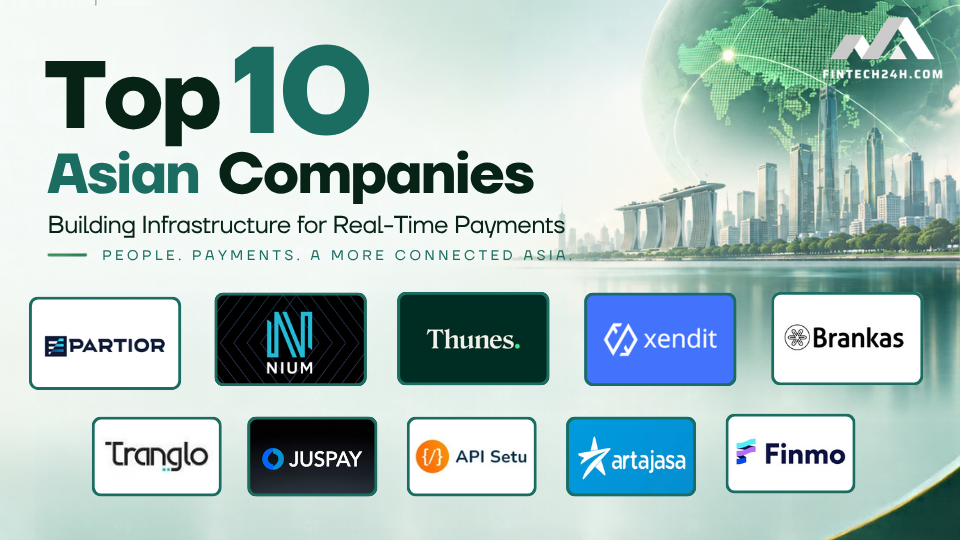
The top 10 Asian companies building infrastructure for real-time payments are transforming the digital economy by providing the APIs, switching systems, and settlement networks that enable instant money movement. From India’s UPI ecosystem to Southeast Asia’s instant bank-transfer networks, these firms provide the essential rails that allow businesses to bypass traditional, slower banking processes.
Unlike traditional payment providers that primarily focus on accepting card payments, these companies operate at different layers of the payment stack. Some connect businesses directly to local payment rails, while others provide infrastructure for banks, fintechs, marketplaces, and financial institutions.
This list looks at 10 Asian companies building real-time payments infrastructure, with a focus on established fintech and infrastructure players rather than household-name global giants such as Visa, Mastercard, Microsoft, or other massive multinational corporations.
Note: This is not a ranking from #1 to #10. The companies are organized to show different parts of the real-time payments infrastructure landscape across Asia.
Why Real-Time Payments Infrastructure Matters in Asia
Asia has become one of the most important markets for instant and account-to-account payments.
India’s UPI is one of the clearest examples. According to India’s Ministry of Finance, UPI processed more than 24,162 crore transactions during FY2025–26, with more than 700 banks connected to the network. The government also reported that UPI represented nearly 49% of global real-time payment volume.
Southeast Asia is developing similarly fragmented but increasingly connected payment ecosystems. Countries including Singapore, Indonesia, Malaysia, the Philippines, and Thailand have their own domestic instant-payment systems and increasingly support cross-border interoperability.
That creates an infrastructure challenge.
A company operating across several Asian markets may need to integrate with different banks, payment systems, regulatory frameworks, currencies, settlement processes, and APIs. This is where payment infrastructure companies become important.
Rather than building separate connections for every market, businesses can use infrastructure providers that connect them to multiple payment methods and financial networks through a more unified technology layer.
The following companies are examples of that infrastructure layer.
Top 10 Asian companies building infrastructure for real-time payments
1. Partior
Headquarters: Singapore
Focus: Clearing, settlement, cross-border payments, financial-market infrastructure

Partior operates at one of the deeper layers of the payment stack: clearing and settlement.
Founded in Singapore, the company is developing a blockchain-based network designed to improve how financial institutions move and settle value across borders. Its infrastructure is particularly relevant to banks and financial institutions dealing with multiple currencies, settlement banks, and correspondent banking relationships.
Partior’s approach is different from a typical payment gateway. Instead of simply providing merchants with a checkout interface, it focuses on the infrastructure underneath institutional money movement.
In September 2026, Partior announced a collaboration with LSEG Digital Settlement House to develop an always-on settlement-bank liquidity solution for its cross-border payments network. The initiative is intended to support 24/7 corporate and financial-institution payments across settlement banks and currencies.
What makes Partior relevant to real-time payments?
Its infrastructure targets some of the most complex parts of cross-border payments:
- Clearing between financial institutions
- Cross-border settlement
- Multi-currency transactions
- 24/7 payment availability
- Settlement-bank connectivity
- Institutional liquidity management
Partior is therefore particularly relevant to the financial infrastructure layer of real-time payments rather than consumer-facing payment acceptance.
2. Nium
Headquarters: Singapore and San Francisco
Focus: Cross-border payment infrastructure and real-time payouts
Nium has built its business around making cross-border money movement more accessible through APIs and payment infrastructure.
The company provides infrastructure for banks, fintech companies, marketplaces, SaaS platforms, and other businesses that need to send money across countries without building individual payment connections themselves.
Nium currently describes its network as supporting payments across more than 190 markets, with real-time payouts available in more than 100 markets. It also states that more than 80% of payments on its network settle in under 15 minutes.
One of Nium’s notable developments in Asia was joining Singapore’s FAST and PayNow networks. This gave Nium direct participation in Singapore’s domestic real-time payment ecosystem.
The company has also connected its infrastructure with Partior and enabled financial institutions to access its real-time payment network through existing SWIFT infrastructure.
Key infrastructure capabilities
Nium provides:
- Real-time cross-border payouts
- Payment APIs
- Multi-currency payment infrastructure
- Bank and wallet connectivity
- Local payment-rail access
- Compliance and transaction monitoring
- Infrastructure for financial institutions
For companies expanding across Asia, Nium represents the cross-border connectivity layer between businesses and local payment networks.
3. Thunes
Headquarters: Singapore
Focus: Global and Asian cross-border payment infrastructure

Thunes is another major infrastructure player headquartered in Asia, with a focus on connecting businesses to local payment systems around the world.
Its infrastructure connects banks, mobile wallets, payment service providers, and other financial endpoints through a direct network.
Thunes currently reports connectivity across 140 countries, 90 currencies, and more than 220 payment methods. Its network includes bank accounts, mobile wallets, cards, and stablecoin wallets.
The company’s relevance to real-time payments comes from its focus on direct connections and faster settlement rather than relying entirely on long chains of intermediary institutions.
In 2026, Thunes expanded its real-time payment capabilities into the United States, connecting its network to major U.S. payment rails through a local financial institution.
Why businesses use infrastructure like Thunes
A company paying users across Asia may otherwise need separate relationships with:
- Banks
- Mobile wallets
- Local payment providers
- Payment networks
- Foreign exchange providers
- Compliance partners
A payment infrastructure provider can consolidate much of this complexity into a single integration.
That makes Thunes particularly relevant to cross-border payout and payment orchestration.
4. Xendit
Headquarters: Indonesia
Focus: Southeast Asian payment infrastructure

Xendit is one of the better-known fintech infrastructure companies to emerge from Southeast Asia, particularly Indonesia.
Rather than focusing exclusively on one payment method, Xendit provides businesses with infrastructure for accepting payments, making payouts, managing platform payments, and handling multiple local payment methods.
Its current platform supports markets including Indonesia, the Philippines, Malaysia, Thailand, Vietnam, Singapore, and other Southeast Asian markets.
One of its infrastructure products is automated payouts, which allows businesses to make transfers to customers, employees, suppliers, and other recipients. Xendit also supports large-scale batch disbursements and multiple destination channels.
Where Xendit fits in the payment stack
Xendit’s infrastructure covers several layers:
Infrastructure layer: Xendit capability
Payment acceptance: Online payment methods and checkout
Money movement: Automated and batch payouts
Platform payments: Split and disbursement capabilities
Local payments: Market-specific payment methods
Developer infrastructure: APIs and integrations
Regional expansion: Multiple Southeast Asian markets
For businesses expanding across Southeast Asia, Xendit’s positioning is particularly relevant because payment infrastructure in the region is highly fragmented by market.
5. Brankas
Headquarters: Southeast Asia
Focus: Open finance, account-to-account payments, banking APIs

Brankas takes a different approach to payment infrastructure.
Instead of primarily operating as a conventional payment gateway, the company provides APIs that connect businesses with banks and financial institutions across Southeast Asia.
Its infrastructure supports payment initiation, account information, disbursements, and other open-finance use cases through a unified API layer.
Brankas is particularly relevant to real-time account-to-account payments. Its payment products allow businesses to integrate bank transfers directly into their workflows, including money-in and money-out use cases.
The company has also developed real-time disbursement capabilities in Indonesia. Its integration with Bank Central Asia, for example, enables businesses to perform bulk disbursements directly from corporate accounts, with funds transferred in real time.
Why Brankas stands out
The important part of Brankas’ model is the API abstraction layer.
Instead of asking a company to build individual integrations with different banks, Brankas provides infrastructure that can connect financial institutions and businesses through standardized APIs.
This makes the company relevant to:
- Open banking
- Account-to-account payments
- Instant bank transfers
- Disbursement infrastructure
- Embedded finance
- Financial data connectivity
6. Tranglo
Headquarters: Singapore / Malaysia
Focus: Cross-border payments and real-time payouts

Tranglo has been operating in the cross-border payments space since 2008 and has developed infrastructure connecting banks, mobile operators, and payment partners across multiple markets.
Its Tranglo Connect platform gives businesses and money-transfer companies access to payout networks through API connectivity.
The company currently reports more than 5,000 payout partners across over 100 countries and says it has processed US$33.60 billion worldwide as of July 2026.
Tranglo has also been actively developing real-time payment capabilities in Asia.
Its real-time payment service for Malaysia uses the country’s DuitNow infrastructure and enables eligible cross-border transfers to reach recipients within minutes. Tranglo previously reported that more than 80% of its cross-border payments were being processed in real time.
Tranglo’s infrastructure role
Tranglo is particularly useful for:
- Cross-border remittances
- Real-time payouts
- Bank connectivity
- Mobile-money connectivity
- Money-transfer operators
- Business payments
Its position between local payment infrastructure and international money movement makes it relevant to the growing demand for faster cross-border transactions in Asia.
7. Juspay
Headquarters: India
Focus: UPI infrastructure and payment orchestration
Juspay is one of the companies most closely associated with India’s UPI infrastructure ecosystem.
Rather than simply providing a consumer payment app, Juspay develops infrastructure that businesses, payment service providers, banks, and fintech companies can use to build and operate payment experiences.
Its platform includes payment orchestration, dynamic routing, UPI stacks, payment analytics, and infrastructure for UPI applications.
Juspay describes its platform as covering multiple layers of India’s UPI stack, including solutions for third-party application providers, prepaid payment instruments, merchants, and banks.
What Juspay brings to real-time payments
Its infrastructure includes:
- UPI payment stacks
- Dynamic payment routing
- UPI SDKs
- Payment orchestration
- Payment observability
- Acquiring infrastructure
- UPI checkout experiences
This makes Juspay an example of a company building software infrastructure on top of a national real-time payment rail.
As UPI continues to operate at extremely high transaction volumes, infrastructure for routing, reliability, monitoring, and user experience becomes increasingly important.
8. API Setu
Headquarters: India
Focus: UPI infrastructure and financial APIs

Setu is another Indian fintech infrastructure company working directly with India’s digital public infrastructure.
The company provides APIs covering payments, financial data, identity, and other financial services. Its UPI infrastructure is designed for businesses and payment aggregators that need to integrate UPI capabilities into their own products.
Setu’s UPI platform supports payment collection, payment links, QR payments, recurring mandates, and payment verification.
Its current UPI infrastructure offering also highlights direct NPCI collaboration, resilient infrastructure, payment routing, and support for high transaction throughput.
Why Setu matters
Setu demonstrates another important part of the real-time payments infrastructure market: developer infrastructure.
Instead of forcing every fintech or business to build its own UPI connectivity and payment workflows, infrastructure providers such as Setu expose these capabilities through APIs.
That allows businesses to build:
- UPI checkout
- Recurring payments
- Payment collection
- QR payment experiences
- Automated reconciliation
- Financial applications
on top of India’s real-time payment ecosystem.
9. Artajasa
Headquarters: Indonesia
Focus: Payment switching and banking infrastructure
Artajasa is one of the more established infrastructure companies on this list.
Founded in 2000, the Indonesian company provides payment infrastructure for banks and financial institutions. Its switching platform is a core part of its business, connecting electronic transactions across financial institutions.
Artajasa describes its switching service as its core platform and positions its infrastructure as supporting electronic transactions that can be accessed in real time.
This is an important distinction.
Companies such as Xendit and Brankas often operate closer to the application and API layer, while Artajasa operates closer to the underlying financial network and switching layer.
Artajasa’s role in Indonesia
Its infrastructure supports areas such as:
- Payment switching
- Bank connectivity
- Electronic transactions
- ATM and banking networks
- Real-time transaction processing
- Financial institution infrastructure
As Indonesia develops increasingly sophisticated digital payment ecosystems, switching infrastructure remains an essential component underneath consumer-facing applications.
10. Finmo
Headquarters: Singapore
Focus: Global payment infrastructure and treasury operations

Finmo is a Singapore-based financial infrastructure company focused on helping businesses manage payments, accounts, currencies, and treasury operations across markets.
Its platform supports local and international payments, virtual accounts, currency management, and real-time payment tracking.
Finmo currently states that its payment infrastructure supports real-time local and international payments across more than 180 countries and more than 80 currencies.
Its approach is particularly relevant to businesses that need more than a simple payment gateway.
For companies operating across multiple Asian markets, payment infrastructure increasingly needs to connect payment execution with:
- Cash visibility
- Currency management
- Settlement
- Reconciliation
- Virtual accounts
- Treasury workflows
Finmo sits at the intersection of these areas.
Its 2026 research with the Emerging Payments Association Asia also highlights a broader trend in the region: businesses increasingly need to understand and manage money movement in real time across multiple currencies, countries, and entities.
What Makes Real-Time Payments Infrastructure Different?
Real-time payment infrastructure is more complex than simply moving money quickly.
1. Connectivity
Payment infrastructure providers need connections to banks, payment networks, wallets, and other financial institutions.
The more fragmented a market is, the more valuable this connectivity becomes.
2. API infrastructure
Modern businesses increasingly expect payments to be integrated directly into their applications.
APIs allow companies to initiate payments, receive transaction status updates, process refunds, manage payouts, and automate reconciliation without relying entirely on manual banking processes.
3. Routing
A payment may have multiple possible routes.
Infrastructure providers can use payment orchestration and routing systems to determine which available payment service provider or network should process a transaction.
This is particularly important when transaction success rates, costs, availability, and processing times vary between providers.
4. Settlement
Real-time payment initiation does not automatically mean every part of settlement happens instantly.
Infrastructure companies therefore need systems that coordinate clearing, settlement, liquidity, reconciliation, and transaction records.
Partior’s work illustrates this deeper layer of the ecosystem, while companies such as Nium and Thunes operate closer to the cross-border transaction and payout layer.
The Future of Real-Time Payments in Asia
The next stage of payment infrastructure development in Asia is likely to involve greater interoperability between domestic payment systems.
The region already has several mature real-time payment ecosystems. India has UPI, Singapore has FAST and PayNow, Indonesia has its own instant-payment infrastructure, while Malaysia operates DuitNow and other markets continue developing their domestic systems.
The challenge is increasingly shifting from making domestic payments instant to making instant payments work across borders.
This creates opportunities for infrastructure companies that can connect different payment systems without requiring businesses to integrate separately with every market.
Cross-border interoperability is already becoming a major focus for companies such as Nium, Thunes, Tranglo, and Partior. Their approaches differ, but all address some version of the same underlying problem: connecting fragmented financial infrastructure.
For businesses operating across Asia, the payment stack may increasingly look less like a collection of isolated national systems and more like a connected network of local rails, APIs, settlement systems, and financial institutions.
Frequently Asked Questions
1. What are real-time payments?
Real-time payments are electronic payments that can be processed and made available to the recipient within seconds or minutes, often operating 24/7 rather than only during traditional banking hours.
The exact processing and settlement model varies by payment network and country.2. What is real-time payments infrastructure?
Real-time payments infrastructure is the technology layer that enables instant or near-instant money movement. It can include payment APIs, bank connectivity, payment switching, routing, clearing, settlement, compliance, reconciliation, and transaction monitoring.3. Which Asian countries have real-time payment systems?
Several Asian markets operate real-time or instant payment systems, including India, Singapore, Indonesia, Malaysia, Thailand, and the Philippines. The systems differ in architecture, participants, regulatory frameworks, and interoperability.4. Why is UPI important to real-time payments in Asia?
UPI has become one of the world’s largest real-time payment ecosystems by transaction volume. India’s Ministry of Finance reported more than 24,162 crore UPI transactions in FY2025–26 and more than 700 participating banks.
5. Are real-time payments the same as cross-border payments?
No. A payment can be real-time domestically without being real-time across borders.
Cross-border transactions usually involve additional challenges such as foreign exchange, regulatory requirements, correspondent banking, liquidity, and different payment networks.