
Defining reliability and effectiveness benchmarks for synthetic data
In financial modeling, synthetic data is reliable when its statistical properties mirror the underlying distribution of historical datasets without introducing bias or artifacts. Effectiveness is measured by the model’s performance on unseen, real-world data after training on these artificial samples.
For a financial institution, reliability means the synthetic output maintains the same correlation structures and volatility clusters found in actual market data. Effectiveness is validated through backtesting and stress-testing results that align with historical benchmarks.
Statistical fidelity versus predictive accuracy
Statistical fidelity focuses on the mathematical closeness between synthetic and real datasets. Practitioners often use metrics like the Jensen-Shannon divergence or Kolmogorov-Smirnov tests to ensure that the synthetic data vs real data comparison preserves the original data’s mean, variance, and tail distributions. High fidelity ensures that the model learns the correct underlying patterns, such as the relationship between interest rate fluctuations and credit default rates.
Predictive accuracy, however, evaluates whether the model trained on synthetic data performs effectively in production. A dataset can have high statistical fidelity but fail to improve predictive accuracy if it lacks the edge cases or rare events—such as flash crashes or liquidity crunches—that are essential for robust financial forecasting.
If the synthetic generation process over-smooths the data, the resulting model may perform well on standard market conditions but fail during periods of high volatility. Achieving both requires a rigorous validation loop where synthetic data is tested against a hold-out set of real-world data to ensure the model generalizes correctly. Relying solely on statistical similarity metrics without verifying the downstream predictive performance creates a dangerous blind spot in risk management systems.
Core criteria for assessing if is synthetic data reliable and effective?
Evaluating synthetic datasets requires a rigorous framework beyond simple statistical parity. Financial institutions must validate that generated records maintain the underlying correlations of real-world data while ensuring they do not introduce bias or synthetic data and data privacy (GDPR compliance) security vulnerabilities.
Reliability hinges on the fidelity of the generative model—typically GANs (Generative Adversarial Networks) or Variational Autoencoders—in replicating the multivariate distributions of complex financial transactions.
Privacy preservation and leakage prevention
The primary concern with synthetic data is the risk of membership inference attacks, where an adversary reconstructs individual records from the synthetic output. To ensure reliability, developers must implement Differential Privacy (DP) during the training phase.
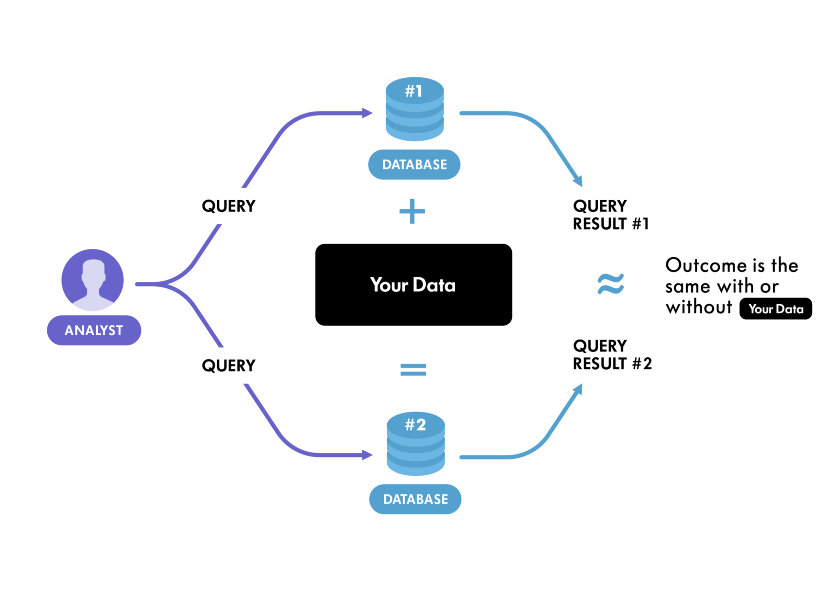
By injecting mathematical noise into the gradient updates, DP provides a formal guarantee that the presence or absence of a single individual in the training set does not significantly alter the synthetic output. Effectiveness is measured by calculating the distance between the synthetic distribution and the original data, ensuring that the ‘privacy budget’ (epsilon) is low enough to prevent data leakage while high enough to maintain utility for downstream model training.
Diversity and edge case coverage
Financial models, particularly those designed for anti-money laundering (AML) or credit risk assessment, often fail because they lack exposure to rare events. Synthetic data is highly effective here because it can oversample minority classes—such as sophisticated fraud patterns—that are underrepresented in historical databases.
A reliable synthetic generator must demonstrate the ability to synthesize these ‘long-tail’ events without overfitting. Practitioners should use coverage metrics like the Jensen-Shannon divergence to compare the synthetic distribution against real-world edge cases.
If the synthetic generator fails to capture the volatility or the specific sequence of events found in high-risk transactions, the resulting model will lack the robustness required for real-time production environments. Testing should involve ‘stress-testing’ the synthetic data against known historical anomalies to confirm that the model learns the underlying logic of the fraud rather than just memorizing static patterns.
Step-by-step validation workflow
To determine if synthetic data is reliable and effective, financial institutions must implement a rigorous validation framework that moves beyond simple statistical similarity. The goal is to ensure that the synthetic distribution preserves the complex correlations and tail-risk behaviors inherent in real-world financial markets.
Baseline performance comparison: Running parallel tests on real versus synthetic datasets to measure model drift
The most effective way to validate synthetic data is through a ‘hold-out’ performance test. First, train two identical machine learning models: one using a high-quality historical dataset and another using a synthetic dataset generated from the same source. Evaluate both models against a common, unseen ‘gold standard’ test set consisting of real-world data.
If the model trained on synthetic data shows significant performance degradation—measured by metrics like Mean Absolute Error (MAE) or F1-score—you have identified model drift. A reliable synthetic dataset should maintain performance within a 2-5% margin of the real-data model. If the gap exceeds this threshold, the synthetic generator likely failed to capture the non-linear relationships or volatility clusters present in the original data.
Adversarial robustness testing: Stress-testing models trained on synthetic data against real-world adversarial inputs
Synthetic data often risks being ‘too perfect’ or overly smoothed, which can lead to models that fail under extreme market conditions. Adversarial robustness testing involves injecting noise, outliers, and black-swan event patterns into your input variables to see how the model reacts.
Use tools like CleverHans or ART (Adversarial Robustness Toolbox) to subject your synthetic-trained model to adversarial perturbations. If the model exhibits erratic behavior or extreme confidence in incorrect predictions when faced with synthetic ‘stress’ scenarios, it indicates that the synthetic data lacks the necessary edge-case diversity.
A robust synthetic dataset must include sufficient ‘long-tail’ events—such as flash crashes or liquidity dry-ups—to ensure the model learns to handle market anomalies rather than just fitting to historical averages. By comparing the failure modes of both models, you can pinpoint exactly which features the synthetic generator is struggling to replicate, allowing for iterative refinement of the generative model’s parameters.
Managing trade-offs in synthetic data generation
While synthetic data offers a path to privacy-compliant model training, it introduces a critical tension between data fidelity and privacy preservation. Financial institutions often face a “privacy-utility trade-off” where aggressive noise injection or differential privacy mechanisms can strip away the subtle, non-linear patterns essential for detecting complex fraud or predicting market volatility.
To ensure synthetic data is reliable and effective, data scientists must calibrate the epsilon parameter in differential privacy models carefully. High privacy guarantees often lead to a loss of statistical correlation, rendering the synthetic output useless for training robust predictive models.
Mitigating bias amplification
Synthetic data generators are prone to learning and magnifying the statistical imbalances present in historical financial datasets. If a training set contains underrepresented demographics in credit scoring, a generative adversarial network (GAN) may exacerbate this by assigning higher weights to majority patterns, leading to discriminatory model outcomes.
To prevent this, practitioners should implement the following strategies:
- Re-balancing input distributions: Before training the generator, apply SMOTE (Synthetic Minority Over-sampling Technique) or similar resampling methods to ensure the generator views a balanced representation of minority classes.
- Adversarial debiasing: Integrate a secondary discriminator during the training phase specifically tasked with identifying protected attributes (such as gender or ethnicity) in the generated output. If the discriminator can predict these attributes, the generator receives a penalty.
- Fairness-aware loss functions: Modify the loss function of the generator to include a fairness constraint. This forces the model to minimize the statistical distance between the synthetic distribution and the target distribution while simultaneously maximizing demographic parity.
Validation remains the final safeguard against these trade-offs. Relying solely on visual inspection of distributions is insufficient. Financial teams must conduct “downstream task performance” testing, where models trained on synthetic data are benchmarked against models trained on real data using hold-out sets. If the performance gap exceeds a pre-defined threshold—typically 2-5% in high-stakes banking applications—the synthetic dataset must be recalibrated or augmented with real-world edge cases to ensure reliability.
Operationalizing synthetic data for production
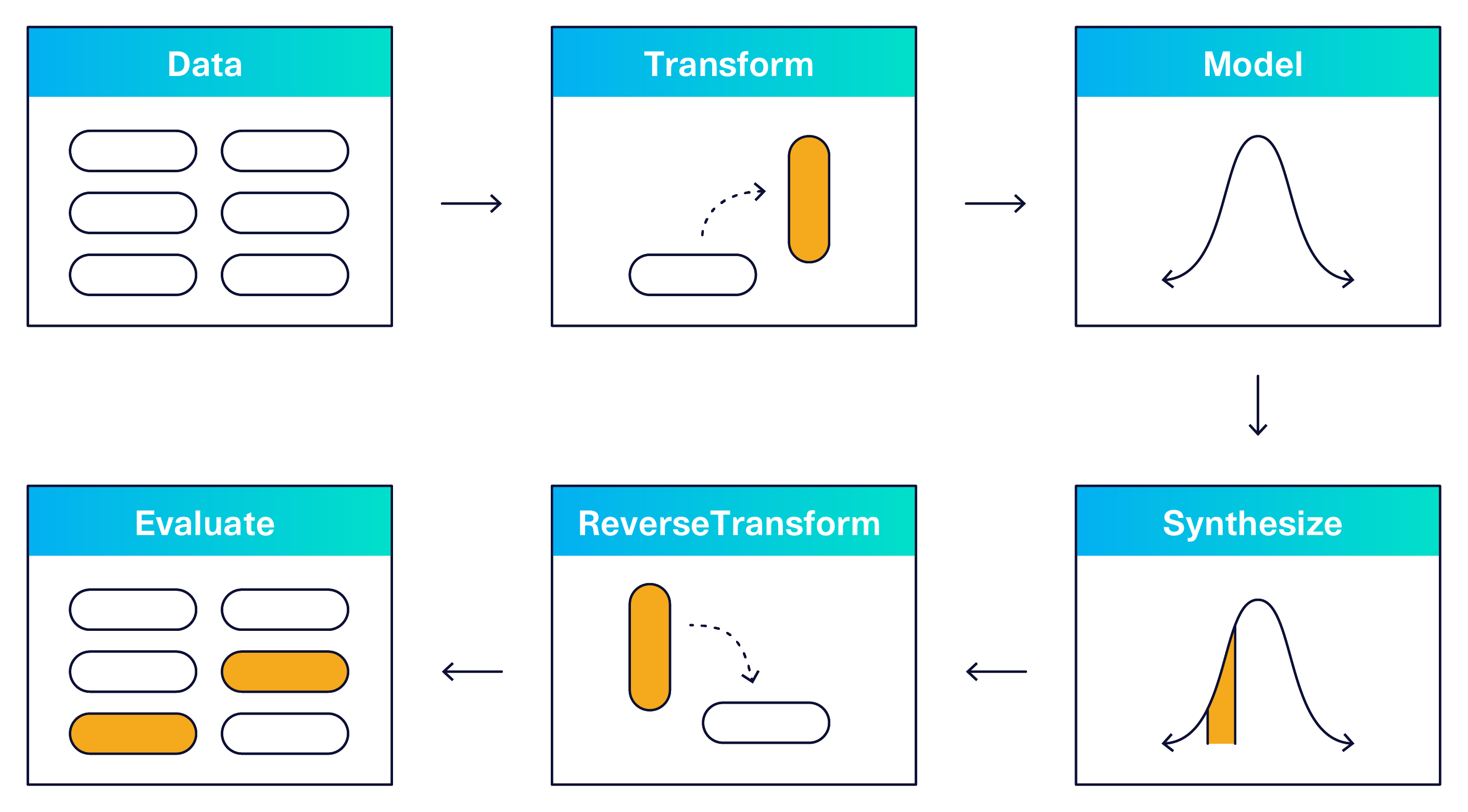
Integrating synthetic datasets into a live financial pipeline requires moving beyond static batch generation. To ensure high-fidelity outputs, firms must implement automated validation checks that compare the statistical distribution of synthetic samples against historical ground truth data.
Tools such as SDV (Synthetic Data Vault) or Gretel.ai allow teams to define specific constraints, such as maintaining non-negative account balances or preserving the correlation between interest rate fluctuations and loan default probabilities. If the synthetic output drifts beyond a predefined Kullback-Leibler divergence threshold, the system should automatically trigger a re-training of the generative model.
Continuous monitoring and retraining cycles
Market volatility often renders static datasets obsolete within weeks. Establishing feedback loops is essential to ensure that synthetic generators adapt to shifting macroeconomic indicators. Financial institutions should adopt a champion-challenger framework where the current production model is tested against a new version trained on the most recent month of synthetic data.
By monitoring the performance delta in real-time, developers can identify if the synthetic generator is failing to capture emerging market patterns or tail-risk events. This iterative process relies on three core components:
- Drift Detection: Automated alerts that notify data scientists when the statistical properties of the synthetic data deviate from the latest production data.
- Adversarial Validation: Using a classifier to attempt to distinguish between real and synthetic records; if the classifier achieves high accuracy, the synthetic data is likely leaking identifiable information or failing to capture true underlying complexity.
- Versioned Data Pipelines: Maintaining a strict lineage of synthetic datasets to allow for rapid rollbacks if a model trained on new synthetic data exhibits unexpected bias or performance degradation in production environments.
Ultimately, determining if synthetic data is reliable and effective depends on the rigor of these operational guardrails. When treated as a living component of the data stack rather than a one-time fix, synthetic data provides a scalable pathway to training robust models without compromising sensitive client information or regulatory compliance.
Frequently Asked Questions
Reliability of synthetic data for training fraud detection models
Yes, synthetic data is highly effective for fraud detection because it allows for the generation of rare, high-impact edge cases that are often missing from historical datasets. However, reliability depends on the model’s ability to maintain the statistical distribution of the original data without introducing bias. For those looking to optimize their synthetic data generation guide strategies, similar validation principles apply.
Primary risks of using synthetic data in finance
The main risks include model collapse, where the synthetic data lacks the complexity of real-world scenarios, and the potential for ‘privacy leakage’ if the generative model overfits to specific individual records in the training set. Reviewing top synthetic data companies and providers is essential for building the custom validation tools needed to mitigate these risks.