

Identifying model collapse in your synthetic data generation guide
Model collapse occurs when generative models, such as GANs or VAEs, produce outputs lacking the statistical variance of the original dataset. This creates a feedback loop of degraded information. You can identify this by monitoring the entropy of your generated feature distributions; a sudden drop indicates that the model has converged on a narrow subset of the training space.
Statistical divergence metrics
To quantify distribution shifts, apply the Jensen-Shannon (JS) divergence to compare the probability distributions of your synthetic output against the ground truth. A JS divergence value approaching zero suggests high fidelity, while values exceeding 0.1 in financial datasets often signal significant loss of diversity. Additionally, the Kolmogorov-Smirnov (KS) test serves as a non-parametric method to determine if two samples are drawn from the same distribution, with a low p-value serving as a direct trigger for model retraining.
Feature correlation degradation
Synthetic variables often lose relational integrity when the model fails to capture the covariance structure of the source data. Calculate the Pearson correlation matrix for both your real and synthetic datasets and compute the Frobenius norm of the difference between these matrices. If this norm increases over successive training epochs, your model is likely suffering from feature decoupling, where individual variables are generated independently rather than as a cohesive vector.
Root causes of poor synthetic data fidelity
Generative models frequently struggle to replicate long-tail events, such as market flash crashes or rare fraud patterns, because these events occupy a tiny fraction of the training data volume. This scarcity causes the model to treat these critical events as outliers or noise, leading to their exclusion from the synthetic output.
Overfitting to noise
Distinguishing between genuine patterns and noise-induced artifacts requires a rigorous analysis of the latent space. If your generator produces outputs that mirror the specific noise profile of the training set rather than the underlying signal, you are likely overfitting. Use a hold-out validation set to check if the synthetic data maintains its statistical properties on unseen data; if it fails, reduce the capacity of your discriminator or increase the regularization strength.
Insufficient training data volume
Mode collapse is often a symptom of an insufficient sample size relative to the complexity of the data manifold. For high-dimensional financial datasets, a minimum threshold of 10,000 to 50,000 records is typically required to prevent the model from collapsing into a single mode. If your source dataset is smaller, consider using data augmentation or transfer learning techniques to stabilize the generation process.
Validation frameworks for synthetic data integrity
Implementing a robust validation protocol is essential to ensure that your guide to synthetic data generation best practices remains fit for downstream machine learning tasks. Without these checks, you risk training production models on biased or incomplete information.
Train-on-synthetic, test-on-real (TSTR) evaluation
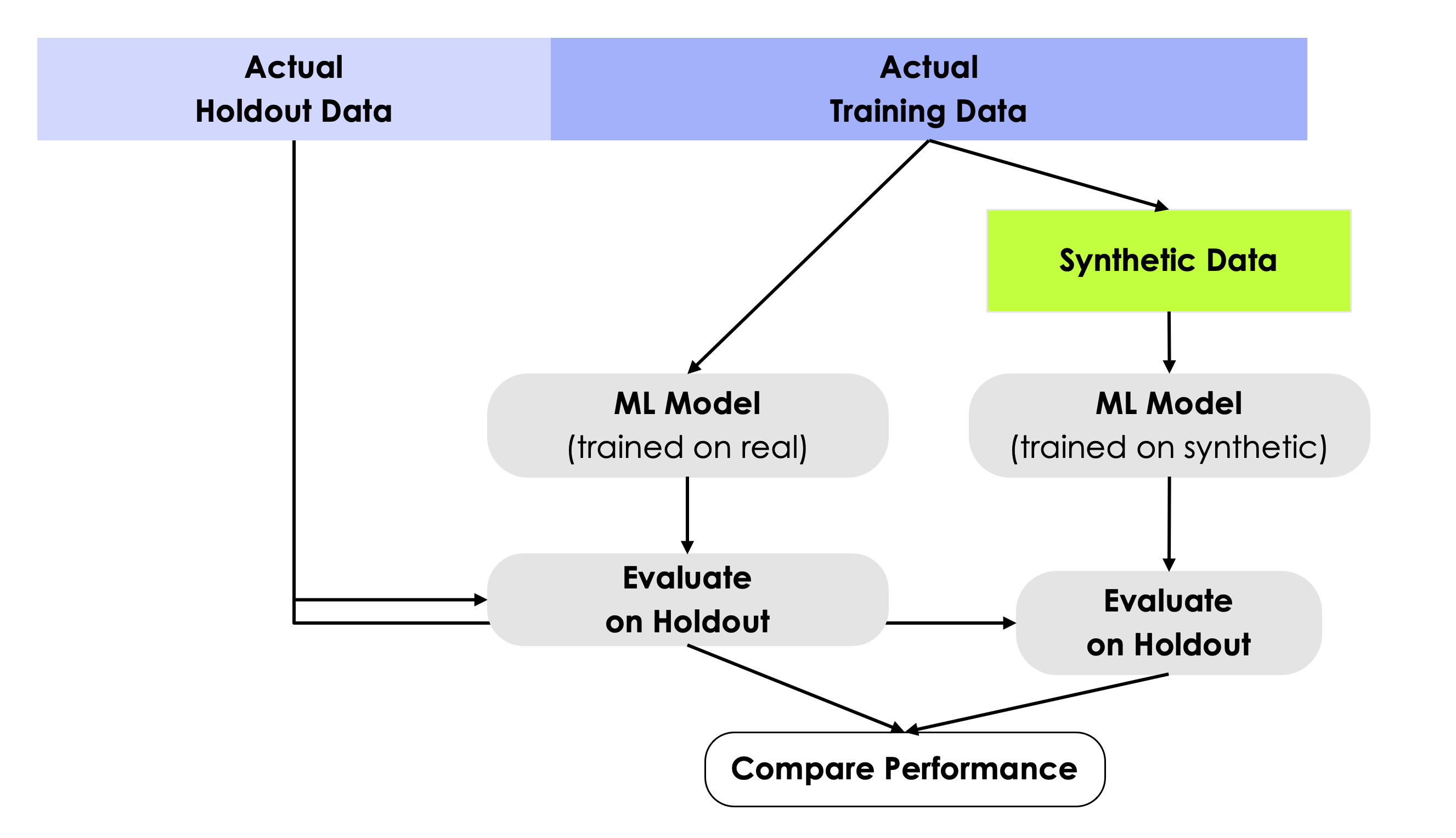
The TSTR method is the gold standard for measuring predictive utility. By training a downstream model (such as a Random Forest or XGBoost classifier) on your synthetic dataset and evaluating its performance on a real-world hold-out set, you can directly quantify the information loss. A performance gap of more than 5-10% compared to a model trained on real data indicates that the generation process has failed to preserve essential predictive features.
Privacy leakage assessment
Membership inference attacks allow you to verify whether the generative model has memorized specific training records. By training a shadow model to predict whether a specific record was part of the training set, you can estimate the risk of privacy leakage. If the attack accuracy is significantly higher than random chance, your synthetic data generation process is likely overfitting to sensitive training data.
Corrective strategies for model recalibration
When synthetic data quality falls below production requirements, you must adjust your architecture to force the model to prioritize critical data structures. This often involves modifying the loss function or the training loop architecture.
Adjusting loss functions for imbalanced classes
To ensure the generator captures rare but critical financial events, implement a weighted loss function that penalizes the model more heavily for failing to reproduce minority classes. By assigning higher weights to these rare samples in the discriminator’s loss calculation, you force the generator to allocate more capacity to learning these specific patterns.
Iterative feedback loops
Integrating discriminator feedback into the generation pipeline allows for real-time refinement of output quality. Use an adaptive learning rate strategy that slows down when the discriminator’s accuracy reaches a plateau, preventing the generator from over-optimizing against a static discriminator. This iterative approach ensures that the generator continuously improves its ability to mimic the source distribution without falling into the trap of mode collapse.
Frequently Asked Questions
How are synthetic data generation mechanisms structured?
Synthetic data is generated using machine learning models like GANs or VAEs that learn the statistical patterns of a real dataset to create new, artificial records that maintain the original data’s utility. If you are struggling with code efficiency, consider reviewing python programming for data science to optimize your training scripts.
What is the definition of synthetic data in AI?
Synthetic data is information that is artificially manufactured rather than generated by real-world events, designed to mimic the statistical properties of real data for training AI models.
What is the operational workflow of synthetic data?
It works by training a model on real data to understand its underlying distribution, then using that model to sample new data points that share the same characteristics as the original set.
Why is synthetic data important in finance?
It allows organizations to train models on large datasets without exposing sensitive personal information, helping to overcome data scarcity and privacy regulations. Many firms also leverage synthetic data and data privacy to accelerate these deployments.
What are the reliability standards for synthetic datasets?
It is reliable if validated through rigorous testing like TSTR and statistical divergence checks, though quality depends heavily on the source data and model architecture.
Can synthetic data protect privacy?
Yes, it can protect privacy by creating data that retains the statistical utility of the original set without containing any actual PII from the source records.