
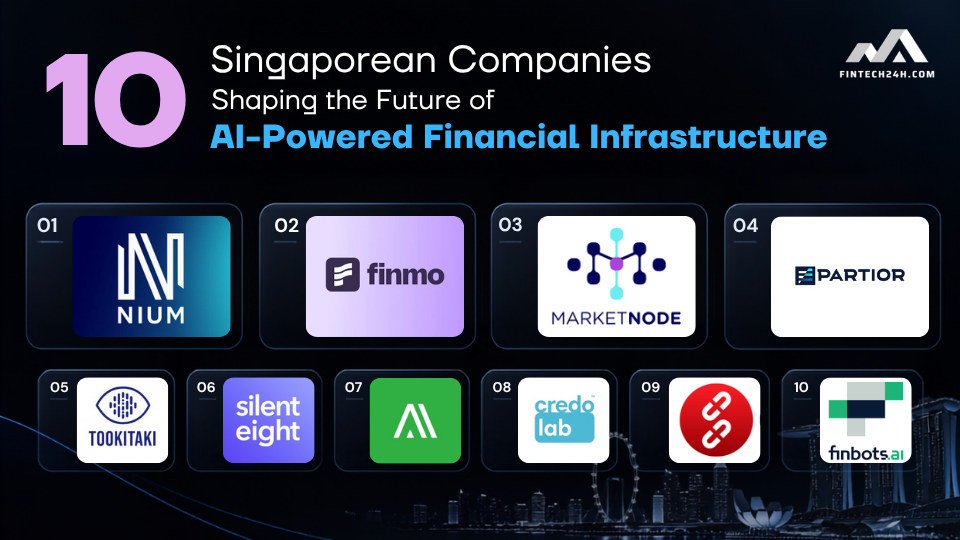
The Top 10 Singaporean companies shaping the future of AI-powered financial infrastructure are redefining how institutions handle payments, treasury, credit decisioning, and compliance. By applying artificial intelligence to the core layers of the financial stack, these firms are moving beyond simple customer-facing tools to build the robust, data-driven rails that power modern finance. This list highlights specialized technology providers that enable faster, more connected, and highly regulated financial workflows.
Singapore’s fintech market is particularly relevant to this shift. Recent industry analysis points to artificial intelligence, real-time payment networks, tokenized assets, and institutional-grade infrastructure as major themes in the country’s fintech ecosystem. For those interested in the broader digital landscape, exploring top data infrastructure companies reveals how these foundational technologies are evolving globally.
Note: This is not a ranking. The companies below were selected based on their relevance to AI, financial infrastructure, payments, risk, compliance, treasury, credit, or financial-market operations, while avoiding mega-corporations such as Visa, Microsoft, or other global technology giants.
Top 10 Singaporean companies shaping the future of AI-powered financial infrastructure
1. Nium — AI-Optimized Cross-Border Payments
Nium is one of the more established Singapore-origin companies building infrastructure for international money movement. Rather than operating primarily as a consumer-facing fintech, Nium provides APIs and payment infrastructure that financial institutions, fintechs, and businesses can integrate into their own products.

Its infrastructure supports cross-border payouts, multi-currency accounts, card issuance, account verification, and stablecoin capabilities.
What makes Nium particularly relevant to AI-powered financial infrastructure is the intelligence layer being added to payment execution. Its Chronometer technology uses real-time AI analysis to optimize payment routes and predict delivery times, helping businesses select more efficient payment paths and identify potential delays.
Nium is also moving toward a more interconnected payment architecture. Its partnership with Partior, for example, connects Nium’s payment infrastructure to blockchain-based clearing and settlement, allowing financial institutions to access real-time payouts and settlement across more than 100 markets.
Why it matters: Nium illustrates how AI can be embedded directly into the operational layer of global payments rather than being treated as a separate customer-facing feature.
2. Finmo — Bringing AI Into Treasury Infrastructure
Finmo represents another important direction in AI-powered financial infrastructure: combining payments, cash management, and financial intelligence into one operating layer.

The Singapore-founded fintech describes its platform as a Treasury Operating System designed to connect payments, cash visibility, liquidity management, and treasury operations. In September 2026, Finmo announced that businesses were moving more than US$1 billion through its platform each month and that it was expanding investment in AI and treasury intelligence from its new Singapore headquarters.
Its AI strategy goes beyond simply summarizing financial information. Finmo’s MO AI assistant is designed to work with financial data and support tasks such as identifying risks, anticipating liquidity requirements, evaluating options, and eventually helping orchestrate financial actions.
The company has also built infrastructure connecting thousands of banks and accounting systems, giving finance teams a consolidated view across entities, currencies, and accounts.
This is significant because treasury has traditionally depended on fragmented banking portals, spreadsheets, ERP systems, and manual reconciliation.
Why it matters: Finmo is positioning AI as an intelligence layer on top of payment and treasury infrastructure, turning financial data into operational decisions rather than static reporting.
3. Marketnode — AI Workflows for Digital Capital Markets
Marketnode sits closer to the capital-markets side of AI-powered financial infrastructure. The Singapore company describes itself as an Asia-Pacific digital market infrastructure operator, providing technology for financial institutions to create faster workflows and new routes to market. It is licensed by the Monetary Authority of Singapore and backed by institutions including Euroclear, HSBC, SGX Group, and Temasek.

Its infrastructure spans several areas of institutional finance. Gateway focuses on tokenized real-world assets, while Fundnode provides a shared network for fund-market participants, including distributors, asset managers, transfer agents, and banks.
The AI component comes through Smartflow, which combines AI-powered extraction, document comprehension, validation, and workflow automation. The system converts complex documents and financial information into structured, system-ready data while retaining audit trails and human review controls.
Marketnode’s partnership with Finastra further demonstrates this approach. The companies have worked on AI-powered credit agreement onboarding, using document extraction and automation to reduce manual data entry in corporate lending workflows.
Why it matters: Marketnode shows how AI can modernize the less visible operational infrastructure behind lending, funds, securities, and institutional markets.
4. Partior — Rebuilding the Settlement Layer
Partior is slightly different from the AI-native companies on this list. Its core technology is blockchain and distributed-ledger infrastructure rather than artificial intelligence. However, it is highly relevant to the broader evolution of AI-powered financial infrastructure because intelligent financial applications ultimately depend on reliable, programmable payment and settlement rails.

Partior emerged from Project Ubin, an industry initiative led by the Monetary Authority of Singapore, and was incorporated in 2021 by founding shareholders DBS, J.P. Morgan, Standard Chartered, and Temasek.
The company operates a permissioned ledger designed for 24/7 clearing and settlement. Its infrastructure supports cross-border payments, multi-currency settlement, and foreign-exchange Payment-versus-Payment transactions.
The significance is architectural. Traditional international settlement often involves multiple intermediaries, reconciliation processes, funding requirements, and operating cutoffs. Partior’s model aims to reduce those frictions through atomic settlement and a unified ledger.
As financial AI moves toward automated treasury, agentic payments, and machine-driven financial workflows, settlement infrastructure becomes increasingly important. For those tracking the industry, checking out top blockchain companies provides insight into how these settlement rails are being adopted globally.
Why it matters: AI can make financial decisions faster, but those decisions still need reliable rails through which value can actually move.
5. Tookitaki — AI-Native Financial Crime Prevention
Tookitaki is one of the clearest examples of AI-powered financial infrastructure emerging from Singapore’s RegTech ecosystem.
The company develops technology for banks, payment providers, digital banks, wallets, and other financial institutions to detect and prevent financial crime. Its FinCense platform combines transaction monitoring, screening, customer risk assessment, alert prioritization, and case management.
AI is integrated throughout the platform rather than being positioned as an isolated feature. Tookitaki describes its architecture as combining specialized AI models, explainable decisioning, collaborative intelligence, and governed automation.
Its transaction-monitoring technology uses AI-driven scenario detection, behavioral analysis, federated learning, and alert prioritization to identify suspicious patterns while reducing unnecessary alerts.
Another interesting component is the company’s AFC Ecosystem, which allows financial institutions to access a continuously updated repository of financial-crime typologies and intelligence.
This network-based approach is important because financial crime rarely occurs within one institution or one transaction.
Why it matters: Tookitaki demonstrates how AI can become part of the underlying trust infrastructure that allows digital financial systems to operate safely at scale.
6. Silent Eight — Agentic AI for Financial Crime Compliance
Silent Eight focuses on a particularly difficult part of financial infrastructure: sanctions screening, customer screening, transaction screening, and financial-crime investigations.

The company is headquartered in Singapore and has expanded internationally, working with large financial institutions across multiple markets.
Its current Iris platform uses agentic AI to investigate and resolve compliance alerts. Rather than simply generating another risk score, the system is designed to investigate alerts, apply institutional policies, and produce documented decisions.
This distinction is important for regulated financial services. AI systems used in banking cannot simply optimize for speed; institutions also need traceability, governance, explainability, and human accountability.
Silent Eight’s technology addresses this by combining AI with policy-bound decisioning and auditability. Its payment screening solution, for example, can screen payment alerts and use AI agents to investigate and resolve cases while maintaining documented reasoning.
The company’s evolution also shows how Singapore-based financial AI is moving from conventional machine learning toward agentic systems capable of handling multi-step workflows.
Why it matters: Silent Eight represents the shift from AI-assisted compliance toward AI executing tightly governed financial decisions.
7. ADVANCE.AI — AI-Powered Identity and Risk Infrastructure
ADVANCE.AI operates at the identity, compliance, fraud prevention, and credit-risk layer of financial infrastructure.

The Singapore-headquartered company provides digital identity verification, KYC/KYB, compliance, risk management, and credit information services to businesses across banking, financial services, fintech, payments, and other sectors.
Its infrastructure combines artificial intelligence, big-data analytics, identity verification, and fraud detection. According to Singapore’s IMDA, the company works with more than 800 enterprise clients across sectors including banking, financial services, fintech, and payments.
This infrastructure is increasingly important as financial services become digital-first. A bank or fintech needs to answer several questions before allowing a user to access a financial product:
- Is this person real?
- Does the identity document appear authentic?
- Does the applicant match the identity being presented?
- Is the customer or business associated with suspicious activity?
- Does the application present unusual fraud or credit risk?
Automating these processes can shorten onboarding while strengthening controls.
Why it matters: ADVANCE.AI shows how AI-powered identity and risk systems are becoming foundational components of digital banking, lending, payments, and embedded finance.
8. Credolab — Turning Behavioural Data Into Credit Intelligence
Credolab approaches financial infrastructure from the data and credit-decisioning side.

The Singapore-headquartered company develops behavioural analytics and alternative credit intelligence using device and behavioural metadata. Rather than operating as a traditional credit bureau, Credolab provides scoring models and intelligence that can be integrated into lending and financial decision-making workflows.
Its technology can help lenders evaluate behavioural signals alongside traditional financial information. The company’s platform is designed to support applications including credit risk assessment, fraud detection, and alternative credit intelligence.
Credolab’s recent partnership with FICO is particularly relevant. In August 2026, Credolab joined the FICO Marketplace, allowing FICO Platform clients to access its behavioural risk scoring and alternative credit intelligence capabilities.
This represents an important direction for AI-powered financial infrastructure: financial institutions increasingly need more granular intelligence than conventional credit data can provide.
At the same time, the company’s model emphasizes explainability rather than treating AI as a black box. Credolab describes its models as auditable and explainable, with behavioural intelligence serving as the core analytical layer.
Why it matters: Credolab provides the data intelligence that can sit underneath lending, fraud prevention, and automated financial decisioning.
9. Cynopsis Solutions — Building an AI-Enabled Compliance Stack
Cynopsis Solutions is a Singapore-headquartered RegTech company focused on KYC, KYB, AML, CFT, onboarding, and transaction monitoring.
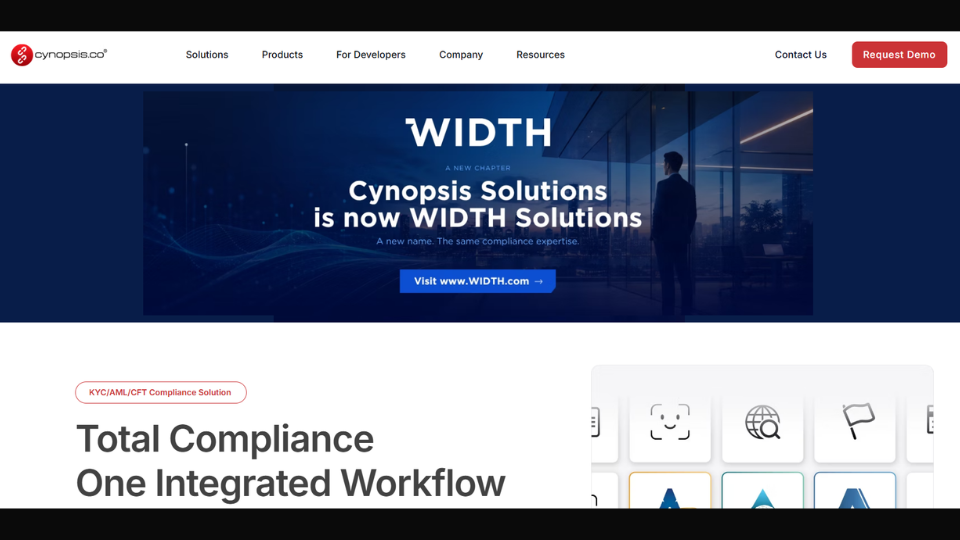
Its platform is structured around three main products: Ares for digital onboarding, Artemis for KYC and customer due diligence, and Athena for transaction monitoring. Together, they cover major stages of the financial-crime compliance lifecycle.
The company’s approach is particularly relevant to AI-powered financial infrastructure because it focuses on connecting compliance processes rather than treating each requirement as a separate tool.
Cynopsis describes its technology as providing AI-driven compliance and workflow automation, helping reduce manual reviews while allowing institutions to manage customer risk continuously.
Its recent integration with teamWork CSS is an example of this infrastructure approach. The partnership embeds KYB and AML controls directly into corporate-secretarial workflows, with compliance outcomes synchronized automatically between systems.
The company’s repeated inclusion in the RegTech100 also reflects its position within the broader regulatory technology market.
Why it matters: Cynopsis is helping turn compliance from a collection of manual checkpoints into a connected, technology-driven infrastructure layer.
10. finbots.ai — Explainable AI for Credit Decisioning
finbots.ai brings artificial intelligence directly into credit-risk infrastructure.
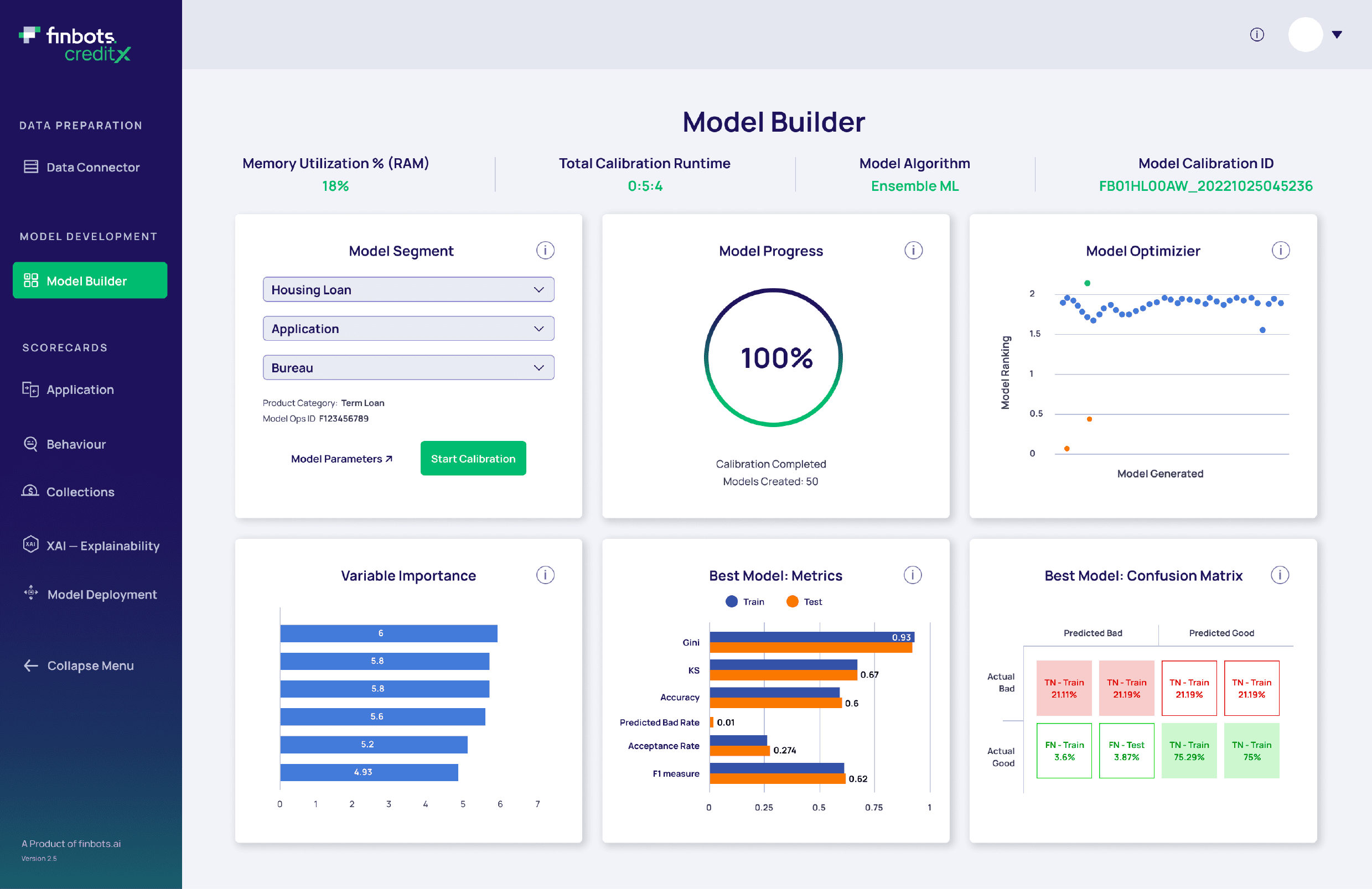
Founded in Singapore, the company develops AI-based credit modelling technology for banks and lenders. Its creditX platform uses machine learning and explainable AI to support automated credit decisioning and credit-score development.
One of the company’s notable milestones was completing Singapore’s AI Verify framework for creditX. AI Verify was developed by Singapore’s IMDA and PDPC to help organizations evaluate whether AI systems meet principles around areas such as fairness, transparency, and accountability.
This is particularly relevant to financial services because credit decisions are highly sensitive. A lender needs more than a prediction; it needs to understand how a model arrives at a decision and whether that decision can be governed appropriately.
finbots.ai therefore represents a different dimension of AI-powered financial infrastructure from payment or compliance companies. Its focus is the decision layer that determines how financial institutions evaluate borrowers and structure credit products.
Why it matters: As lending becomes increasingly automated, explainable AI can provide the decisioning infrastructure needed to scale credit assessment without completely removing transparency and governance.
Why Singapore Is Becoming a Financial Infrastructure Hub
Singapore’s position is not simply the result of having a large number of fintech startups.
The country combines several characteristics that are particularly useful for financial infrastructure companies: a major financial centre, strong digital infrastructure, an internationally connected economy, established payment networks, and an active regulatory environment.
That combination creates an interesting environment for companies developing AI-powered financial infrastructure. For those looking at how digital transformation is supported by modern tech, our guide on top SaaS technology companies offers further context on the tools driving these changes.
Instead of building consumer applications alone, Singapore-based fintechs are increasingly targeting the layers underneath financial services: payment rails, treasury systems, credit models, compliance platforms, digital identity, settlement networks, and capital-market infrastructure.
Recent investment data supports this direction. KPMG reported that AI and machine learning accounted for 18 of Singapore’s 53 fintech deals in H1 2026, with US$365.9 million in disclosed deal value. The firm also noted that investment was increasingly flowing toward AI-enabled infrastructure, tokenization, and digital-asset technologies.
What Comes Next for AI-Powered Financial Infrastructure?
The next stage could involve more than simply adding AI features to existing fintech products.
Three developments are particularly relevant.
Agentic finance
AI agents may increasingly move from recommending actions to executing tightly controlled financial workflows. Silent Eight’s compliance agents and Finmo’s work on agentic treasury intelligence provide examples of this direction.
Programmable money movement
As stablecoins, tokenized deposits, and blockchain-based settlement networks mature, companies such as Partior and Nium are exploring infrastructure that can make cross-border money movement more programmable. Partior
Intelligence embedded into every financial workflow
The bigger opportunity may be the combination of AI with existing financial infrastructure.
Rather than replacing payment systems, banks, or accounting platforms, AI can increasingly sit between data and execution — interpreting information, identifying anomalies, forecasting outcomes, and triggering controlled actions.
That could make financial infrastructure not only faster, but increasingly context-aware and adaptive.
Frequently Asked Questions
1. What is AI-powered financial infrastructure?
AI-powered financial infrastructure refers to the technology layers that support financial services while using artificial intelligence, machine learning, automation, or data intelligence to improve how those systems operate. Examples include payment routing, credit decisioning, fraud detection, AML monitoring, treasury management, identity verification, and financial-market workflows.
2. Why is Singapore important for financial infrastructure?
Singapore combines a major financial centre with a strong fintech ecosystem, digital infrastructure, regulatory institutions, and access to Southeast Asian markets. Its fintech ecosystem has increasingly focused on AI, real-time payments, tokenization, and institutional financial infrastructure.
3. Are all 10 companies purely AI companies?
No. The list intentionally includes both AI-native companies and financial infrastructure companies incorporating AI into important parts of their platforms. For example, Silent Eight and finbots.ai are heavily AI-focused, while Partior is primarily a settlement infrastructure company using distributed-ledger technology.
4. Which areas are these companies transforming?
The companies cover several layers of finance, including cross-border payments, treasury, capital markets, settlement, AML, fraud prevention, digital identity, credit intelligence, compliance, and credit decisioning.
5. Why does explainable AI matter in financial services?
Financial decisions can have significant consequences for customers and institutions. Explainability, auditability, governance, and human oversight can therefore be important when AI is used for lending, compliance, fraud prevention, or other regulated processes. Singapore’s AI governance initiatives specifically address responsible and explainable AI deployment.