
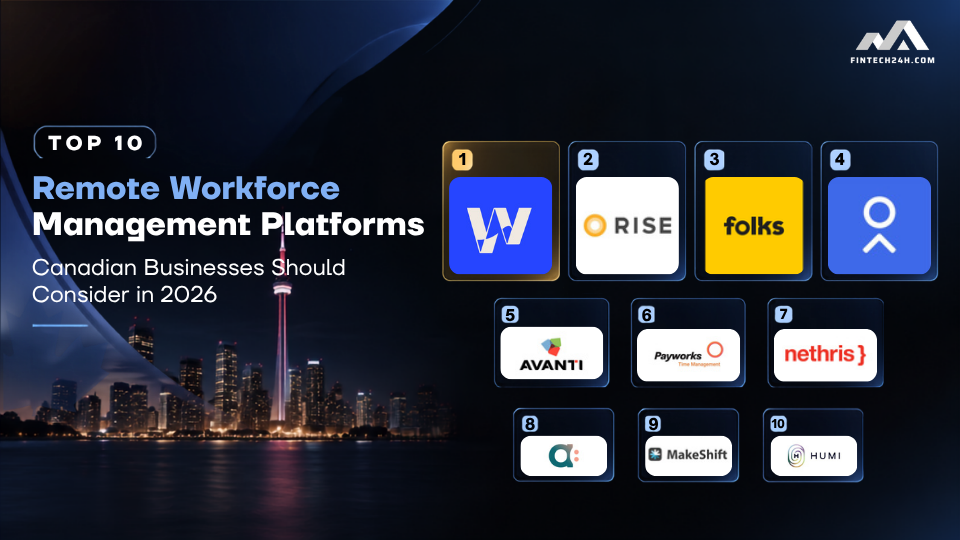
The Top 10 remote workforce management platforms Canadian businesses should consider in 2026 include specialized solutions like Workleap, Rise People, and Folks HR, which are designed to handle provincial payroll, bilingual requirements, and distributed team coordination. Managing a remote or hybrid workforce requires more than video meetings and messaging apps. As Canadian businesses continue to support employees across provinces, cities, home offices, and flexible workplaces, HR and operations teams need better ways to manage employee information, time off, payroll, performance, scheduling, communication, and engagement.
The challenge is that not every workforce management platform is equally suitable for Canadian organizations. Provincial employment standards, payroll requirements, bilingual workplaces, time tracking, privacy considerations, and different approaches to remote and hybrid work can all influence the right choice.
This is where remote workforce management platforms can make a difference. The right platform can bring employee data, HR workflows, time management, payroll, performance, and employee communication into a more connected system.
For this 2026 list, the focus is on established or specialized providers rather than enormous global technology corporations that dominate every software category. The platforms below include Canadian companies and providers with meaningful relevance to Canadian businesses. They also cover different workforce-management needs, so companies can compare solutions according to their team structure and operating model.
Note: The platforms are presented as a curated Top 10 list rather than a universal ranking. Each solution has a different focus, and the right choice depends on company size, workforce type, province, and required functionality.
What Is Remote Workforce Management Software?
Remote workforce management software is a category of business technology designed to help organizations manage employees who work remotely, in hybrid environments, across multiple locations, or outside a traditional office.
For Canadian companies, local requirements are particularly important. Payroll and employment rules can differ between provinces, while organizations operating in Quebec may also have additional language and regulatory considerations.
Modern platforms therefore increasingly compete not just on the number of features they provide, but on how well those features fit the realities of Canadian businesses.
How We Selected These Remote Workforce Management Platforms
The platforms in this list were considered based on several practical factors relevant to Canadian employers:
| Evaluation Factor | What It Covers |
|---|---|
| HR Management | Employee records, onboarding, documents and HR workflows |
| Remote & Hybrid Support | Tools that help manage distributed employees |
| Time Management | Time tracking, attendance, schedules and leave |
| Payroll | Native payroll or payroll integrations |
| Employee Experience | Engagement, performance and self-service |
| Canadian Relevance | Canadian compliance, support or market focus |
| Scalability | Suitability for growing organizations |
| Mobile Access | Employee and manager access outside the office |
| Reporting | Workforce insights, analytics and dashboards |
| Industry Fit | Usefulness across different business models |
The objective is not to identify one platform that works for every company. Instead, this list highlights different types of workforce management solutions that Canadian businesses can investigate in 2026.
Top 10 remote workforce management platforms Canadian businesses should consider in 2026
1. Workleap
Best for employee engagement and performance in distributed teams
Workleap is a Montreal-based technology company focused on helping organizations manage employee engagement, performance, compensation, and the broader employee experience. Its positioning makes it particularly relevant to companies where remote workforce management involves more than payroll and attendance.
The platform includes products and capabilities around employee engagement, performance management, organizational visibility, and employee experience. Workleap specifically positions its solutions for hybrid, remote, and distributed work environments.
One area where Workleap can be particularly relevant is employee feedback. Remote employees can have fewer informal interactions with managers and colleagues, making structured feedback and engagement measurement more important.
Workleap Officevibe, for example, is designed around employee engagement and feedback, while Workleap Performance focuses on structured performance conversations and reviews.
Key features
- Employee engagement surveys
- Feedback and recognition
- Performance management
- Performance reviews
- Employee experience insights
- Organizational charts
- AI-supported HR insights
- Tools for hybrid and distributed teams
Why Canadian businesses may consider it
Being Montreal-based gives Workleap a particularly strong connection to the Canadian HR technology market. It can be an interesting option for companies that already have an HRIS or payroll system but need stronger tools for managing engagement, performance, and connection across remote teams.
2. Rise People
Best for all-in-one HR, payroll and people management
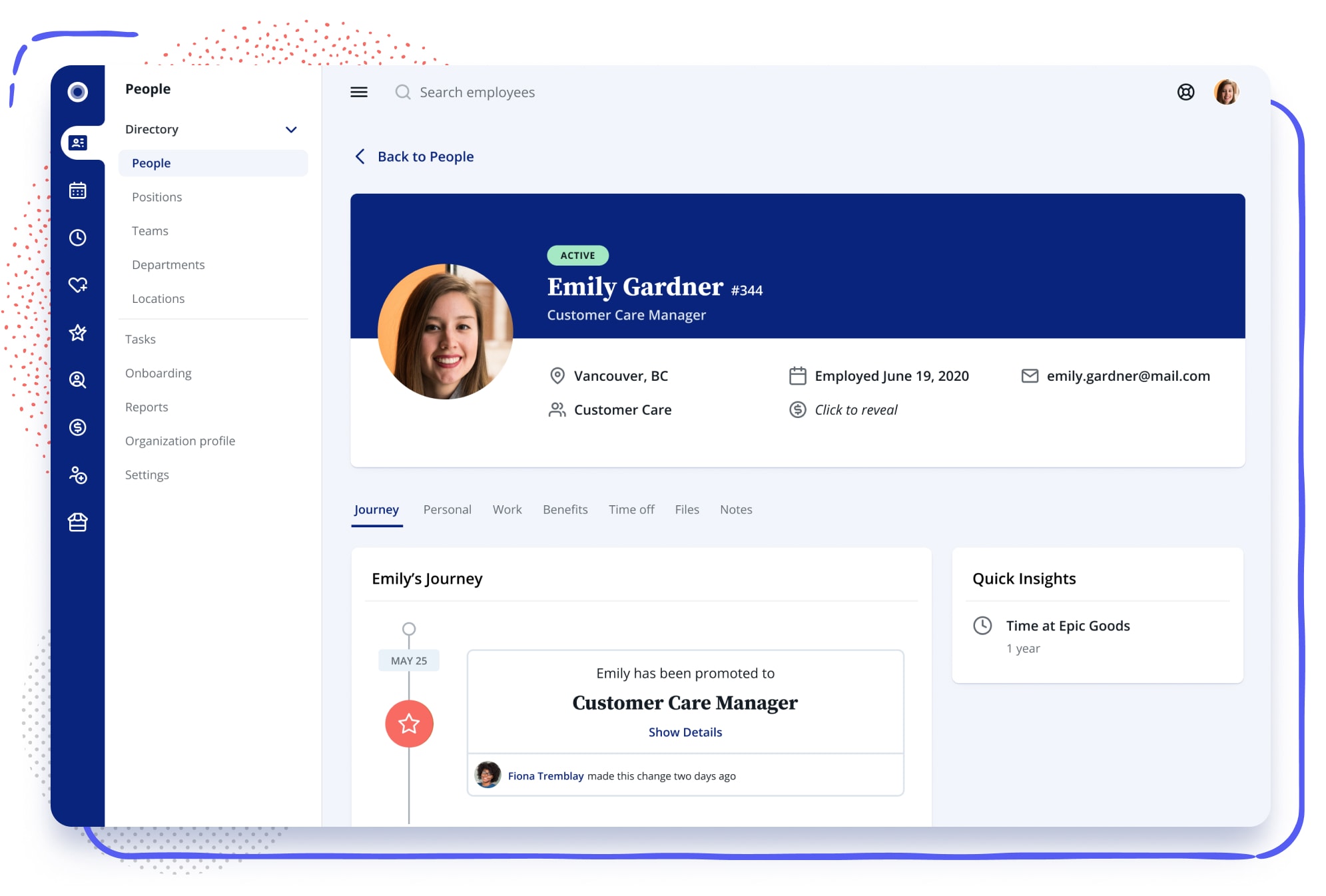
Rise People is a Canadian HR technology provider that combines HR, payroll, time off, performance, benefits, and related employee-management functions. The platform is particularly relevant to Canadian companies looking for a more centralized system rather than managing HR through multiple disconnected applications.
Rise positions its platform for Canadian businesses and supports areas such as Canadian payroll, scheduling, time tracking, performance and employee benefits. It also offers Canadian payroll support across provinces and territories.
The platform has also continued expanding its capabilities in 2026, including mobile functionality, integrations, and connections between different Rise products.
Key features
- HR management
- Canadian payroll
- Time off management
- Scheduling and time tracking
- Performance management
- Employee benefits
- Employee self-service
- Mobile access
- HR reporting
- Payroll services
Why Canadian businesses may consider it
For a company managing employees across multiple Canadian provinces, having HR and payroll functions designed around the Canadian market can reduce the need to piece together separate systems.
Rise may be particularly useful for organizations that want their remote workforce management strategy to cover both people operations and payroll administration.
3. Folks HR
Best for Canadian SMBs seeking an all-in-one HR platform
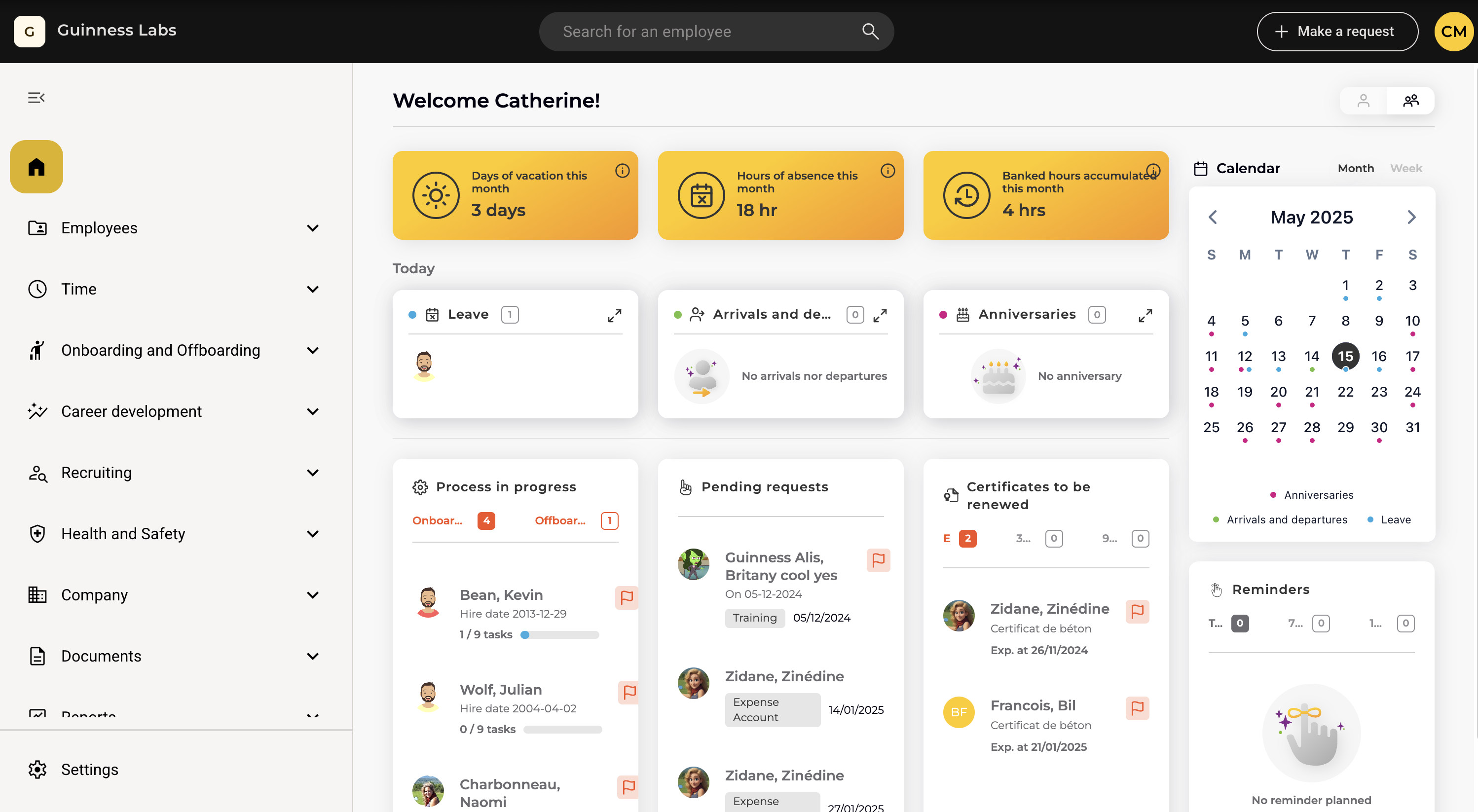
Folks HR is a Canadian HR software provider designed specifically around small and medium-sized businesses. Its platform combines employee management, onboarding, time management, performance, payroll, recruitment, reporting, and other HR processes.
One of its notable characteristics is its Canadian focus. Folks states that its software was designed for Canadian companies and supports Canadian employment standards, payroll requirements, and bilingual English-French functionality.
For distributed teams, the platform can centralize employee information, documents, time-off requests, onboarding processes, performance reviews, and payroll-related information.
Key features
- Core HR
- Employee profiles
- Onboarding and offboarding
- Time management
- Absence and PTO management
- Performance management
- Payroll
- Recruitment
- Employee documents
- HR analytics
- Mobile access
- Training and certification management
Folks also supports employee self-service, allowing employees to update information and manage requests without relying entirely on HR administrators.
Why Canadian businesses may consider it
Remote teams often create additional administrative complexity because HR information is no longer handled face-to-face. Centralizing these workflows can help HR teams reduce manual communication and spreadsheet-based processes.
Folks can therefore be relevant to businesses that want a Canadian-focused HR system without moving directly into a large enterprise HCM environment.
4. Collage HR
Best for centralized HR and employee lifecycle management

Collage HR is another Canadian-focused HR platform designed to bring employee management, payroll, time tracking, performance, benefits, recruitment, and onboarding into one environment.
Its platform includes employee records, onboarding workflows, time-off management, timesheets, clock-in functionality, performance management, and payroll capabilities.
For remote employees, Collage can help centralize processes that would otherwise require email, spreadsheets, shared folders, and separate HR applications.
The platform also supports customizable time-off policies, including work-from-home days and other organization-specific leave categories.
Key features
- Employee management
- Digital onboarding
- Time off and PTO
- Timesheets
- Time tracking
- Geofenced clock-in
- Payroll
- Benefits administration
- Performance management
- Recruitment
- HR analytics
- Employee training
Why Canadian businesses may consider it
Collage is especially interesting for companies looking for a balance between HR administration and workforce management.
Its Canadian payroll functionality also includes support for items such as T4s, T4As, ROEs and CRA remittances.
That combination makes it potentially useful for companies that want remote workforce management to connect directly with payroll and HR operations.
5. Avanti
Best for workforce scheduling, time tracking and Canadian payroll
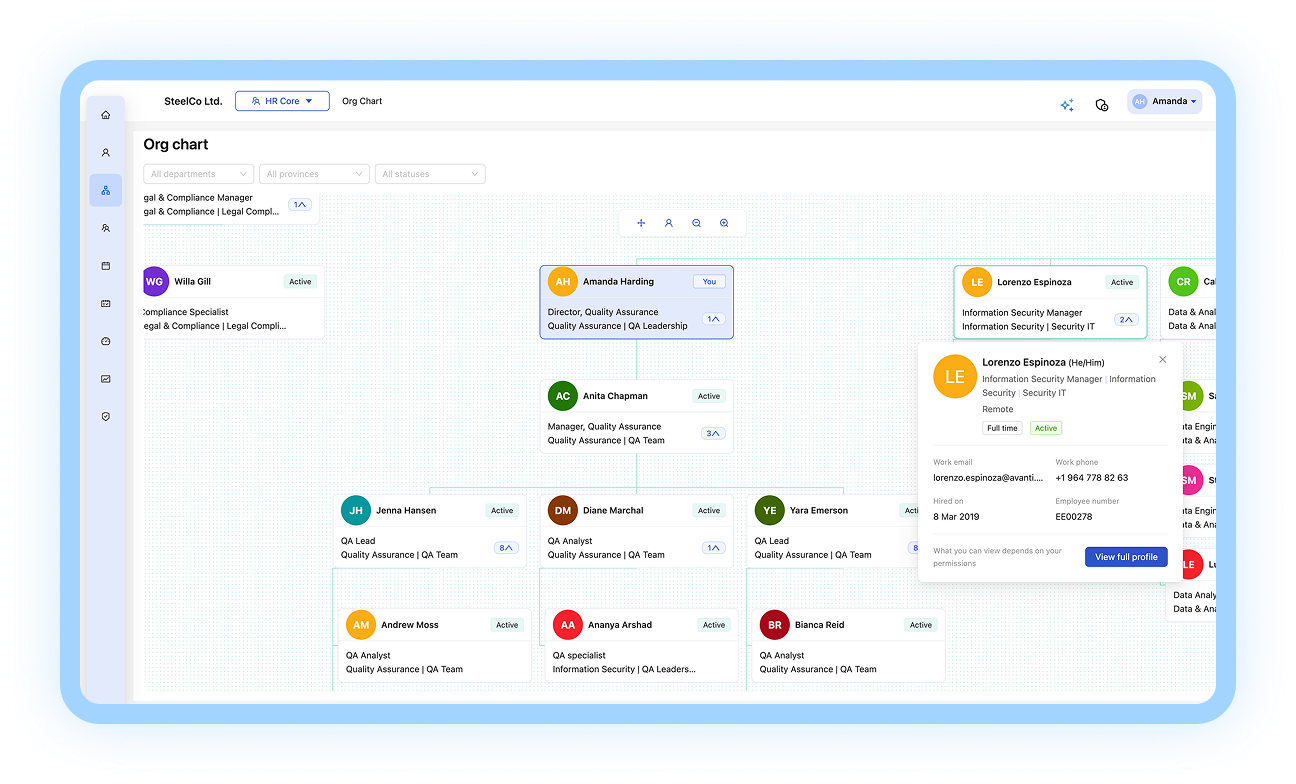
Avanti is a Canadian-owned and operated HCM and workforce management provider with a strong focus on payroll, time and attendance, scheduling, HR, and employee self-service.
While some remote workforce platforms focus primarily on knowledge workers and employee engagement, Avanti has a stronger operational workforce-management orientation.
Its tools allow businesses to manage schedules, employee availability, time off, shift swaps, time tracking, payroll, and employee information within an integrated environment. Avanti also supports remote clock-in and clock-out through its mobile and self-service tools.
Key features
- Workforce management
- Payroll
- Time and attendance
- Shift scheduling
- Remote clock-in and clock-out
- Employee self-service
- Absence management
- Workforce analytics
- HR management
- Mobile workforce tools
- Employee document management
Avanti also provides scheduling capabilities that can account for employee availability, vacation, skills, shift eligibility, and other workforce requirements.
Why Canadian businesses may consider it
Avanti can be particularly useful for organizations where remote workforce management includes a mixture of remote, mobile, hybrid, and location-based employees.
Its Canadian payroll and compliance focus can also be relevant for employers that want time data and workforce activity to flow directly into payroll.
6. Payworks
Best for integrated payroll, HR and time management
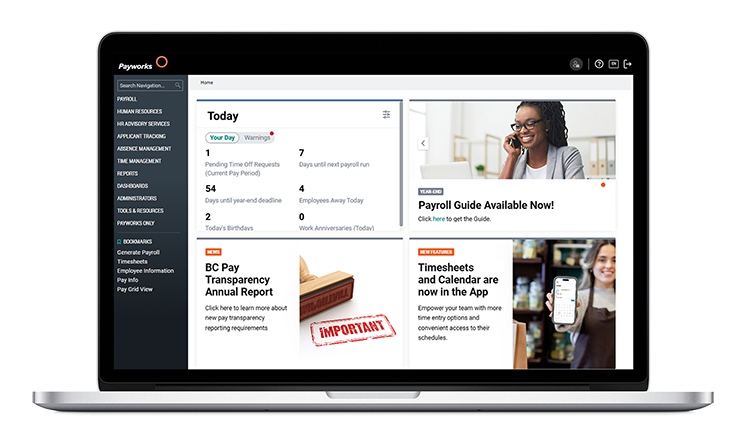
Payworks has been serving Canadian businesses since 2001 and provides a suite covering payroll, HR, time management, absence management, workforce analytics, recruitment, benefits, and employee self-service.
Its approach is particularly relevant for companies that want workforce management and payroll to operate as connected processes.
The platform’s time management capabilities include scheduling, capturing hours worked, absence management, analytics, and employee self-service. Employees can access information through web-enabled devices or mobile tools.
Key features
- Canadian payroll
- HR management
- Time tracking
- Employee scheduling
- Absence management
- Workforce analytics
- Recruitment
- Benefits
- Employee self-service
- Payroll and HR integration
Why Canadian businesses may consider it
Remote and hybrid teams create a need for reliable employee self-service. Employees may need to access pay statements, timesheets, schedules, or HR information without physically visiting an HR department.
Payworks addresses this through its integrated employee-management environment.
It can also be relevant to companies managing both salaried and hourly employees because time management, scheduling, and payroll functions can operate together.
7. Nethris
Best for Canadian payroll and time management
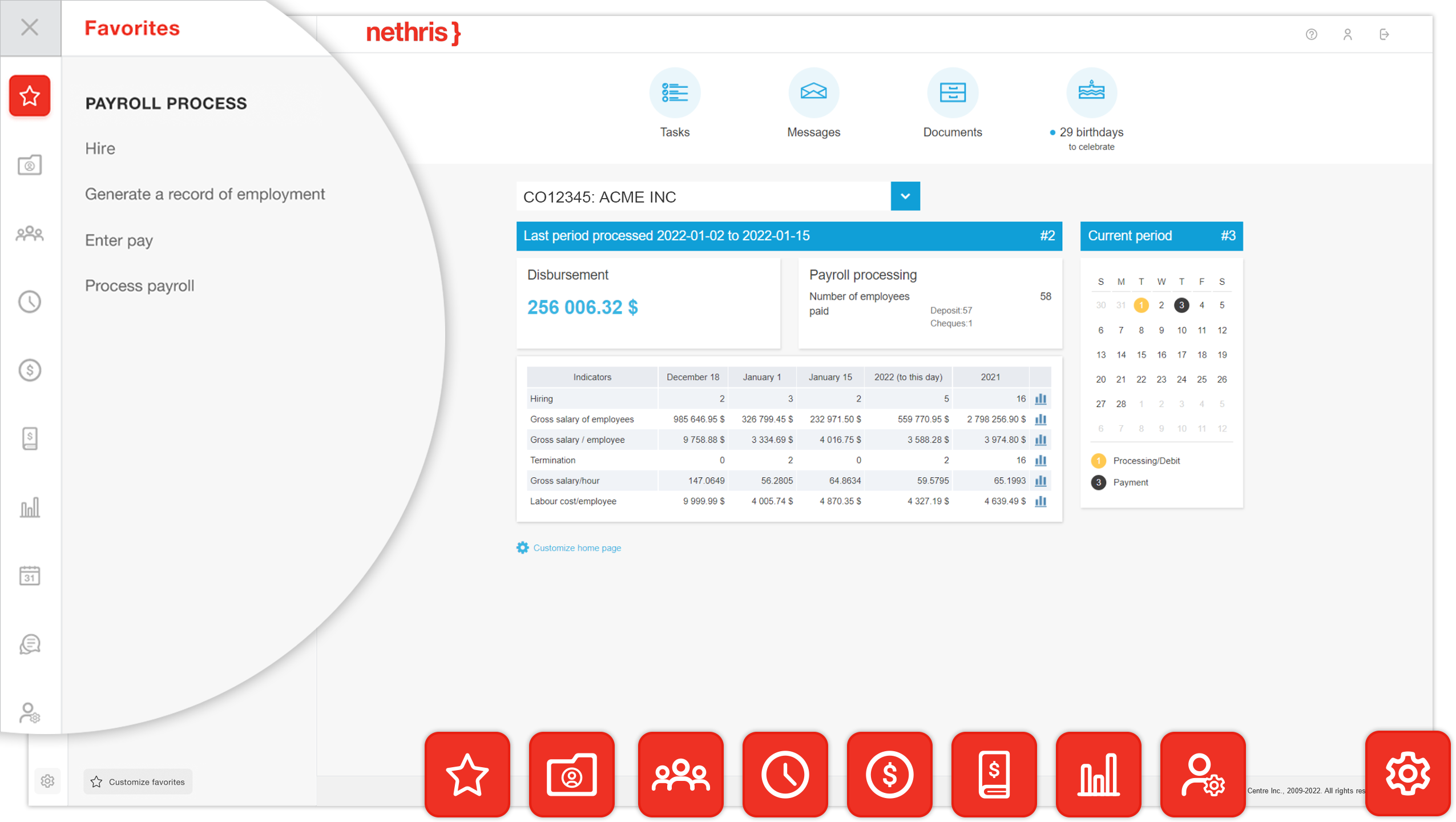
Nethris is a Canadian payroll and HR provider with a long history serving Canadian businesses. Its platform covers payroll, employee management, time management, scheduling, employee self-service, and related workforce processes.
For organizations with remote or hybrid employees, Nethris provides digital timesheets that employees can complete from a computer or mobile device. Its time management tools also support scheduling, employee availability, absence requests, shift exchanges, and labour-cost information.
Key features
- Canadian payroll
- Digital timesheets
- Time and attendance
- Employee scheduling
- Absence management
- Shift exchange
- Employee self-service
- Payroll reporting
- HR services
- Labour-cost tracking
Why Canadian businesses may consider it
One of Nethris’ strengths is its Canadian payroll orientation. The platform supports payroll calculations, direct deposits, ROEs, government remittances, and other Canadian payroll requirements.
This makes it useful for companies where remote workforce management needs to connect closely with payroll rather than operating as a standalone employee-monitoring or productivity solution.
8. Agendrix
Best for scheduling and time tracking for distributed or frontline teams
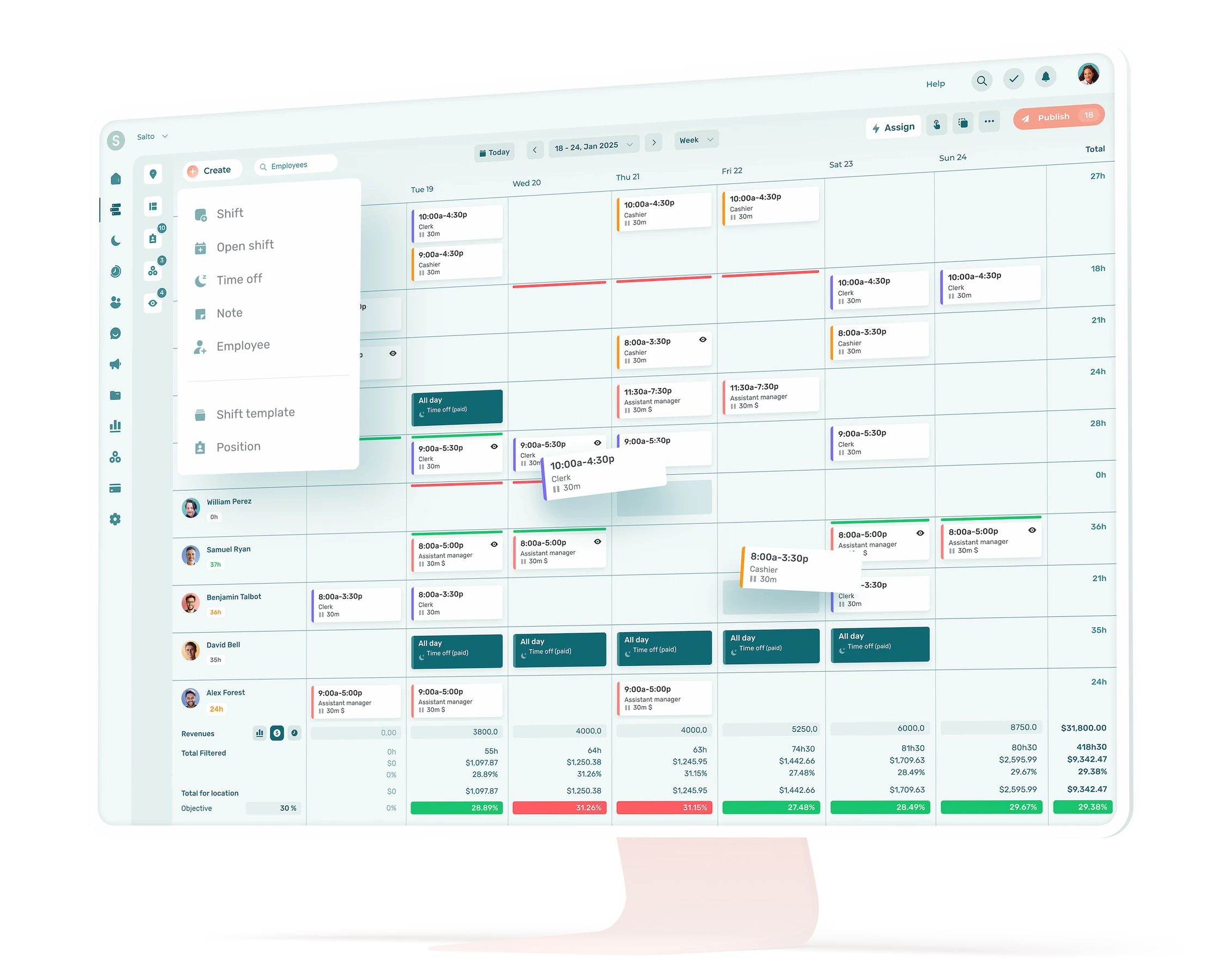
Agendrix is a Canadian workforce management platform focused heavily on employee scheduling, time tracking, communication, and people management.
The platform is particularly relevant for businesses with hourly or shift-based employees, including retail, hospitality, healthcare, and other frontline environments. Its 2026 product coverage includes scheduling, employee time tracking, mobile access, PTO management, communication, and payroll integrations.
Although it is not designed exclusively for traditional remote knowledge workers, its workforce coordination capabilities make it relevant to businesses operating hybrid, mobile, distributed, or multi-location teams.
Key features
- Employee scheduling
- Time tracking
- Mobile time clock
- PTO management
- Shift swapping
- Employee availability
- Team communication
- Payroll integrations
- HR tools
- Employee notifications
Agendrix also emphasizes bilingual support and integrations with Canadian payroll providers, which can be important for Canadian employers.
Why Canadian businesses may consider it
Not every distributed workforce sits behind a laptop from 9 to 5. Some companies have employees moving between customer locations, stores, facilities, clinics, or other worksites.
For these businesses, remote workforce management may be less about monitoring online activity and more about knowing who is working, where schedules stand, and how hours flow into payroll.
9. MakeShift
Best for complex shift-based workforce management
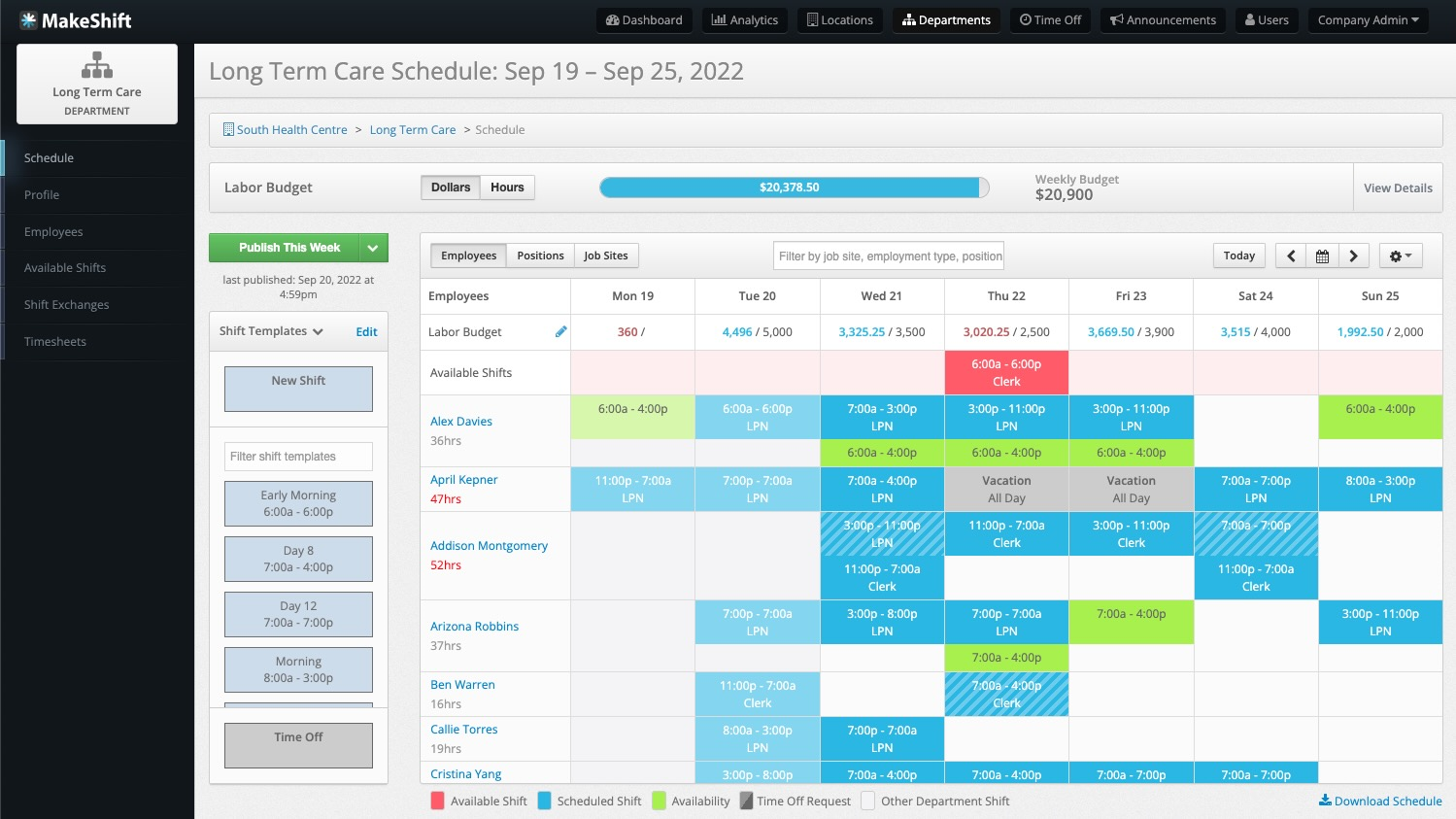
MakeShift is another workforce management platform worth considering when scheduling and workforce coordination are central to a company’s operations.
Rather than positioning remote workforce management purely around desk-based employees, MakeShift is more relevant to businesses that manage employees across shifts, locations, and changing availability.
This makes the platform particularly interesting for organizations where workforce flexibility involves variable schedules, employee availability, shift coverage, and mobile access.
Key features
- Employee scheduling
- Shift management
- Time tracking
- Employee availability
- Shift swaps
- Mobile workforce access
- Attendance management
- Workforce communication
- Reporting
- Payroll-related workflows
Why Canadian businesses may consider it
Canadian companies with employees spread across multiple locations may need more sophisticated workforce coordination than a standard HRIS provides.
MakeShift can be considered wen the biggest operational challenge is not employee records but getting the right people scheduled at the right time while maintaining visibility over workforce activity.
10. Humi
Best for Canadian businesses seeking integrated HR and workforce management

Humi is a Canadian HR and workforce management platform designed to bring core people-management processes into one centralized system. Rather than focusing on a single workforce function, Humi combines employee management, payroll, time off, benefits, recruiting, performance, documents, reporting, and other HR workflows.
For remote and hybrid businesses, having these processes in one system can help reduce the administrative work associated with managing employees across different locations. HR teams can maintain employee records, manage onboarding and offboarding, handle time-off requests, process payroll, and access workforce information without relying on multiple disconnected tools.
Key features
- Employee management
- HR administration
- Payroll management
- Time-off and absence management
- Employee onboarding and offboarding
- Digital document management
Humi also provides performance-management functionality for activities such as 360-degree feedback, one-on-one reviews, coaching, and goal setting. This can be useful for organizations managing distributed employees where structured performance processes are important.
Why Canadian businesses may consider it
For Canadian companies managing remote or hybrid teams, Humi provides a broad combination of HR administration, payroll, employee management, and workforce processes rather than focusing on only one aspect of remote work.
Its payroll functionality includes payroll records, tax forms, ROEs, benefits and deductions, income types, and vacation-related adjustments. Humi also supports Canadian vacation-pay calculations within its payroll workflows.
How to Choose the Right Remote Workforce Management Platform in Canada
There is no single solution that fits every Canadian organization. A 30-person software company with employees working from home has very different requirements from a 500-person retailer with multiple locations.
Before selecting a platform, consider the following.
1. Determine Your Workforce Structure
Start by identifying how your employees actually work.
Do you have:
- Fully remote employees?
- Hybrid employees?
- Office-based teams?
- Hourly employees?
- Field workers?
- Shift workers?
- Employees across multiple provinces?
- Contractors or temporary workers?
A company with remote knowledge workers may prioritize engagement, performance, onboarding, and employee communication.
A company with frontline employees may prioritize scheduling, attendance, time tracking, and labour costs.
2. Check Canadian Payroll Compatibility
Payroll should be a major consideration for Canadian employers.
Look for support for relevant Canadian payroll processes, including:
- Provincial payroll requirements
- Tax deductions
- T4s
- ROEs
- Vacation calculations
- Statutory holidays
- Overtime rules
- Payroll reporting
- Payroll integrations
Platforms such as Rise, Collage, Avanti, Payworks, Nethris, and Folks place significant emphasis on Canadian payroll functionality or compatibility.
3. Consider Provincial Differences
Canada is not one uniform employment environment.
A business operating in Ontario may have different requirements from one operating in Quebec, British Columbia, Alberta, or multiple provinces.
If your company has employees in several jurisdictions, check whether the platform can manage:
- Different leave policies
- Provincial holidays
- Overtime requirements
- Payroll rules
- Employee classifications
- Different workplace policies
This becomes particularly important as a remote company expands geographically.
4. Look at Employee Self-Service
Remote employees should not need to contact HR for every small request.
A strong employee self-service system can allow employees to:
- Request time off
- View schedules
- Check pay information
- Update personal information
- Access company documents
- Submit timesheets
- Complete onboarding tasks
- Request schedule changes
This can reduce administrative workload while giving employees greater visibility into their own information.
Remote Workforce Management Trends Canadian Businesses Should Watch in 2026
The workforce management market is becoming more integrated. Instead of using completely separate systems for payroll, HR, scheduling, performance, and employee engagement, businesses are increasingly looking for platforms that connect these workflows.
Several trends are particularly relevant in 2026.
AI Is Moving Into Workforce Management
AI is increasingly being added to HR reporting, workforce analytics, performance management, recruitment, and administrative workflows.
For example, Workleap has expanded AI capabilities around people-management insights, while Avanti is developing AI-supported workforce management capabilities focused on workforce planning and administrative automation.
However, businesses should look beyond the phrase “AI-powered.” The more important question is what the AI actually does and whether it solves a specific operational problem.
Employee Self-Service Is Becoming Standard
Employees increasingly expect to access workplace information themselves.
Rather than sending an email to HR to ask about vacation balances, schedules, documents, or pay information, employees can increasingly complete these tasks through mobile apps and employee portals.
This is particularly useful for distributed teams because employees may not have immediate physical access to an HR department.
Workforce Data Is Becoming More Connected
Modern workforce management increasingly depends on data flowing between HR, payroll, time tracking, scheduling, and analytics.
This reduces duplicate data entry and can give managers a clearer picture of labour costs, attendance, employee development, and workforce requirements.
Platforms such as Payworks, Avanti, Collage, and Nethris illustrate this more integrated approach.
Frequently Asked Questions
1. What is the best remote workforce management platform for Canadian businesses?
There is no single platform that is suitable for every Canadian business. Companies should compare platforms based on workforce type, company size, payroll requirements, provincial coverage, HR functionality, scheduling needs, and employee experience.
2. What should Canadian businesses look for in remote workforce management software?
Important considerations include HR management, employee self-service, time tracking, payroll compatibility, absence management, performance management, reporting, mobile access, security, integrations, and Canadian compliance.
3. Is remote workforce management software only for fully remote companies?
No. These platforms can also support hybrid, multi-location, mobile, field, and shift-based workforces. In fact, many workforce management systems combine remote employee administration with traditional workplace scheduling and time tracking.
4. Do Canadian businesses need Canadian HR software?
Not necessarily. International platforms can also support Canadian organizations. However, businesses should verify Canadian payroll, provincial requirements, privacy considerations, support availability, currency, and integrations before choosing a platform.
5. What is the difference between HR software and workforce management software?
HR software generally focuses on employee information and HR processes such as onboarding, documents, performance, and benefits. Workforce management software often places more emphasis on scheduling, time tracking, attendance, labour planning, and workforce utilization. Many modern platforms combine both categories.