
Quantifying the energy consumption of generative AI
Are ai chatbots bad for the environment? The answer depends on how organizations manage the massive computational load required for both training and inference. Generative AI models consume significant electricity during their initial training phase and their ongoing inference phase, which occurs every time a user interacts with a chatbot. While training a large language model like GPT-4 requires thousands of megawatt-hours, the cumulative energy used by millions of daily user queries often surpasses the initial training cost within a few months of deployment.
Distinguishing training versus inference energy costs
Training represents the upfront capital expenditure of energy, involving massive GPU clusters running for weeks. However, inference is the operational expenditure. In high-traffic fintech applications, the sheer volume of requests means that the energy required to process tokens for customer support or transaction analysis accumulates rapidly. Organizations must prioritize inference efficiency to manage their long-term carbon footprint.
Infrastructure optimization to lower carbon intensity
Reducing the environmental impact of your AI deployment requires a shift toward hardware-aware software engineering. By optimizing how models run on physical infrastructure, companies can significantly lower their electricity demand per query.

Selecting low-carbon data center regions
Geographic placement of servers is a primary lever for carbon reduction. Data centers located in regions with high renewable energy penetration—such as those powered by hydroelectric or wind grids—have a lower carbon intensity per kilowatt-hour. Selecting a cloud region with a low marginal carbon intensity for your inference endpoints directly correlates to a smaller environmental footprint.
Model distillation and quantization techniques
Quantization reduces the precision of model weights, typically from 16-bit to 8-bit or 4-bit, which drastically lowers the computational resources required per request. Distillation involves training a smaller ‘student’ model to mimic a larger ‘teacher’ model. These techniques allow for faster, less energy-intensive responses without sacrificing the accuracy required for financial services.
Framework for evaluating if are ai chatbots bad for the environment in your specific use case
Determining the environmental viability of an AI tool requires a rigorous lifecycle assessment. If the energy consumed by an automated chatbot exceeds the efficiency gains it provides, the tool may be environmentally counterproductive. To audit your system effectively, consider the following factors:
- Energy per query: Calculate the total milliwatt-hours (mWh) consumed during a standard user interaction.
- Grid carbon intensity: Map your cloud provider’s region to real-time carbon grid data.
- Process displacement: Evaluate if the AI replaces a more energy-intensive human process or adds unnecessary computation.
- Value-to-carbon ratio: Compare the carbon output against the business value generated in terms of transaction speed or customer resolution.
Lifecycle assessment criteria for fintech applications
To audit your system, follow this checklist: 1. Calculate the total energy per query (mWh). 2. Determine the carbon intensity of your cloud provider’s region. 3. Assess if the AI task replaces a more energy-intensive human process or adds a new, unnecessary layer of computation. 4. Compare the carbon output against the business value generated in terms of transaction speed or customer resolution.
Implementing sustainable procurement policies
Sustainable AI begins with vendor selection. When contracting with cloud providers or AI-as-a-service vendors, you must mandate transparency regarding their energy sourcing and efficiency metrics.
Standardizing PUE and carbon reporting requirements
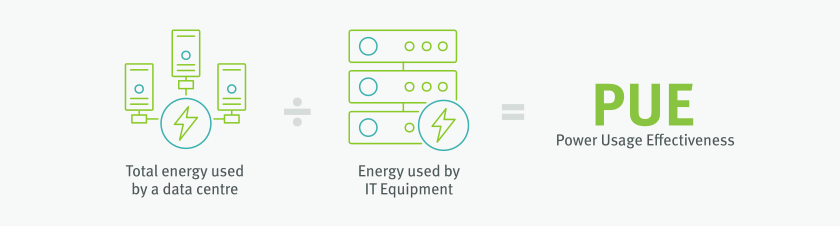
Power Usage Effectiveness (PUE) is the industry standard for measuring data center efficiency. Demand that your vendors provide PUE data and, more importantly, their actual carbon intensity metrics. Prioritize vendors that offer carbon-aware scheduling, which shifts non-urgent workloads to times when renewable energy supply is highest on the grid.
Monitoring and iterative reduction cycles
Energy efficiency is not a one-time setup but a continuous improvement process. By integrating monitoring into your development lifecycle, you ensure that performance updates do not inadvertently spike energy usage.
Integrating energy monitoring into CI/CD pipelines
Automate the tracking of energy consumption during model fine-tuning and software updates. Tools like CodeCarbon or cloud-native monitoring dashboards allow engineering teams to see the carbon impact of a specific code commit. If a new model version increases latency or energy usage beyond a defined threshold, the CI/CD pipeline should trigger an alert for optimization before deployment. By treating carbon as a first-class metric alongside latency and accuracy, fintech firms can maintain a sustainable competitive advantage while minimizing their ecological footprint.
Frequently Asked Questions
Definition of AI chatbots versus ChatGPT
No. ChatGPT is a specific product developed by OpenAI, while an AI chatbot is a general category of software that uses natural language processing to interact with users.
Criteria for selecting research-focused AI chatbots
Models with web-browsing capabilities and citation features, such as Perplexity AI or Claude 3.5, are generally preferred for research due to their ability to access real-time data.
Cost structures of AI chatbot services
Many AI chatbots offer free tiers, but these are often limited by usage caps or older model versions. Professional and enterprise-grade versions typically require a subscription.
Data privacy and reporting capabilities of AI chatbots
AI chatbots do not proactively report users to authorities. However, most service providers log conversations and may share data with law enforcement if legally compelled or if terms of service are violated.
Limitations of AI chatbots for medical advice
No AI chatbot should be used for medical advice. You should always consult a licensed healthcare professional for any medical concerns.
Operational mechanics of AI chatbots
AI chatbots use large language models (LLMs) trained on vast datasets to predict the most likely next word in a sequence, allowing them to generate human-like text responses based on user input.