
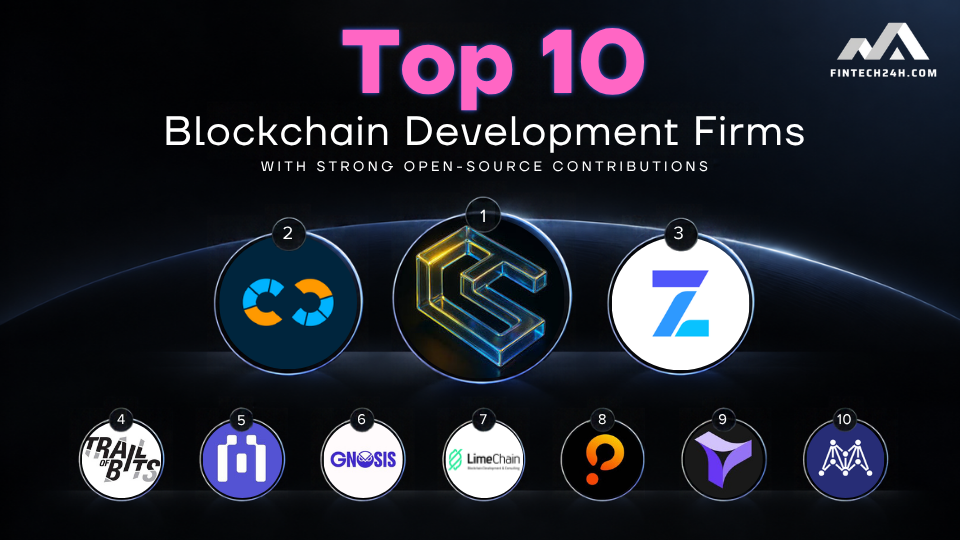
Choosing the right partner among the top 10 blockchain development firms with strong open-source contributions requires more than comparing marketing claims. For businesses building decentralized applications, smart contracts, and Web3 infrastructure, a company’s open-source footprint offers tangible insight into its technical expertise, engineering practices, and ecosystem involvement. Public repositories, reusable developer tools, and community-maintained software provide verifiable evidence that prospective clients can examine before making a decision.
This guide explores 10 blockchain development agencies and specialized Web3 engineering teams with notable open-source projects or publicly accessible technical work. From smart contract libraries and blockchain security tools to Ethereum clients and decentralized governance infrastructure, these companies represent different approaches to blockchain engineering. The list is designed to help startups, established businesses, and Web3 founders identify potential partners based on their technical focus and project requirements.
How We Selected These Blockchain Development Firms
The companies featured in this list were selected based on their blockchain specialization, identifiable open-source projects, technical relevance, and potential suitability for real-world development engagements. Rather than treating GitHub popularity as a direct measure of commercial quality, this evaluation considers several complementary factors.
-
Public code and repositories: The availability of source code, libraries, SDKs, developer tools, or infrastructure projects that can be independently examined.
-
Technical relevance: The relationship between a company’s open-source work and practical blockchain development needs, including smart contracts, node infrastructure, decentralized applications, and security.
-
Engineering specialization: Evidence of focused expertise in one or more blockchain ecosystems, programming environments, or Web3 development disciplines.
-
Community and documentation: The usefulness of technical documentation, contribution guidelines, testing practices, and publicly accessible development resources.
-
Project suitability: The types of blockchain products and engineering challenges for which each firm may be a relevant candidate.
The companies are presented as a curated shortlist, not a definitive ranking based on repository statistics or independently verified client satisfaction scores. Open-source activity can change over time, and a public repository alone does not establish the quality of a company’s commercial delivery.
Top 10 Blockchain Development Firms with Strong Open-Source Contributions
1. ChainSafe Systems
ChainSafe Systems is a blockchain research and development company known for its work across decentralized infrastructure, protocol engineering, and Web3 tooling. Its technical portfolio makes it a relevant candidate for organizations that need engineering expertise beyond conventional decentralized application development.
One reason to consider ChainSafe is its involvement in open-source blockchain infrastructure and ecosystem-level development. Its work has included projects associated with Ethereum, Polkadot, and other blockchain technologies, giving it a technical profile suited to teams working with complex protocol integrations or decentralized systems.
For businesses, this specialization can be valuable when a project requires interoperability, blockchain client development, infrastructure integration, or contributions to an existing open-source ecosystem. Teams building products that depend on multiple blockchain networks may also benefit from working with engineers who understand protocol-level constraints.
Best suited for: Blockchain infrastructure, cross-chain applications, protocol engineering, and Web3 products that require specialized technical research.
2. Nethermind
Nethermind is a blockchain engineering and research company with a strong focus on Ethereum infrastructure and related blockchain technologies. Its public engineering work includes Nethermind, an open-source Ethereum execution client, alongside other infrastructure and developer-oriented projects.
An execution client is a fundamental component of an Ethereum node, responsible for processing transactions, executing smart contracts, and maintaining execution-layer state. Building and maintaining such software requires a detailed understanding of protocol behavior, performance optimization, compatibility, and testing.
Nethermind’s publicly accessible code provides a useful reference point for organizations evaluating its infrastructure expertise. Its work is particularly relevant to businesses that operate blockchain nodes, develop Ethereum-compatible networks, or need advanced blockchain infrastructure engineering.
Compared with a general-purpose software agency, Nethermind is more specialized in the underlying systems that support blockchain applications. However, its suitability for a project depends on whether the required work aligns with its infrastructure and research capabilities.
Best suited for: Ethereum infrastructure, execution clients, node operations, protocol engineering, and blockchain performance optimization.
3. OpenZeppelin
OpenZeppelin is a prominent name in smart contract security and reusable blockchain development components. Its open-source ecosystem includes OpenZeppelin Contracts, a library of Solidity components used to implement common smart contract functionality.
These libraries support widely used standards and development patterns, including token contracts, access control, and upgradeable contract architectures. Reusable components can reduce the amount of custom code developers need to write, although they do not eliminate the need for project-specific testing and security reviews.
For businesses building decentralized finance applications, tokenization platforms, governance systems, or digital asset products, OpenZeppelin offers a valuable combination of development tooling and security expertise. Its public code also gives development teams an opportunity to examine implementation details and understand established smart contract patterns.
It is important to distinguish between using OpenZeppelin’s open-source libraries and hiring a team to develop a complete commercial application. Organizations should assess the specific services available and determine whether they need security consulting, contract development, or both.
Best suited for: Smart contract development, tokenization, DeFi applications, access-control systems, and security-conscious Ethereum projects.
4. Trail of Bits
Trail of Bits is a cybersecurity engineering company with extensive work in software security, vulnerability research, and blockchain-related tooling. Its public repositories include projects associated with smart contract analysis and the broader field of software assurance.
Open-source security tools are particularly valuable in blockchain development because vulnerabilities in deployed smart contracts can result in irreversible transactions and substantial financial losses. Static analysis, automated testing, and other security techniques can help teams identify potential weaknesses before deploying code to production.
Trail of Bits is relevant to organizations that want a more rigorous approach to engineering risk. Its research-oriented background can be especially useful when a project involves complex contract logic, cryptographic components, or security assumptions that require careful examination.
Companies should nevertheless distinguish between publicly available security tools and a professional security engagement. The existence of open-source tooling does not mean a specific application has been audited, and automated findings should be interpreted alongside manual review and testing.
Best suited for: Smart contract security, vulnerability research, security tooling, cryptographic engineering, and high-risk blockchain applications.
5. Blockscout
Blockscout develops an open-source blockchain explorer used to inspect and analyze transactions on Ethereum-compatible networks and other supported blockchain environments. Its publicly accessible software provides an example of how open-source development can support the operational transparency of decentralized infrastructure.
A blockchain explorer allows users and developers to investigate transactions, wallet addresses, blocks, token activity, and smart contract information. For blockchain networks, these capabilities can improve observability and make on-chain activity easier to understand without relying exclusively on proprietary interfaces.
Blockscout is particularly relevant to teams launching their own EVM-compatible networks, application-specific chains, or Layer 2 environments. An open-source explorer can provide a foundation for transaction visibility and network analytics while allowing technical teams to examine and adapt the software to their requirements.
Organizations considering this approach should assess deployment complexity, supported network configurations, maintenance requirements, and the availability of any additional engineering services they need.
Best suited for: Blockchain explorers, EVM-compatible networks, Layer 2 ecosystems, transaction analytics, and on-chain transparency tools.
6. Gnosis Guild
Gnosis Guild focuses on open-source infrastructure for decentralized governance and programmable on-chain organizations. Its Zodiac framework provides composable tools that allow developers to extend the functionality of smart-contract-based accounts and governance systems.
Decentralized autonomous organizations often need more than a basic voting mechanism. They may require transaction restrictions, execution modules, cross-chain coordination, and configurable rules governing how treasury assets or other on-chain resources can be managed.
Zodiac addresses part of this challenge through modular smart contract components and standardized interfaces. This approach can help development teams assemble governance functionality from reusable building blocks rather than designing every component independently.
For businesses developing DAO infrastructure, treasury management applications, or programmable organizational systems, Gnosis Guild’s open-source work provides a relevant technical reference. Its suitability depends on the governance model, account architecture, and security requirements of the intended application.
Best suited for: DAO tooling, programmable accounts, on-chain governance, treasury management, and modular smart contract systems.
7. LimeChain
LimeChain is a Web3 development and consulting company associated with blockchain engineering, decentralized applications, and infrastructure projects. It is a potential candidate for organizations seeking a development partner that can connect blockchain architecture with product implementation.
Open-source contributions are especially useful to examine when evaluating a Web3 engineering partner because they can reveal the technologies a team works with and the kinds of problems its engineers address. For LimeChain, prospective clients should review its public technical work alongside its development portfolio to determine the relevance of its experience to a specific project.
The company may be worth evaluating for businesses that need support across multiple stages of blockchain product development, from technical discovery and architecture to implementation and integration. As with any commercial development firm, the exact scope of its current services should be confirmed during vendor evaluation.
Best suited for: Custom Web3 applications, blockchain consulting, smart contract integration, and end-to-end blockchain product development.
8. Protofire
Protofire is a blockchain engineering company associated with open-source development, protocol integrations, and infrastructure for decentralized ecosystems. Its technical focus makes it relevant to organizations working with established blockchain networks and the applications built around them.

Protocol integrations can involve complex requirements, including smart contract compatibility, governance mechanisms, developer tooling, and coordination with existing decentralized infrastructure. Teams with experience in these areas can help reduce the gap between a protocol’s technical capabilities and a usable application.
When evaluating Protofire, businesses should examine the specific repositories and ecosystem projects associated with the team, rather than relying solely on a general claim of open-source participation. Repository ownership, contribution history, documentation, and the relationship between public work and commercial services are useful factors to investigate.
For Web3 startups, the potential advantage of a specialized engineering partner is access to blockchain-specific experience without needing to build every capability internally.
Best suited for: Protocol integrations, decentralized applications, blockchain infrastructure, and ecosystem-specific engineering projects.
9. Tenderly
Tenderly is a Web3 development platform focused on improving the smart contract development lifecycle. Its tooling includes capabilities for debugging, transaction simulation, contract monitoring, and blockchain application observability.
Although Tenderly is better known for its developer platform than for operating as a traditional custom-development agency, it belongs in this comparison because developer tooling and open-source engineering can be important parts of a blockchain project’s technical foundation.
Debugging smart contracts can be challenging because execution depends on contract state, transaction inputs, external calls, and the behavior of other contracts. Simulation and debugging tools help developers investigate these interactions before or after deployment, while monitoring can make it easier to identify unexpected behavior in production.
For organizations building sophisticated DeFi products or applications with substantial on-chain activity, Tenderly’s tooling may complement an internal engineering team or an external blockchain development partner. Businesses should evaluate its actual public repositories separately from the features of its commercial platform.
Best suited for: Smart contract debugging, transaction simulation, application monitoring, and Web3 developer workflows.
10. Matter Labs
Matter Labs is the company behind the development of zkSync technology, an Ethereum scaling ecosystem built around zero-knowledge proofs. Its engineering focus makes it relevant to organizations exploring blockchain scalability, Layer 2 applications, and zero-knowledge technology.
Layer 2 systems aim to improve the scalability and efficiency of blockchain applications while maintaining important security properties associated with the underlying network. Building these systems requires specialized knowledge of protocol design, cryptography, execution environments, and developer infrastructure.
For businesses considering applications within the zkSync ecosystem, Matter Labs’ technical work provides a useful starting point for understanding the underlying architecture and available development opportunities. Public code and documentation can help engineering teams assess compatibility, development workflows, and the maturity of relevant components.
However, ecosystem participation should not be confused with a guarantee that Matter Labs offers conventional outsourced development services for every use case. Companies should first determine whether they need protocol-level expertise, ecosystem integration, or a separate implementation partner.
Best suited for: Ethereum scaling, zero-knowledge technology, Layer 2 applications, and projects targeting the zkSync ecosystem.
Why Open-Source Contributions Matter When Choosing a Blockchain Development Company
Open-source activity can provide an additional layer of evidence when evaluating blockchain development companies, particularly when marketing materials alone do not explain how a team approaches technical challenges. Public code allows prospective clients to inspect implementation details, review documentation, and observe how a project is structured.
There are several practical advantages to considering open-source work during vendor selection.
Greater technical transparency. Public repositories can reveal programming practices, testing approaches, architectural decisions, and documentation quality. They provide evidence that can complement, rather than replace, client references and project case studies.
Reusable development components. Open-source libraries and frameworks can help teams avoid rebuilding common functionality from scratch. However, dependencies must be reviewed for maintenance status, compatibility, licensing, and security implications.
Stronger ecosystem alignment. Contributions to established blockchain projects may indicate familiarity with ecosystem standards, development conventions, and the needs of other developers. The relevance of those contributions matters more than the number of repositories alone.
More informed technical due diligence. Examining public issues, release notes, contribution guidelines, and testing practices can help buyers prepare better questions before entering a commercial engagement.
Open-source participation is not a substitute for commercial delivery evidence. A company may maintain useful public software while offering limited outsourced development services, and a capable development firm may contribute relatively little code publicly because of client confidentiality or its business model.
How to Evaluate Open-Source Contributions Before Hiring a Blockchain Development Firm
Before selecting a partner, businesses should conduct a focused technical review rather than relying on repository popularity or broad claims of ecosystem involvement. For those scaling their operations, integrating python development can often streamline backend processes.
-
Inspect relevant repositories. Identify projects directly related to the intended application, such as Solidity libraries for tokenization, node software for infrastructure, or developer tools for contract testing.
-
Review maintenance activity. Examine recent releases, meaningful commits, issue responses, and pull-request discussions. A large repository with little ongoing maintenance may not be appropriate for a production dependency.
-
Check code quality and testing. Review automated tests, continuous integration, documentation, dependency management, and the project’s approach to security disclosures.
-
Verify the company’s role. Determine whether the firm created the repository, maintains it, contributes to another organization’s project, or simply uses an existing open-source framework. These roles demonstrate different levels of ownership and responsibility.
-
Ask about commercial delivery. Request relevant case studies, team credentials, proposed milestones, testing plans, maintenance arrangements, and references where available. Public contributions do not independently establish delivery reliability.
-
Clarify security and licensing. Confirm the applicable software licenses, third-party dependencies, audit requirements, and ownership of any custom code developed under the engagement.
This process helps distinguish a company with relevant engineering evidence from one whose public reputation is not closely aligned with the project’s actual technical requirements.
Frequently Asked Questions
1. What is an open-source blockchain development company?
An open-source blockchain development company builds or contributes to publicly accessible software used in blockchain ecosystems. Its work may include smart contract libraries, blockchain clients, developer tools, decentralized applications, infrastructure, or security research. Some companies also provide commercial development and consulting services, while others focus primarily on products or protocol engineering.
2. How can I verify a blockchain firm’s open-source contributions?
Start by examining its public repositories, commit history, releases, pull requests, documentation, and contribution guidelines. Confirm whether the company owns or maintains the project, contributes to another team’s repository, or merely uses the software. For critical infrastructure, review testing practices, security disclosures, licensing, and evidence of ongoing maintenance.
3. Are open-source blockchain development firms more secure?
Not necessarily. Publicly available code makes independent inspection possible, but it does not guarantee that the software is secure or properly maintained. Security depends on implementation quality, testing, threat modeling, dependency management, review processes, and deployment practices. Critical smart contracts may require independent audits and additional verification.
4. What should businesses look for in a blockchain development partner?
Businesses should assess technical specialization, experience with the relevant blockchain ecosystem, security practices, project references, communication, documentation, maintenance capabilities, and commercial terms. Open-source contributions can provide supporting evidence, but the final choice should reflect the project’s architecture, budget, risk profile, and delivery requirements.
5. Which blockchain development firm is best for smart contract projects?
The right choice depends on the scope. OpenZeppelin is particularly relevant to reusable smart contract components, while Trail of Bits is worth evaluating for security-focused work. ChainSafe and Nethermind are more relevant to infrastructure and protocol engineering. Businesses should compare the actual services available and verify that the selected team has experience with the intended application.