
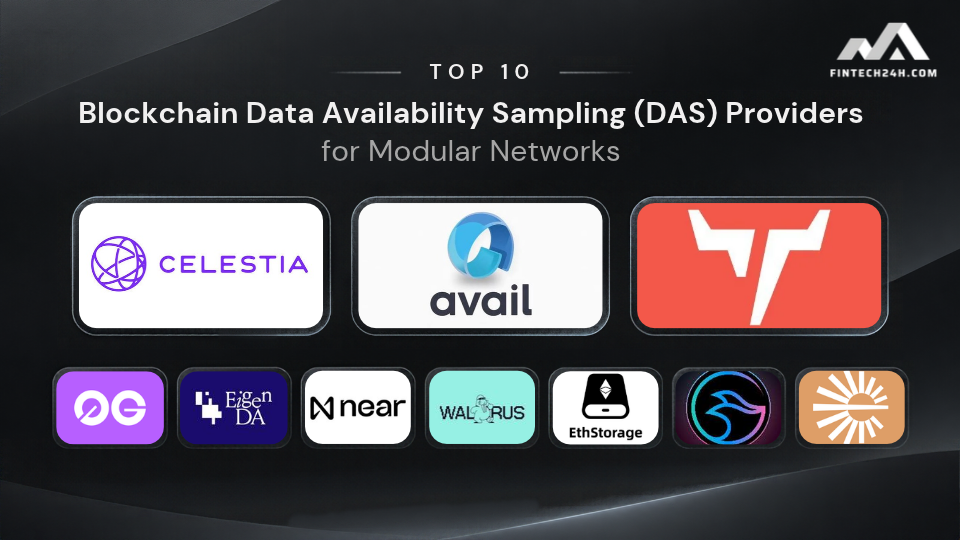
The top 10 blockchain data availability sampling (DAS) providers for modular networks offer essential infrastructure for rollups and appchains to verify transaction data without downloading entire blocks. As decentralized applications continue to evolve, ensuring that transaction data remains accessible to network participants has become a critical requirement for modular blockchain architecture.
Traditional blockchain networks often combine execution, consensus, and data availability within a single system. Modular networks separate these responsibilities, allowing developers to use specialized infrastructure for transaction execution, settlement, and data publication. This approach can improve flexibility and scalability, but it also introduces an important challenge: how can participants verify that blockchain data is available without downloading and storing every transaction?
Data Availability Sampling (DAS) addresses this challenge by allowing light clients to download small, randomly selected portions of encoded block data. Through repeated sampling and cryptographic verification, participants can gain confidence that the complete dataset is available without requiring the resources of a full node.
For developers building modular networks, choosing the right data availability provider involves evaluating more than transaction throughput. Security assumptions, sampling mechanisms, data retrieval, network decentralization, integration requirements, and ecosystem compatibility all influence whether a solution is suitable for a particular application.
In this article, we explore 10 blockchain data availability providers and infrastructure projects relevant to modular networks. The selection includes dedicated DA networks, sampling-focused infrastructure, and complementary data availability services. Each provider is evaluated according to its technical approach, ecosystem relevance, and potential applications, rather than being presented as an interchangeable DAS solution.
What Is Data Availability Sampling (DAS)?
Data Availability Sampling is a blockchain verification technique that allows network participants to check whether block data has been published without downloading the entire dataset. Instead of retrieving every transaction, a light client requests randomly selected data samples and verifies them against cryptographic commitments.
DAS typically works alongside erasure coding. Before block data is distributed, the original dataset is encoded with additional redundancy. This allows the network to reconstruct the original information even when some data fragments are unavailable.
When a light client successfully retrieves multiple independent samples, it increases its confidence that the complete dataset has been published and can be reconstructed. The security of this process depends on the encoding scheme, sampling protocol, network assumptions, and the ability of honest participants to obtain the requested data.
For modular blockchain networks, DAS can reduce the resources required for independent verification. It also supports architectures in which execution environments publish transaction data to a separate availability layer while maintaining their own execution and settlement logic.
However, DAS is not the same as data storage, data availability certification, or data availability committees. Some providers offer sampling directly, while others rely on operator attestations, restaking, or alternative verification mechanisms. These differences matter when comparing providers.
How We Selected the Top 10 Blockchain Data Availability Providers
This list focuses on infrastructure relevant to modular blockchain networks, rollups, application-specific chains, and decentralized data publication.
The selection considers five main criteria:
-
Technical relevance: Whether the project provides data availability infrastructure, sampling technology, or complementary capabilities that address data publication and verification.
-
Architecture: Whether the solution supports modular networks, independent execution environments, or specialized data availability workloads.
-
Verification approach: Whether it provides direct sampling, light-client verification, cryptographic commitments, operator attestations, or another mechanism.
-
Ecosystem development: Whether the project has an identifiable developer ecosystem, infrastructure documentation, or integrations relevant to blockchain applications.
-
Practical suitability: Whether developers can reasonably evaluate the solution for rollups, appchains, decentralized applications, or specialized workloads.
The ranking is an editorial comparison, not a definitive security assessment or performance benchmark. Providers differ in their architectures, and not every project listed implements native DAS. Where a provider uses a different availability model, that distinction is explained rather than treating its capabilities as equivalent.
Top 10 blockchain data availability sampling (DAS) providers for modular networks
1. Celestia
Celestia is a modular blockchain network designed specifically around data availability and consensus. Rather than requiring every application to operate its own complete blockchain infrastructure, Celestia allows rollups and other execution environments to publish data to a dedicated availability network.

Its architecture separates data availability from execution and settlement, making it particularly relevant to developers building modular blockchain systems.
Key Technology and Architecture
Celestia uses Data Availability Sampling to allow light nodes to verify the availability of block data without downloading complete blocks. Its architecture combines erasure coding, data availability commitments, and Namespaced Merkle Trees (NMTs).
Namespaced Merkle Trees allow applications to retrieve data associated with their own namespaces rather than downloading unrelated information from the entire block. This can improve efficiency for rollups and application-specific chains that need access to their own transaction data.
The network also uses an extended data square architecture. Block data is encoded with redundancy, enabling light clients to sample portions of the dataset while full nodes retain the ability to reconstruct the complete block.
Why Celestia Matters for Modular Networks
Celestia is particularly relevant for sovereign rollups and developers seeking to separate execution from data availability. Its dedicated DA architecture allows application developers to focus on execution environments while using an external network for data publication.
Its light-client sampling model also makes it a useful reference point for understanding how DAS can support scalable modular infrastructure.
Potential Use Cases
Celestia can support sovereign rollups, application-specific blockchains, modular execution environments, and decentralized applications that require a dedicated data availability layer.
Developers evaluating Celestia should consider the network’s security assumptions, data retrieval requirements, integration architecture, and the responsibilities of their own settlement layer.
2. Avail
Avail is a modular blockchain infrastructure project focused on data availability, interoperability, and scalable verification. Its architecture is designed to support rollups and application-specific networks that need an independent data availability layer.
Avail is particularly relevant to developers who want to combine data availability with cryptographic verification and light-client infrastructure.
Key Technology and Architecture
Avail uses erasure coding, KZG commitments, and Data Availability Sampling to support verification of published blockchain data.
Its light clients can sample block data and verify availability using cryptographic commitments. This allows participants to obtain availability assurances without downloading the entire dataset.
Avail also provides a dedicated blockchain environment for data availability, rather than operating solely as a storage service attached to another network.
Why Avail Matters for Modular Networks
Avail is designed to support modular infrastructure across different execution environments. Its data availability architecture can be evaluated by rollup developers, application-specific chain builders, and projects exploring cross-chain interoperability.
The combination of sampling and cryptographic commitments makes Avail relevant to applications that need lightweight verification and a dedicated availability layer.
Potential Use Cases
Avail can support modular rollups, application-specific chains, blockchain gaming infrastructure, and decentralized applications that require efficient data publication.
Developers should evaluate its consensus architecture, verification requirements, ecosystem integrations, and the specific availability guarantees relevant to their applications.
3. Nubit
Nubit is a blockchain data availability project focused on scalable data publication and lightweight verification. Its architecture is relevant to developers exploring decentralized data availability, modular blockchain infrastructure, and applications that require data to remain accessible without relying exclusively on conventional full-node operation.
Nubit is particularly interesting because its technical design explicitly incorporates light clients and Data Availability Sampling.
Key Technology and Architecture
Nubit’s architecture includes data availability sampling, cryptographic commitments, and protocols designed to allow light clients to verify data availability.
Light clients can request randomly selected portions of block data rather than downloading complete blocks. Repeated sampling increases confidence that the dataset is available.
The project also explores a Bitcoin-oriented data availability architecture, making it relevant to applications interested in connecting decentralized data publication with Bitcoin-related infrastructure.
Why Nubit Matters for Modular Networks
Nubit addresses the resource requirements associated with independent data verification. Its sampling-oriented approach is relevant to modular networks where participants need to verify availability without operating resource-intensive full nodes.
Its architecture also provides an alternative perspective on how decentralized data availability systems can be designed around light-client participation.
Potential Use Cases
Nubit can be evaluated for modular blockchain applications, decentralized data publication, Bitcoin-related data availability infrastructure, and projects requiring lightweight availability verification.
Developers should assess its current network maturity, data retrieval model, cryptographic verification requirements, and compatibility with their intended execution environment.
4. 0G
0G is a decentralized infrastructure project focused on data availability, storage, and AI-oriented workloads. Its architecture addresses the growing demand for scalable data infrastructure across decentralized applications and computational systems.

Although its broader infrastructure includes capabilities beyond conventional blockchain DAS, its data availability architecture makes it relevant to modular networks.
Key Technology and Architecture
0G’s infrastructure separates data availability, storage, and related network functions to support decentralized workloads.
Its architecture incorporates distributed data infrastructure and verification mechanisms intended to improve the scalability of data-intensive applications.
For modular blockchain developers, the important distinction is between its broader data availability capabilities and the specific verification guarantees offered by a dedicated DAS implementation.
Why 0G Matters for Modular Networks
Modular blockchain infrastructure increasingly intersects with AI, decentralized computing, and applications that generate substantial data volumes.
0G is relevant to developers exploring these intersections because it provides an infrastructure-oriented approach to data availability rather than focusing exclusively on conventional rollup transaction publication.
Its suitability depends on whether the application’s requirements align with its data availability model and the security assumptions of the network.
Potential Use Cases
0G can be evaluated for data-intensive decentralized applications, AI infrastructure, modular blockchain systems, and workloads requiring scalable data availability.
Developers should distinguish its data availability capabilities from its storage and computational services when assessing whether it provides the required sampling guarantees.
5. EigenDA
EigenDA is a data availability service built within the EigenLayer ecosystem. It focuses on providing high-throughput data availability infrastructure for rollups and other blockchain applications.

Unlike dedicated DA blockchains that use native consensus and light-client sampling, EigenDA employs an actively validated service architecture secured through restaking.
Key Technology and Architecture
EigenDA uses erasure coding, cryptographic commitments, and operator-based data distribution.
Its architecture distributes data across operators and uses attestations to provide availability assurances. The system is designed to reduce the amount of data each operator must store while supporting high-throughput data publication.
EigenDA’s security model differs from a native DAS network. Operator attestations and economic security are central to its availability mechanism, and developers should not assume that its current architecture provides the same independent sampling guarantees as Celestia or Avail.
Why EigenDA Matters for Modular Networks
EigenDA is relevant to developers building rollups and application-specific chains that prioritize throughput and integration with Ethereum-oriented infrastructure.
Its restaking-based architecture offers a different approach to data availability security, making it useful for teams comparing dedicated DA networks with actively validated services.
Potential Use Cases
EigenDA can support rollups, modular execution environments, and applications requiring high-throughput data publication.
Developers should evaluate operator assumptions, data retrieval guarantees, integration requirements, and whether the application’s security model requires independent DAS.
6. NEAR DA
NEAR DA is a data availability solution associated with the NEAR ecosystem. It is designed to provide data availability infrastructure for rollups and applications that want to use NEAR-based infrastructure without building a complete data availability system themselves.
Its architecture is relevant to modular blockchain developers evaluating alternative DA services.
Key Technology and Architecture
NEAR DA uses NEAR infrastructure to provide data availability for external applications and rollup environments.
Its approach is different from a standalone DAS blockchain. Rather than assuming that all data availability providers use the same sampling architecture, developers should evaluate the specific verification and retrieval mechanisms supported by NEAR DA.
This distinction is important because a data availability service can provide publication and retrieval capabilities without necessarily implementing the same light-client sampling protocol as a dedicated DAS network.
Why NEAR DA Matters for Modular Networks
NEAR DA is relevant to application developers who want to use an established blockchain ecosystem for data availability.
Its integration model may be attractive to projects that prioritize ecosystem compatibility and data publication costs.
However, its availability guarantees should be evaluated according to the specific architecture and verification path used by the application.
Potential Use Cases
NEAR DA can be considered for rollups, modular applications, and blockchain systems seeking data availability through NEAR infrastructure.
Developers should assess its integration requirements, data retrieval mechanisms, and whether additional verification components are necessary for their security model.
7. Walrus
Walrus is a decentralized data storage and availability project associated with the Sui ecosystem. It focuses on distributing and retrieving large data objects through decentralized infrastructure.

Walrus is relevant to modular blockchain developers because data availability increasingly involves more than transaction batches. Applications may also need to publish large files, datasets, media, and other information that cannot be efficiently handled as ordinary on-chain transactions.
Key Technology and Architecture
Walrus uses decentralized storage infrastructure and a blob-oriented data model.
Its architecture is designed to distribute data across storage providers while supporting retrieval and verification mechanisms.
However, decentralized blob storage and blockchain DAS are not identical. Walrus should be evaluated according to its actual availability guarantees, storage model, and verification requirements rather than assumed to provide the same light-client sampling protocol as Celestia or Avail.
Why Walrus Matters for Modular Networks
Modular applications may require external data infrastructure for information that is too large or expensive to store directly on their execution layer.
Walrus provides an alternative approach to decentralized data handling, particularly for applications that combine blockchain execution with large data objects.
Its relevance depends on whether the application requires transaction data availability, decentralized storage, or both.
Potential Use Cases
Walrus can be evaluated for decentralized applications, data-intensive blockchain workloads, large blob storage, and systems that require distributed data retrieval.
Developers should determine whether its storage guarantees satisfy their application’s availability requirements and whether additional DA verification is necessary.
8. EthStorage
EthStorage is a decentralized storage project focused on Ethereum-oriented infrastructure and scalable data storage.
Its architecture is relevant to developers exploring modular blockchain systems that require external storage and data availability capabilities.
Key Technology and Architecture
EthStorage focuses on decentralized storage and Ethereum-related data infrastructure.
Its design explores how blockchain applications can use external storage while maintaining verifiable relationships with on-chain commitments.
For modular networks, this is relevant because transaction data, application state, and historical information may require different storage and verification mechanisms.
EthStorage should not automatically be classified as a native DAS provider. Developers need to evaluate whether the specific implementation offers sampling-based availability verification or primarily provides decentralized storage.
Why EthStorage Matters for Modular Networks
Storage requirements are an important consideration for rollups and application-specific chains.
EthStorage is relevant to developers seeking Ethereum-oriented storage infrastructure and approaches that connect off-chain data with blockchain verification.
Its potential role depends on the application’s data availability requirements, retention needs, and settlement architecture.
Potential Use Cases
EthStorage can be evaluated for Ethereum-oriented decentralized storage, modular applications, and blockchain systems requiring scalable data handling.
Developers should distinguish persistent storage capabilities from short-term data availability guarantees and assess whether independent sampling is supported.
9. Manta Network
Manta Network is a blockchain ecosystem focused on zero-knowledge applications and modular infrastructure.

Its relevance to data availability comes from its use of modular architecture and the role that data publication plays in supporting application execution.
Key Technology and Architecture
Manta’s infrastructure includes blockchain execution environments designed to support applications using zero-knowledge technology.
Its architecture illustrates how modular blockchain systems can separate application execution and related infrastructure responsibilities.
However, Manta Network should not be treated as a standalone DAS provider solely because it operates in the modular blockchain ecosystem.
The specific data availability mechanism used by an application deployed within the Manta ecosystem should be evaluated independently.
Why Manta Matters for Modular Networks
Manta is relevant to developers exploring zero-knowledge applications, modular execution, and blockchain infrastructure.
Its ecosystem provides a useful example of how data availability requirements interact with application execution and security.
For developers, the key question is whether the application’s DA configuration provides sampling, external availability certification, or another verification mechanism.
Potential Use Cases
Manta can be evaluated for zero-knowledge applications, modular blockchain development, and decentralized applications requiring specialized execution environments.
Developers should verify the availability layer used by the specific deployment rather than assuming that the ecosystem itself provides native DAS.
10. Espresso Systems
Espresso Systems develops infrastructure for modular blockchain applications, with a focus on shared sequencing and coordination across rollups.

Its relevance to data availability comes from the relationship between sequencing, transaction ordering, and the publication of transaction data.
Key Technology and Architecture
Espresso’s infrastructure focuses on shared sequencing and modular blockchain coordination.
Shared sequencing can help applications coordinate transaction ordering across different execution environments. However, sequencing and data availability are separate responsibilities.
A shared sequencer can determine transaction order without independently guaranteeing that all transaction data is available for reconstruction.
Developers evaluating Espresso should therefore identify the specific DA layer used by the application and determine whether its verification mechanism includes sampling.
Why Espresso Matters for Modular Networks
Modular blockchain applications increasingly require coordination across multiple execution environments.
Espresso is relevant to developers exploring shared sequencing and interoperability, particularly where transaction ordering and data publication must work together.
Its inclusion in this list reflects its role in modular infrastructure rather than a claim that shared sequencing itself constitutes DAS.
Potential Use Cases
Espresso can be evaluated for rollup coordination, shared sequencing, and modular application architectures.
Developers should assess its sequencing capabilities separately from the availability and retrieval guarantees provided by the application’s DA layer.
How to Choose a Data Availability Provider for a Modular Blockchain
Selecting a DA provider requires understanding what the application needs to verify and what responsibilities remain outside the availability layer.
1. Evaluate the Verification Model
The first consideration is how the provider establishes that data is available.
Sampling-based networks allow light clients to retrieve random data fragments and verify them against cryptographic commitments. Other systems rely on operator attestations, committees, or economic incentives.
Developers should determine whether their application requires independent sampling, certificate-based verification, or a different availability model.
2. Understand the Security Assumptions
A data availability provider does not automatically inherit the security guarantees of the execution or settlement layer.
Dedicated DA networks use their own consensus and validator assumptions. Restaking-based services rely on operator commitments and economic security. Storage systems may provide data retrieval without offering the same guarantees as a blockchain availability protocol.
The application must understand what happens if data is withheld, operators fail, or the availability layer becomes unavailable.
3. Compare Data Retrieval and Retention
Data availability and long-term storage are separate requirements.
A network may provide availability guarantees during a defined period without maintaining every historical dataset indefinitely.
Rollup developers should determine how transaction data can be retrieved, how long it remains accessible, and whether archival infrastructure is required for historical reconstruction.
4. Consider Ecosystem Compatibility
Integration requirements can influence the total cost and complexity of adopting a DA provider.
Developers should evaluate supported execution environments, client libraries, settlement integrations, available documentation, and the operational requirements of their own infrastructure.
A provider that offers strong technical capabilities may still require additional engineering work if its architecture does not align with the application’s execution or settlement model.
5. Separate Throughput from Security
High throughput does not automatically mean stronger data availability guarantees.
A provider’s performance claims should be evaluated alongside its verification architecture, network assumptions, and ability to serve data when applications need it.
Developers should compare performance under relevant workload conditions rather than relying exclusively on headline throughput figures.
Frequently Asked Questions
1. What is Data Availability Sampling in blockchain?
Data Availability Sampling is a verification technique that allows blockchain light clients to check whether block data is available without downloading the complete dataset. It uses random sampling and cryptographic verification to increase confidence that the data has been published and can be reconstructed.
2. Which blockchain networks support Data Availability Sampling?
Celestia and Avail are established examples of dedicated data availability networks that support sampling-based light-client verification. Nubit also incorporates DAS into its architecture. Other providers may offer data availability through different mechanisms, including operator attestations, storage infrastructure, or alternative verification models.
3. Is Data Availability Sampling the same as decentralized storage?
No. DAS is a verification mechanism, while decentralized storage focuses on distributing and retrieving data.
A decentralized storage network may provide data retrieval without implementing the same sampling protocol used by a dedicated DA blockchain. Similarly, a DAS network may provide availability guarantees for a defined period without offering indefinite archival storage.
4. Why is DAS important for modular blockchain networks?
DAS allows participants to verify data availability without downloading entire blocks. This can reduce resource requirements for light clients and support modular architectures in which execution and data availability are handled by separate systems.
It is particularly relevant to rollups and application-specific chains that need efficient data publication and independent verification.
5. Does every data availability provider support DAS?
No. Some providers implement native sampling, while others use operator attestations, committees, decentralized storage, or different verification mechanisms.
Developers should evaluate the specific architecture and security assumptions of each provider rather than treating all DA services as equivalent.