
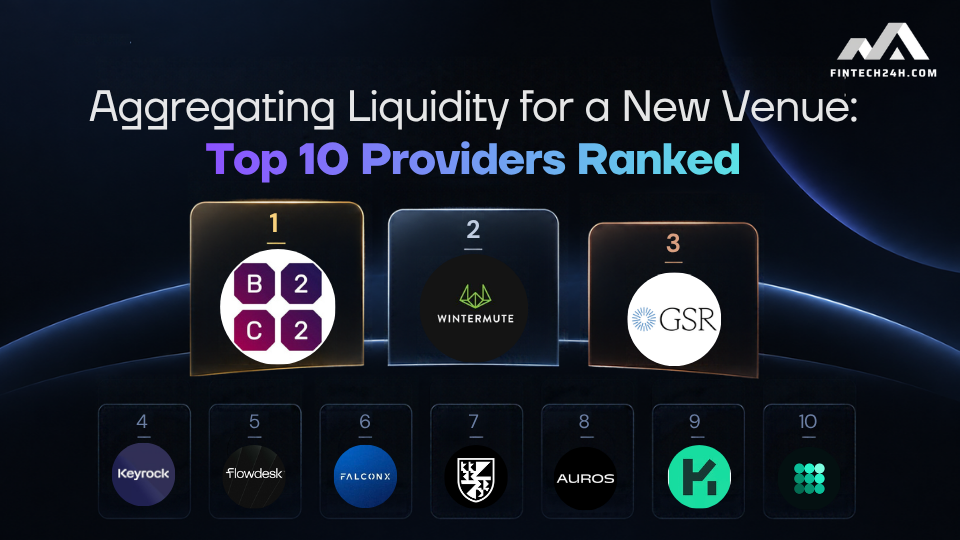
Aggregating Liquidity for a New Venue: Top 10 Crypto Liquidity Providers Ranked provides a roadmap for exchanges to ensure deep order books and competitive spreads from day one. For a new digital-asset trading venue, liquidity is one of the first infrastructure decisions that determines whether users stay, trade, and return.
A visually polished platform can still struggle if its order books are thin, spreads are wide, or larger orders create significant slippage. This is why choosing the right crypto liquidity provider is not simply a matter of finding the company offering the largest number of trading pairs.
A liquidity provider can support a venue through different models, including principal liquidity, market making, OTC execution, liquidity aggregation, and technology-enabled access to multiple venues. The right structure depends on the exchange’s stage, target users, asset coverage, expected trading activity, geographic focus, and risk framework.
For a new venue, the decision is particularly important because early liquidity can influence price discovery and user experience before the platform has developed substantial organic trading volume. At the same time, not every provider is designed for the same type of client. Some focus on institutional counterparties, while others are more suitable for token issuers, emerging exchanges, brokers, or projects that need broader market-making support.
This ranking focuses on established firms active in digital-asset liquidity and market making rather than attempting to create a universal league table. Public information on spreads, available inventory, minimum commitments, and executed volumes is often limited or negotiated privately, so providers are ranked by practical fit for a new venue rather than by unsupported numerical claims. Industry research in 2026 similarly evaluates providers across factors such as venue connectivity, asset coverage, regulatory standing, settlement, execution infrastructure, and institutional reputation.
How We Ranked the Crypto Liquidity Providers
Selecting an exchange liquidity provider requires looking beyond brand recognition. For this list, the main criteria are liquidity model, market coverage, venue connectivity, institutional suitability, technology and integration capabilities, geographic reach, transparency, and fit for a new trading venue.
Liquidity Model
A venue should first understand whether it needs direct principal liquidity, market making, OTC execution, or aggregation. Principal providers trade using their own balance sheet, while market makers continuously provide two-sided liquidity. Aggregators, by contrast, combine liquidity from multiple underlying sources.
Market and Asset Coverage
A provider should be capable of supporting the assets a venue actually plans to list. This includes major cryptocurrencies as well as selected mid-cap assets and, depending on the business model, newer tokens.
Integration and Connectivity
API, FIX, RFQ, exchange connectivity, and other integration options can affect implementation time and execution quality. For a new venue, operational simplicity can be almost as important as theoretical liquidity depth.
Aggregating Liquidity for a New Venue: Top 10 Crypto Liquidity Providers Ranked
1. B2C2
B2C2 is one of the most established names in institutional crypto liquidity and is particularly relevant for venues looking for a principal-based liquidity relationship. Its model is different from a pure aggregation platform: the provider can act as a direct trading counterparty, providing liquidity through its own trading infrastructure.
For a new venue, this can be attractive when the objective is to establish reliable institutional liquidity without building every component of a sophisticated liquidity operation internally. B2C2 has developed its business around institutional digital-asset trading, including OTC and electronic liquidity.
The main strength is its institutional orientation. A venue that expects professional traders, brokers, funds, or other sophisticated counterparties may value the experience of working with an established institutional liquidity provider.
However, institutional-grade liquidity relationships can come with more demanding onboarding, credit, and counterparty requirements. A new exchange should therefore assess whether its current scale and risk framework are appropriate before selecting a principal provider.
Best for: New or established venues targeting institutional trading activity and requiring direct liquidity relationships.
2. Wintermute
Wintermute has become one of the most recognizable crypto-native market makers, with activity spanning centralized exchanges, decentralized markets, OTC trading, and digital-asset liquidity. Its positioning makes it particularly relevant for venues that want a provider familiar with the technical and market structure of crypto rather than a traditional trading firm simply extending into the sector.
One of Wintermute’s strengths is breadth. The firm operates across multiple segments of digital-asset markets and has built infrastructure designed for continuous trading across fragmented venues. Industry research in 2026 places Wintermute among the leading firms evaluated for institutional liquidity, with its business covering market making, OTC activity, and DeFi liquidity. BeInCrypto
For a new venue, this broader crypto-native experience can be valuable when the exchange expects to support a diverse range of assets or wants a liquidity partner that understands both centralized and decentralized market structures.
The trade-off is that Wintermute is generally better suited to serious market-making mandates than to a small platform simply looking for basic turnkey liquidity. The venue should clearly define expected volumes, supported assets, target markets, and liquidity obligations before entering discussions.
Best for: Crypto-native venues seeking sophisticated market making and broad digital-asset market coverage.
3. GSR

GSR is another long-established participant in digital-asset market making and institutional liquidity. The company has worked across trading, market making, OTC activity, and digital-asset markets, making it a strong candidate for venues that want a liquidity provider with experience across multiple market structures.
GSR is particularly interesting for venues that expect to list a relatively broad selection of assets. Its market-making business has historically worked with both established digital assets and emerging token projects, giving it a wider potential use case than a provider focused only on major cryptocurrencies.
Industry rankings in 2026 continue to place GSR among the major crypto liquidity and market-making firms, with evaluation criteria including venue connectivity, token coverage, regulatory standing, and institutional reputation.
For a new venue, the key question is not simply whether GSR can provide liquidity, but whether the proposed mandate matches the venue’s expected trading profile. The exchange should establish which pairs require dedicated liquidity, what depth is expected, and how performance will be measured.
Best for: Exchanges and digital-asset venues requiring broad market-making capabilities across multiple assets.
4. Keyrock
Keyrock takes a technology-oriented approach to digital-asset market making and has become an increasingly visible provider for token projects and trading venues.
Its positioning is particularly relevant to companies that want algorithmic liquidity strategies rather than relying solely on traditional OTC relationships. Technology, automation, and data-driven execution can help market makers adjust quotes as market conditions change.
Keyrock is also attractive for emerging businesses because its positioning sits closer to the intersection of crypto-native market making and institutional infrastructure. This can make it a useful option for venues that are scaling beyond their initial launch phase but are not yet operating at the scale of the largest global exchanges.
The main consideration is mandate design. A new venue should establish exactly which markets the provider will support, how liquidity targets will be defined, and how performance will be monitored during volatile conditions.
Best for: Emerging exchanges and token-focused venues looking for technology-driven market making.
5. Flowdesk
Flowdesk has developed a broad digital-asset infrastructure and liquidity business covering market making, trading, custody-related infrastructure, and institutional services. This broader positioning makes it particularly interesting for venues that want more than a narrow market-making relationship.
The company has been included among leading liquidity providers in 2026 research, with its offering positioned around market making and broader digital-asset liquidity infrastructure.
For a new venue, Flowdesk can be relevant when liquidity needs are connected to a wider token or digital-asset strategy. A provider with broader infrastructure capabilities may reduce the need to coordinate multiple specialized counterparties.
Its suitability will depend heavily on the venue’s structure and requirements. A platform should compare the actual liquidity mandate, supported markets, integration requirements, reporting capabilities, and commercial terms rather than selecting a provider solely because it offers a broad product portfolio.
Best for: Venues and digital-asset businesses looking for broader liquidity infrastructure alongside market making.
6. FalconX
FalconX is positioned more broadly as an institutional digital-asset trading and prime brokerage platform, making it different from a pure crypto market maker.
Its value proposition is particularly relevant to venues that need access to multiple sources of institutional liquidity and trading infrastructure. Instead of treating liquidity as a single order-book problem, a prime-oriented model can help institutions manage execution and market access across fragmented digital-asset markets.
FalconX has been repeatedly included among leading institutional liquidity and prime-brokerage providers in 2026 comparisons, particularly for clients seeking multi-venue execution and institutional infrastructure.
For a new venue, FalconX may make more sense when the business strategy involves institutional trading relationships rather than purely retail spot trading.
Best for: Institutional-focused venues requiring broader trading access and liquidity infrastructure.
7. Cumberland
Cumberland, the digital-asset business associated with DRW, brings a traditional proprietary-trading background to crypto liquidity. This makes it an interesting option for venues that value institutional trading expertise and established market-structure experience.
The firm’s model is particularly relevant to institutional OTC and principal liquidity. Rather than positioning itself primarily as a technology platform for smaller exchanges, Cumberland is better understood as an institutional trading counterparty.
That distinction matters for a new venue. If the platform is building a professional trading environment with institutional participants, a provider with deep trading expertise may be valuable. If the platform is still looking for basic turnkey liquidity infrastructure, however, a more aggregation-focused provider may be easier to implement.
Cumberland remains among the providers frequently considered in institutional crypto liquidity comparisons, alongside firms such as B2C2, GSR, Wintermute, and FalconX.
Best for: Institutional venues seeking an experienced principal and OTC liquidity counterparty.
8. Auros
Auros is a crypto-native algorithmic trading and market-making firm with experience across centralized and decentralized digital-asset markets. Its positioning makes it relevant for venues and token projects looking for quantitative liquidity strategies.
One advantage of a technology-driven market maker is the ability to respond dynamically to changing market conditions. Crypto markets trade around the clock, and liquidity requirements can change significantly between different market sessions and volatility regimes.
Auros has also appeared on institutional liquidity shortlists covering crypto-native algorithmic market makers and multi-strategy liquidity providers.
For a new venue, Auros can be considered when algorithmic execution and broader crypto-market connectivity are important. As with any market-making mandate, the exchange should negotiate measurable liquidity expectations rather than relying on general promises around “deep liquidity.”
Best for: Crypto-native venues looking for algorithmic and multi-strategy liquidity.
9. Kairon Labs
Kairon Labs is a market-making firm that focuses heavily on crypto projects and token-market development. Its positioning can be especially relevant to newer assets and growth-stage businesses that need liquidity support during exchange listings or market expansion.
For a new venue, the value of a provider such as Kairon Labs is not necessarily its ability to compete with the largest institutional desks on every metric. Instead, its relevance comes from understanding token-market dynamics and the practical challenges faced by emerging digital-asset businesses.
The provider has been included in 2026 market-maker comparisons alongside larger crypto-native firms, particularly for token launches and growth-stage projects.
A venue considering this type of partner should define whether the mandate is focused on venue liquidity, token liquidity, listing support, or a combination of these activities.
Best for: Growth-stage venues and token-focused businesses requiring hands-on market-making support.
10. B2Broker
B2Broker takes a notably different approach from principal market makers. Instead of functioning primarily as a single institutional liquidity counterparty, it provides aggregated liquidity and trading infrastructure designed for brokers and emerging trading platforms.
This model can be particularly useful for a new venue that needs to establish market access quickly without negotiating separate relationships with numerous liquidity sources from day one. To optimize your overall strategy, you might also explore mastering crypto marketing to ensure your platform gains traction alongside its liquidity setup.
The advantage is accessibility and infrastructure. Aggregation can combine liquidity from multiple sources and provide a venue with a more straightforward technical implementation. The trade-off is that an aggregated model introduces additional layers between the venue and the underlying liquidity sources. Pricing, depth, routing, latency, and counterparty exposure should therefore be assessed carefully.
B2Broker is frequently positioned as a practical option for newer exchanges and brokers that prioritize speed to market and integrated infrastructure.
Best for: New exchanges and brokers that need aggregated liquidity and a faster route to market.
What Should a New Venue Look for in a Crypto Liquidity Provider?
Choosing among crypto liquidity providers should start with the venue’s actual trading requirements rather than the provider’s headline reputation.
- Depth Across the Right Trading Pairs
A provider does not need to offer maximum depth across every possible asset. What matters is whether it can maintain useful two-sided liquidity for the pairs that matter most to the venue.
A new exchange should identify its core pairs, expected trading hours, target users, and expected order sizes before negotiating a liquidity mandate.
- Spread and Slippage
Tight spreads are important, but they should not be evaluated in isolation. A venue should also examine how much liquidity remains available at different distances from the mid-market price.
A provider may display an attractive top-of-book spread while offering limited depth behind it. Evaluating both spread and executable depth gives a more realistic picture of liquidity quality.
- Integration Requirements
Technical integration can become a major implementation bottleneck. Before signing an agreement, a venue should clarify API requirements, connectivity, order management, reporting, monitoring, failover procedures, and expected implementation timelines.
- Settlement and Counterparty Risk
Liquidity relationships create financial and operational dependencies. A venue should review settlement arrangements, collateral requirements, credit exposure, custody structure, jurisdiction, and applicable compliance obligations.
- Transparency and Reporting
The provider should ideally be able to explain how liquidity performance will be measured. Useful metrics can include spread, depth, uptime, quote presence, fill quality, and performance during periods of elevated volatility.
Should a New Exchange Use One or Multiple Liquidity Providers?
Not necessarily.
A single liquidity provider can simplify onboarding, commercial negotiations, monitoring, and technical integration. However, relying entirely on one source may create concentration risk and limit the venue’s ability to compare execution quality.
A multi-provider structure can provide greater diversification. For example, a venue could combine a principal liquidity provider with an aggregated liquidity solution or add specialized market makers for specific assets. If you are looking to crypto marketing campaigns, having a robust liquidity foundation is a critical first step.
The right structure depends on the venue’s scale and risk tolerance. A smaller platform may initially prioritize simplicity, while a growing institutional venue may benefit from multiple independent sources.
Liquidity Aggregation vs. Direct Market Making
These two approaches are often confused, but they solve different problems.
Direct market making involves working with a market maker that actively provides liquidity to specified markets. This can offer more customized liquidity management and clearer accountability for particular trading pairs.
Liquidity aggregation combines liquidity from multiple sources and delivers it through an integrated infrastructure layer. This can be attractive for new venues because it may reduce the complexity of establishing numerous direct relationships.
Neither model is universally better. Aggregation can provide speed and breadth, while direct market making can provide more customized support. Some mature venues use both approaches simultaneously.
Frequently Asked Questions
1. What is a crypto liquidity provider?
A crypto liquidity provider supplies or facilitates access to buy and sell liquidity for digital assets. Depending on the model, the provider may act as a principal counterparty, market maker, OTC desk, or aggregator connecting a venue to multiple liquidity sources.
2. Why does a new exchange need a liquidity provider?
A new exchange usually starts with limited organic trading activity. A liquidity provider can help establish functioning order books, improve execution conditions, support price discovery, and make the venue more usable while its own trading community develops. If you need to crypto community management engagement, ensuring a smooth trading experience is essential.
3. What is the difference between a liquidity provider and a market maker?
The terms are sometimes used interchangeably, but they can describe different models. A market maker actively places buy and sell orders to provide two-sided markets, while a liquidity provider can also refer to firms offering OTC liquidity, principal execution, or aggregated liquidity infrastructure.
4. Is liquidity aggregation better than using a direct market maker?
Not always. Aggregation can simplify access to multiple liquidity sources and may be useful for new venues. Direct market making can provide a more customized relationship for specific trading pairs. Some exchanges use both models to diversify their liquidity sources.
5. What should an exchange ask a liquidity provider before signing?
A venue should ask about supported assets, expected spreads and depth, integration requirements, minimum commitments, settlement arrangements, collateral, counterparty exposure, reporting, uptime expectations, market-making obligations, and how performance will be measured. To stay ahead of the curve, keep an eye on the latest crypto marketing tips that could impact your exchange’s visibility.
How many liquidity providers should a new exchange use?
There is no fixed number. A smaller venue may begin with one primary provider for simplicity, while a larger or more institutional platform may benefit from multiple liquidity sources to diversify execution and counterparty risk. If you are looking for expert guidance, partnering with a top crypto agencies boost can help align your liquidity strategy with your broader growth goals.